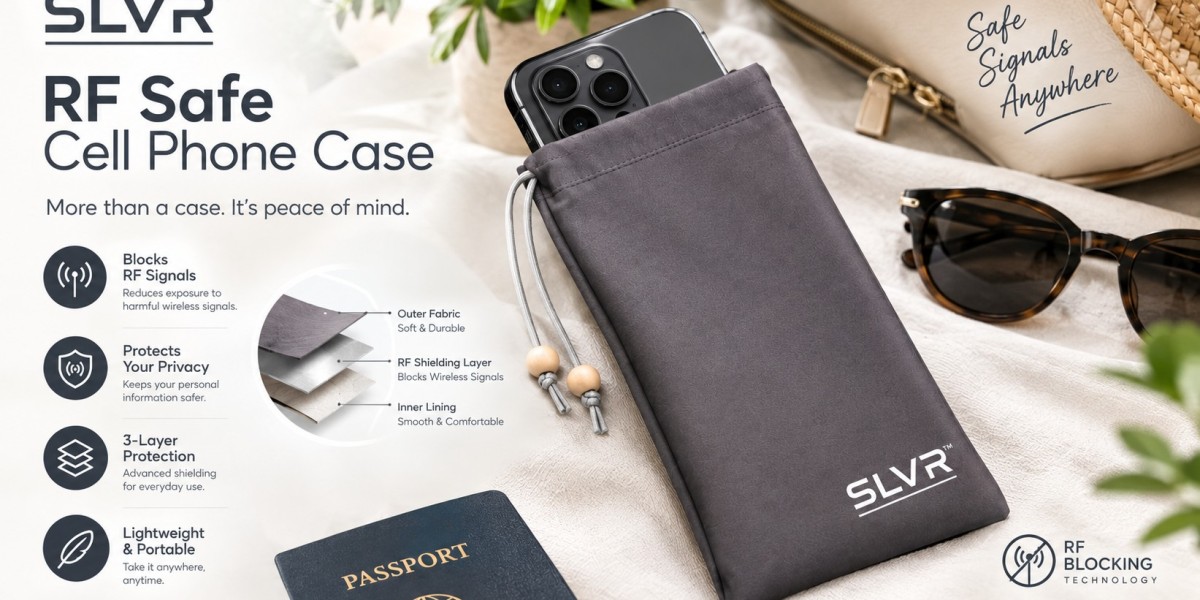


Few product categories attract as many strong claims as RF protection. Some pages promise dramatic results. Others dismiss the entire topic. Readers who simply want to understand the, rf safe cell phone case deserve something better, a clear explanation of what the product does, what science says, how to use it sensibly.
This article separates myths from facts. We cover the physics of shielding, the language used by major health organizations, the difference between a physical enclosure and marketing claims, the daily habits that make sense whether or not you use an rf phone protector. We also stay careful with wording. An RF safe cell phone case is a personal accessory for managing wireless signals, not a medical device.
RF Shielding Is Real Physics
The principle behind an rf shield phone case is well established. A closed conductive enclosure, known as a Faraday cage, reduces the electromagnetic fields that reach its interior. Engineers use this idea in many places, shielded rooms for testing electronics, shielded cables, protective bags for forensic and security work. The key conditions are conductivity (the material must conduct electricity well) and continuity (there should be no significant gaps compared with the wavelength of the signal). This is why a sealed pouch with a continuous silverfiber layer can reduce phone signals, while a plastic case with a metallic looking finish usually cannot.
Any Phone Case Can Block RF Signals
Most standard phone cases are made from plastic, silicone, or leather, which are insulators, not conductors. They do not form a conductive shell. Even cases that look metallic may only have a decorative coating. A genuine rf blocking cell phone case or rf shielded enclosure uses conductive materials in a continuous layer around the device. When you evaluate a product, ask what the conductive material is, where it is placed, whether it surrounds the phone fully when closed.
Shielding Effectiveness Is Measured in Decibels
Brands that take shielding seriously usually describe performance in decibels (dB). A few reference points:
Reduction (dB) | Approximate Signal Power Reduction |
10 dB | 90% |
20 dB | 99% |
30 dB | 99.9% |
40 dB | 99.99% |
60 dB | 99.9999% |
These numbers describe power reduction, not a promise about any outcome. They are useful for comparing products when the testing method, frequency range, sample type are clearly stated.
Silver Is an Excellent Conductor, Which Is Why It Appears in Shielding Textiles
Silver has very high electrical conductivity among common metals. When silver is plated onto fibers and woven into a fabric, it can give textiles conductive properties while keeping them flexible. That is the material story behind SLVR Wear™ and Silver Scrubs®. Silver Scrubs® show how conductive textile thinking can extend into apparel. If you are curious about how phone accessories and wearable garments relate in the same product family, the RF protection for cell phones perspective on the SLVR Wear™ apparel page is worth a look.
Should Keep My Phone Sealed All Day
Most people use shielding enclosures intermittently. You need your phone for navigation, payments, emergency calls and communication. A common approach is to seal the phone during specific moments, such as focus blocks, meetings, rest periods, or travel. The right balance is a personal decision. Safety and convenience also matter. If you rely on your phone for emergencies or medical alerts, make sure you are comfortable with how often and how long it is unreachable.
Privacy Is a Major Reason People Choose RF Shielded Enclosures
Many people buy a shielded pouch for privacy reasons rather than health reasons. A sealed enclosure can limit wireless connectivity in situations where you would rather your phone not communicate, such as confidential meetings or sensitive travel situations. In this context, an rf phone blocker is a tool for control over your own device.
Choosing a Product That Matches the Facts
If you are ready to look at a specific option, the SLVR Wear™ Faraday phone pouch follows the sealed enclosure approach described in this article; it uses silverfiber materials associated with the brand. For a wider view of the lineup, including Silver Scrubs®, the rf safe cell phone case homepage gathers everything in one place.
A Balanced Daily Routine
Here is a simple, balanced routine that respects both the research and your preferences:
Use speaker mode or a headset for longer calls.
Keep the phone out of constant skin contact during the day when practical.
Seal the phone in a shielded enclosure during focus time, meetings, or rest.
Use airplane mode when you want the radios off and the phone is nearby.
Inspect your enclosure regularly for wear.
Stay informed by reading updates from recognized health organizations.
Quick Facts Recap
Shielding is real physics based on conductive, continuous enclosures.
Decibels describe signal reduction 20 dB equals a 99% drop in power.
No adverse health effect from mobile phone use has been established to date, according to the World Health Organization, though research continues.
IARC classified RF fields as Group 2B in 2011, reflecting limited evidence.
Closure design and seams matter as much as material.
An RF safe cell phone case is a personal accessory, not a medical device.
Frequently Asked Questions(FAQs)
Is an RF safe cell phone case proven to protect health?
No, It is a physical accessory that reduces signal passthrough when the phone is enclosed. Major health organizations say research is ongoing and that no adverse effect from mobile phone use has been established to date.
Why do some cases claim to be RF shielding but do nothing?
Many cases use insulating materials or decorative finishes with no continuous conductive layer.
Does airplane mode replace a shielded pouch?
They do different things. Airplane mode turns the phone's radios off through software, while a pouch physically reduces signal pass through. Some people use both.
Can a pouch damage my phone?
No, a shielded enclosure does not harm the device. Many users enable airplane mode first to avoid the phone searching for signals.
What does dB mean in shielding claims?
It measures how much signal power is reduced. Each 10 dB is a tenfold change.






