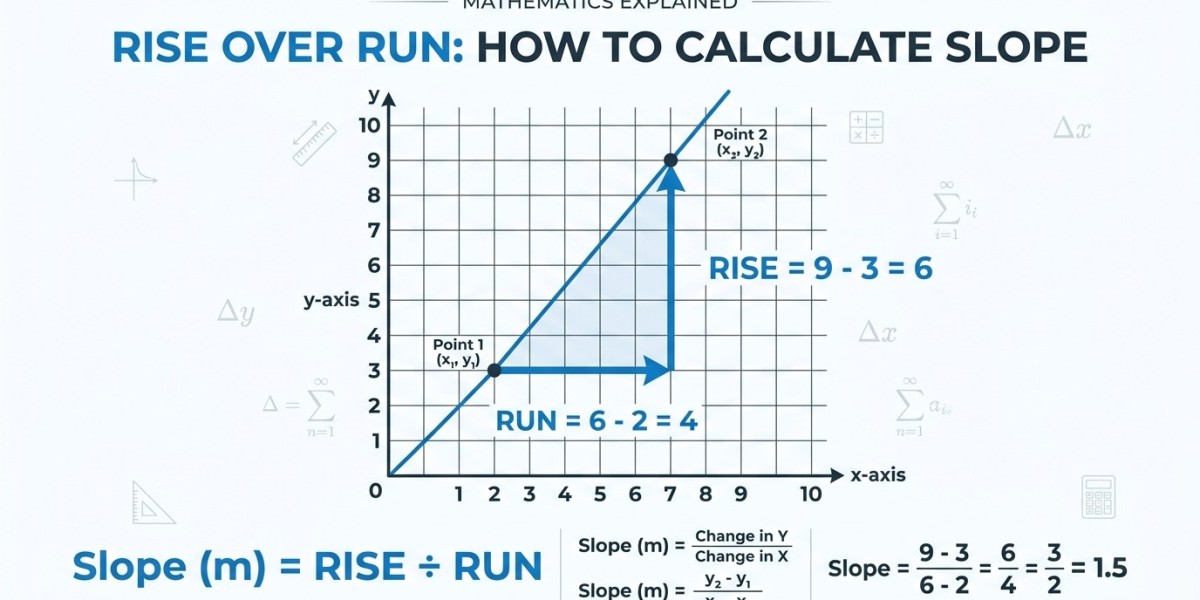


Slope is one of the most useful concepts in mathematics because it helps us understand how steeply a line rises or falls. Whether you are studying algebra, working with graphs, or solving real-world measurement problems, understanding slope makes many calculations easier.
One of the simplest ways to understand slope is through the phrase rise over run. Rise describes how much a line moves vertically, while run describes how much it moves horizontally. By dividing the rise by the run, you can determine the slope of a line.
What Does Rise Over Run Mean?
Rise over run is a simple formula used to calculate the slope of a straight line.
Slope = Rise ÷ Run
The rise is the vertical change between two points. It tells you how far the line moves upward or downward.
The run is the horizontal change between the same two points. It tells you how far the line moves from left to right.
For example, if a line rises 6 units while moving 3 units to the right, its slope is:
Slope = 6 ÷ 3 = 2
This means that for every 1 unit the line moves horizontally, it rises 2 units vertically.
How to Calculate Slope
You can calculate slope by selecting any two different points on a straight line. Suppose the two points are:
(x₁, y₁) and (x₂, y₂)
The standard slope formula is:
m = (y₂ − y₁) ÷ (x₂ − x₁)
The difference between the y-values represents the rise, while the difference between the x-values represents the run.
Example of Calculating Slope
Suppose you have two points:
(2, 3) and (6, 11)
First, calculate the rise:
11 − 3 = 8
Next, calculate the run:
6 − 2 = 4
Now divide the rise by the run:
Slope = 8 ÷ 4 = 2
Therefore, the slope of the line is 2.
Positive and Negative Slope
Slope can be positive, negative, zero, or undefined. The sign of the slope tells you the direction of the line.
A positive slope means the line rises as it moves from left to right. For example, a slope of 3 means the line rises 3 units for every 1 unit of horizontal movement.
A negative slope means the line falls as it moves from left to right. For example, if the rise is -4 and the run is 2, the slope is:
-4 ÷ 2 = -2
A zero slope occurs when the line is perfectly horizontal. The vertical change is zero, so:
0 ÷ 5 = 0
A vertical line has an undefined slope because its horizontal change is zero. Division by zero is not defined in standard mathematics.
Rise Over Run From a Graph
Finding slope from a graph is often straightforward. Choose two points that are clearly marked on the line. Starting from the first point, count how many units you need to move vertically to reach the level of the second point. This is the rise.
Then count how many units you need to move horizontally to reach the second point. This is the run.
Finally, divide the rise by the run.
For instance, if you move 4 units upward and 2 units to the right, the slope is:
4 ÷ 2 = 2
If you move 4 units downward and 2 units to the right, the rise is -4, giving a slope of:
-4 ÷ 2 = -2
Keeping track of the direction is important because it determines whether the slope is positive or negative.
Why Is Slope Important?
Slope is not only used in school mathematics. It can describe changes in many real-world situations.
For example, engineers can use slope when designing roads, ramps, and drainage systems. Architects and construction professionals use slope to understand angles and changes in elevation. In economics, slope can describe how one variable changes in relation to another.
Slope is also important when interpreting graphs. A steep line represents a larger rate of change, while a flatter line represents a smaller rate of change.
Rise Over Run vs. Slope Formula
The rise-over-run concept and the standard slope formula are essentially two ways of expressing the same calculation.
Rise over run can be written as:
Slope = Rise ÷ Run
Using two coordinate points, the same idea becomes:
m = (y₂ − y₁) ÷ (x₂ − x₁)
The first version is useful when working directly with a graph. The second version is particularly helpful when you are given the coordinates of two points.
Both methods calculate the same value as long as the correct points and changes are used.
Use a Slope Calculator
When calculations involve larger numbers, fractions, decimals, or multiple points, manually calculating slope can become inconvenient. A Rise Over Run Calculator can help simplify the process by calculating the vertical and horizontal changes and determining the slope.
A calculator can also be useful for checking your work after solving a problem manually. However, it is still important to understand the rise-over-run concept so you know what the result means.
Calculate Wiki provides simple online calculators designed to make everyday mathematical calculations easier. Using a calculator alongside an understanding of the underlying formula can make solving slope problems faster and more reliable.
Final Thoughts
Rise over run is one of the easiest ways to understand slope. The basic idea is simple: measure the vertical change, measure the horizontal change, and divide the rise by the run.
The main formula to remember is:
Slope = Rise ÷ Run
When working with two coordinate points, use:
m = (y₂ − y₁) ÷ (x₂ − x₁)
Once you understand this relationship, you can calculate the slope of lines from graphs, coordinates, and real-world measurements. Practicing with different positive, negative, horizontal, and vertical lines is a good way to build confidence and understand how slope represents change. Explore More Calculators on Calculate Wiki.






