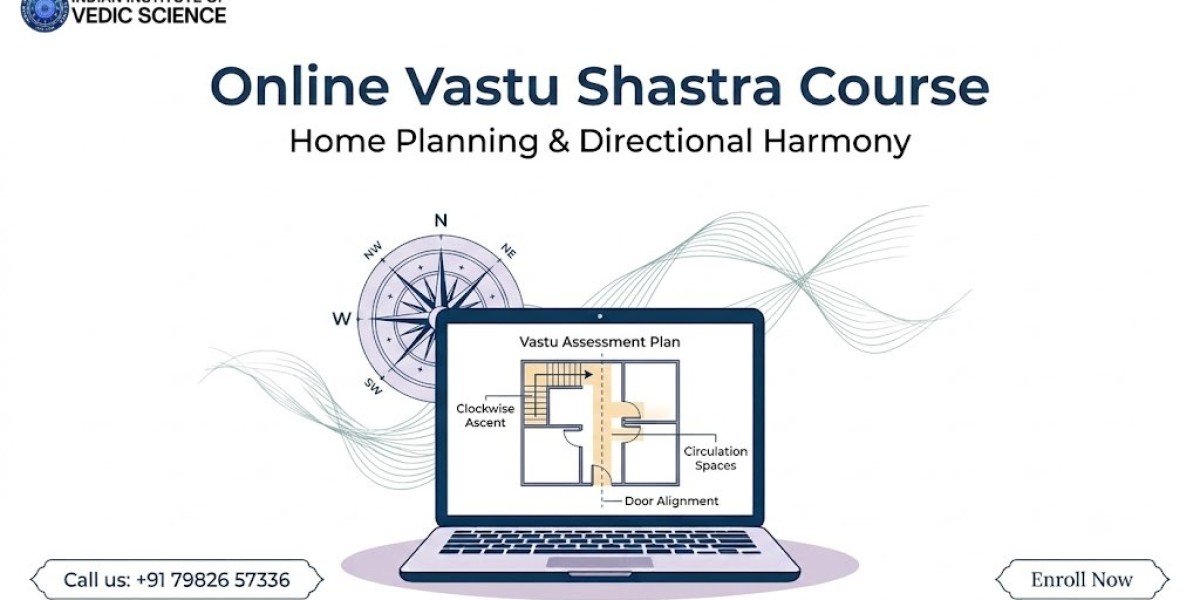


Online Vastu Shastra Course: How to Evaluate Staircase Direction, Door Alignment & Circulation Spaces in Home Planning
A well-planned home should feel comfortable, functional, and easy to navigate. While architects and interior designers consider room dimensions, ventilation, structural safety, and movement patterns, Vastu Shastra introduces a traditional Indian framework for evaluating how different spaces relate to directions, entrances, and the overall arrangement of a building. Understanding both the traditional principles and their practical application can help learners develop a more systematic approach to home planning.
An online vastu shastra course can introduce students to concepts such as staircase placement, main door alignment, room circulation, directional zones, and the relationship between architectural layouts and traditional Vastu interpretations. Instead of relying on isolated rules, learners can develop the ability to examine a floor plan, identify potential planning concerns, and explain recommendations responsibly.
For anyone exploring a vastu shastra course, one important skill is learning to evaluate how people enter, move through, and use a home. Staircases should support safe movement, doors should function comfortably, and circulation spaces should allow residents to navigate the property without unnecessary obstruction.
The Indian Institute of Vedic Science (IIVS) offers a learning environment for people interested in traditional knowledge and its structured study. Students considering Vastu education can explore relevant courses and seek guidance about the curriculum, learning format, and fees before enrolling.
What Is Vastu Shastra and Why Does Home Planning Matter?
Vastu Shastra is a traditional Indian architectural knowledge system that considers the orientation, arrangement, and use of built spaces. Its principles commonly discuss directions, entrances, rooms, open areas, and the placement of different architectural elements.
In contemporary home planning, learners may study Vastu alongside practical architectural considerations. This distinction matters because traditional interpretations and measurable building-performance factors are not the same thing. Vastu may provide a cultural or philosophical framework for evaluating a layout, while structural stability, fire safety, accessibility, ventilation, and building regulations must be assessed using appropriate professional standards.
A structured online course for vastu shastra can help students understand traditional terminology, directional concepts, and the process of reviewing a residential floor plan. Rather than memorising every recommendation, students should learn to ask relevant questions:
Where is the main entrance located in relation to the building's directions?
Does the staircase interfere with convenient movement between rooms?
Are doors positioned so that they open and close comfortably?
Do corridors and connecting spaces provide sufficient clearance?
Which observations arise from traditional Vastu principles, and which relate to practical design or safety?
These questions create a useful foundation for evaluating residential layouts without treating every traditional guideline as a universal architectural rule.
How to Evaluate Staircase Direction in a Home
Staircases are important circulation elements because they connect different floors and influence how residents move through a property. In Vastu education, staircase direction and placement are frequently discussed through directional zones and traditional interpretations.
However, staircase assessment should begin with function and safety. The available space, structural design, stair dimensions, headroom, handrails, lighting, and access to upper floors all affect usability.
1. Identify the Main Directions Before Reviewing Placement
The first step is to establish the orientation of the building. A floor plan should indicate north or provide enough information to determine its direction accurately.
Students learning through a vastu course online should practise reading floor plans rather than relying on assumptions based on how a drawing appears on the page. A plan may be rotated, and the top edge does not necessarily represent north.
Once the orientation is established, learners can mark the principal directions and compare the staircase's location with the traditional Vastu framework being studied.
2. Understand Traditional Staircase Placement Guidelines
Different Vastu traditions may offer recommendations concerning staircase locations and movement patterns. A student should learn the reasoning and terminology associated with the particular framework being taught, while recognising that interpretations can vary.
During a layout review, record the staircase's position, its relationship with nearby rooms, and its effect on movement between floors. If a recommendation is made, explain whether it is based on a traditional Vastu interpretation or a practical design concern.
A staircase should never be relocated or structurally altered solely to follow a traditional recommendation without assessment by a qualified architect or structural engineer.
3. Examine Staircase Access and Circulation
A staircase can be located in a preferred directional zone according to a chosen Vastu framework and still create practical problems if it blocks a passage or restricts access to essential rooms.
Check whether the approach is clear, whether people can move safely between floors, and whether the staircase affects the use of nearby doors or shared spaces. Also consider lighting, ventilation, headroom, handrails, and compliance with applicable building codes.
A good learner understands that directional evaluation and functional assessment are complementary but distinct exercises.
4. Avoid One-Rule-Fits-All Recommendations
Residential layouts differ significantly. A compact apartment, an independent house, and a multi-storey property have different structural and circulation requirements.
A quality advance vastu course online should encourage learners to interpret plans in context, explain the limitations of general guidelines, and avoid recommending expensive alterations without sufficient information.
The goal is not to declare every staircase good or bad based on one rule. It is to understand the relevant traditional principles, examine the actual layout, and communicate recommendations responsibly.
Door Alignment: What Should Learners Examine?
Doors influence privacy, accessibility, circulation, and the relationship between adjoining rooms. Traditional Vastu discussions may also examine entrance direction, the placement of the main door, and the alignment of openings.
A systematic assessment begins with the actual layout rather than a generalised claim about a particular door position.
1. Locate the Main Entrance Correctly
The main entrance is often an important topic in Vastu studies. Learners should first identify the building's orientation and the entrance's position on the relevant exterior wall.
Some traditional frameworks divide a side of a building into sections and interpret entrance placement according to directional subdivisions. The precise method can differ between teaching traditions, so students should understand which system they are applying.
A practical floor-plan exercise should record the entrance location, door dimensions, opening direction, access route, and nearby obstructions.
2. Review Door-to-Door Alignment
When two doors face each other or align along a corridor, consider how this arrangement affects privacy, circulation, and the intended use of the rooms.
For example, directly aligned bedroom and bathroom doors may raise privacy concerns. A door that opens into a narrow passage may obstruct movement. A main entrance that opens into an overcrowded area may benefit from better organisation.
Some Vastu interpretations assign additional meaning to door alignment. Learners can document these traditional interpretations while distinguishing them from practical considerations that can be observed directly.
3. Check Door Swing and Clearance
A door should open without striking furniture, blocking an escape route, or creating a hazard for people moving through the space. Hinges, handles, thresholds, and the available opening width should be assessed as part of the design review.
This is particularly important in homes occupied by older adults, children, or people with mobility needs. Accessibility and safe movement should remain priorities regardless of the traditional interpretation of a doorway.
4. Understand Entrance Recommendations in Context
Students comparing different vastu shastra courses should look for instruction that explains directional concepts and practical layout assessment rather than relying entirely on rigid statements.
A good course should help learners interpret a plan, identify relevant questions, explain the chosen traditional framework, and recognise when an architect or another qualified professional is needed.
Circulation Spaces: The Often-Overlooked Part of Home Planning
Circulation spaces include corridors, entrance lobbies, passageways, stair landings, and the connecting areas that allow people to move between rooms. These spaces may not receive as much attention as bedrooms or kitchens, but they strongly influence how a home functions.
In traditional Vastu discussions, open areas and the arrangement of spaces may be considered alongside directional zones. In practical design, circulation is evaluated through accessibility, clearance, safety, privacy, and ease of movement.
Evaluate Corridors and Passageways
Start by tracing the usual route from the main entrance to frequently used rooms. Identify narrow sections, awkward turns, blocked pathways, and areas where doors collide with one another.
A corridor should be sufficiently wide for its intended use and compliant with applicable standards. Furniture, storage units, decorative objects, and electrical fittings should not create avoidable obstacles.
Review the Relationship Between Rooms
A home may contain every required room yet still feel inconvenient if the layout forces residents to cross private areas to reach shared spaces.
Review the relationships between the entrance, living room, kitchen, bedrooms, bathrooms, and staircase. Consider whether the arrangement supports privacy and practical daily routines.
A traditional Vastu assessment can be documented separately, allowing learners to distinguish cultural or directional recommendations from the observed functional qualities of the layout.
Consider Light, Ventilation, and Visual Clutter
Poor lighting can make corridors and staircases difficult to use safely. Cluttered circulation areas can interfere with movement and create hazards.
Learners should therefore note lighting conditions, ventilation where relevant, and the placement of furniture or storage. These observations are useful regardless of whether a homeowner follows Vastu principles.
Prepare a Clear Layout Assessment
For each circulation issue, document the location, the observation, its practical effect, and any relevant traditional interpretation. If a change is proposed, describe the expected benefit and identify whether professional assessment is necessary.
This approach makes recommendations easier to understand and avoids presenting subjective interpretations as established technical facts.
How to Choose the Right Vastu Shastra Course
Choosing a course requires more than comparing advertisements. Students should examine the syllabus, teaching approach, practical exercises, instructor background, assessment methods, and the support available during learning.
If you are comparing the best online vastu course, consider whether it covers foundational concepts and practical residential layouts. A course should ideally progress from terminology and directions to entrances, staircases, room arrangements, circulation spaces, and case-based exercises.
People searching for the best vastu shastra course in india should also verify the course's actual delivery format. Some programmes may focus on introductory concepts, while others may offer a more detailed study of traditional methods. Course descriptions should make these differences clear.
Similarly, anyone researching the best institute to learn vastu shastra should review the curriculum, available learning support, assessment structure, and transparency of course information. The best institute for vastu shastra in india is not necessarily the one making the biggest claims; it is the one whose verified educational offering suits the learner's goals.
Before enrolling, ask whether the programme includes:
A structured introduction to Vastu Shastra concepts and terminology.
Directional assessment and floor-plan reading.
Case-based exercises involving entrances, staircases, and circulation.
Clear explanations of the traditional framework being taught.
Guidance on ethical communication and the limits of Vastu recommendations.
Transparent information about completion requirements and any certificate offered.
A diploma in vastu shastra may appeal to learners seeking a more structured or extended programme, but the title alone does not establish the depth, recognition, or professional standing of a qualification. Verify what the programme actually includes and what the certificate represents.
Learning Vastu Shastra Online: What Should You Expect?
An online course of vastu shastra can provide flexibility for working professionals, beginners, and learners who cannot attend in-person classes. Depending on the programme, instruction may include recorded lessons, live sessions, assignments, practical examples, and assessments.
An online vastu certificate course may be suitable for learners who want a defined curriculum and a completion credential. Before enrolling, confirm the course duration, attendance or assessment requirements, certificate conditions, and whether the qualification is issued by the named provider.
A vastu shastra course online should ideally combine conceptual learning with practical exercises. Students can practise identifying directions on sample plans, marking entrances, examining staircase access, and tracing movement through different rooms.
Those interested in professional development should also recognise the limits of their role. Vastu education does not automatically qualify someone to design structures, approve building plans, or provide engineering advice. Complex alterations should be referred to the relevant qualified professionals.
Vastu Shastra for Home: Applying the Learning Responsibly
The practical value of vastu shastra for home lies in understanding a layout carefully and communicating observations clearly. A useful review does not begin by promising to correct every perceived problem. It begins by gathering accurate information.
Consider a hypothetical home where the staircase opens directly into a narrow passage, two doors interfere with each other, and the entrance area is crowded with storage.
A structured assessment could proceed as follows:
Record the orientation: Establish the directions shown on the floor plan and note the entrance location.
Map circulation: Trace the routes connecting the entrance, staircase, living spaces, and bedrooms.
Check door operation: Identify overlapping door swings, restricted openings, and privacy concerns.
Review staircase usability: Examine access, lighting, headroom, handrails, and other relevant safety factors.
Document traditional interpretations: Explain how the selected Vastu framework views the identified locations.
Separate recommendations: Distinguish low-impact organisational suggestions from changes requiring architectural or structural expertise.
This process gives homeowners a clearer picture of their options. It also demonstrates why a responsible practitioner should explain the basis for each recommendation and avoid guaranteeing health, financial, relationship, or other outcomes from a particular arrangement.
Vastu Shastra Course Fees: What Is a Reasonable Budget?
The vastu shastra course fees can vary depending on course depth, teaching format, learning support, programme duration, and the nature of the certificate or diploma.
For initial budgeting, a range of ₹45,000 to ₹60,000 may be used as an indicative planning range when comparing a more comprehensive course offering. This is not a confirmed fee for every Vastu programme or a guarantee of IIVS's current pricing. Actual fees should be verified directly with the institute before making a payment.
When comparing fees, ask what is included. Does the programme offer live instruction, recorded content, assignments, individual feedback, practical case studies, assessments, or a certificate? Are there additional charges for learning materials or examinations?
A lower price does not necessarily mean poor quality, and a higher price does not automatically mean better instruction. Compare the curriculum and learning support with your personal goals.
Explore Vastu Learning with the Indian Institute of Vedic Science (IIVS)
The Indian Institute of Vedic Science (IIVS) focuses on education in traditional knowledge areas, including Vedic and related learning disciplines. For learners interested in studying Vastu Shastra, exploring the available programme details is a practical first step toward understanding the course structure and learning options.
If you are also researching online astrology courses, compare their curriculum separately from Vastu programmes. Learners looking for online astrology courses in india may find it useful to understand how astrology and Vastu differ in subject matter, methods, and learning outcomes.
An astrology course online typically focuses on interpreting astrological concepts and charts, whereas Vastu education focuses on traditional interpretations of built spaces and their arrangement. Astrology classes online and online classes for astrology may suit students interested in horoscope-related subjects, while learners who want to study residential layouts may prefer a dedicated Vastu programme.
People who want to learn astrology online should compare teaching depth, practical chart exercises, and course support. When evaluating astrology certification courses, verify what the certificate represents and whether the programme meets your learning needs rather than assuming that all certifications have the same standing.
Choosing the right programme begins with a clear goal. Whether your interest is Vastu, astrology, or a combination of traditional knowledge subjects, review the course details carefully and seek clarification before enrolling.
Learning to evaluate staircase direction, door alignment, and circulation spaces requires more than memorising traditional rules. Students need to understand the selected Vastu framework, read floor plans accurately, observe how people move through a home, and communicate recommendations with care.
A structured course can help learners build this foundation through progressive lessons and practical examples. Before enrolling, compare the curriculum, course format, fees, and certificate requirements to ensure the programme matches your goals.
Explore the available learning options at IIVS, ask questions about the syllabus, and choose a programme based on transparent information and realistic expectations.
Book your free counselling with the Indian Institute of Vedic Science (IIVS) to discuss your interests and identify a suitable next step in your Vastu Shastra learning journey.
Frequently Asked Questions
1. What can I learn in an online Vastu Shastra course?
A course may cover traditional directional concepts, entrance placement, staircase positioning, room arrangements, circulation spaces, and floor-plan assessment. The exact syllabus depends on the provider, so review the curriculum before enrolling.
2. Can beginners enrol in a Vastu Shastra course?
Many introductory programmes are designed for beginners and explain foundational concepts before moving into residential layout examples. Confirm the entry requirements and whether previous architectural knowledge is expected.
3. How should I evaluate staircase direction according to Vastu?
Begin by identifying the building's orientation and the staircase location, then apply the specific traditional framework being studied. Also assess practical safety, structural requirements, access, lighting, and applicable building regulations.
4. Why are door alignment and circulation spaces important?
Door alignment can affect privacy, access, and movement between rooms. Circulation spaces influence how easily residents navigate the home. Traditional Vastu interpretations may provide an additional framework for considering these elements, but practical design and safety should remain priorities.
5. What are the typical Vastu Shastra course fees?
Fees vary by curriculum, duration, delivery format, and learning support. An indicative budgeting range of ₹45,000–₹60,000 may help when comparing some comprehensive programmes, but confirm the actual current fee directly with the provider.
6. Is an online Vastu certificate course the same as a diploma?
Not necessarily. A certificate and a diploma may differ in curriculum depth, duration, assessment, and requirements. Check the programme specifications and the issuing organisation before enrolling.
7. How can I choose the right institute for Vastu Shastra?
Compare the syllabus, teaching approach, practical exercises, instructor information, learner support, fee transparency, and certificate details. Prefer clear, verifiable information over unsupported promises about guaranteed results.
8. Can Vastu recommendations replace an architect or structural engineer?
No. Vastu education concerns a traditional knowledge framework and does not replace professional expertise in structural safety, architecture, accessibility, or building regulations. Consult qualified professionals before making significant changes to a property.






