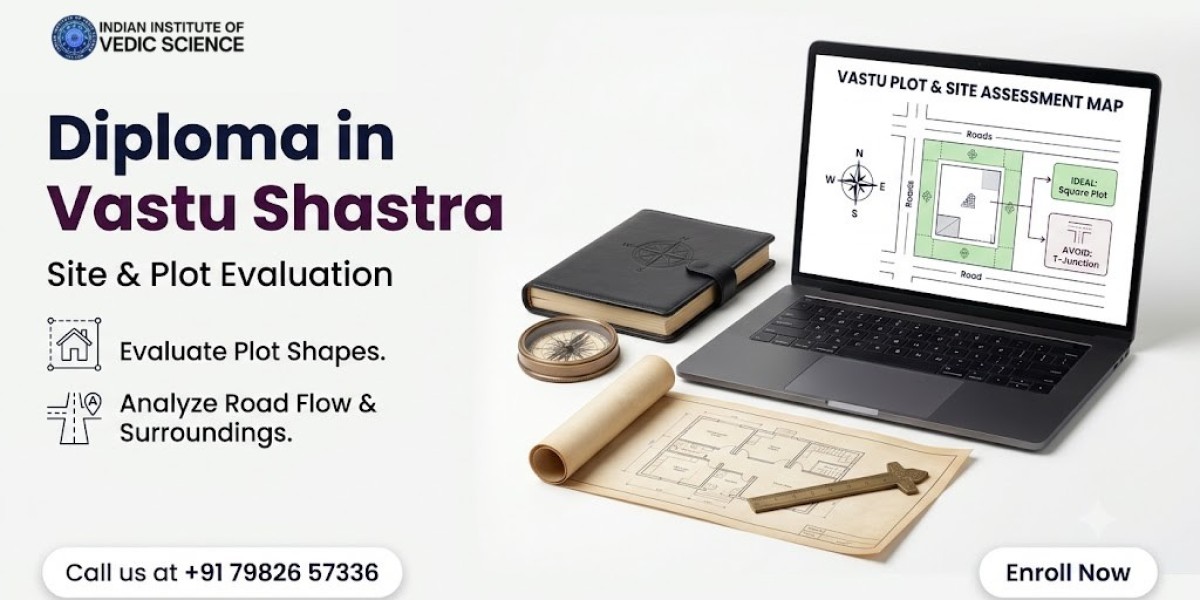


Diploma in Vastu Shastra: How to Evaluate Plot Shapes, Road Junctions & Surrounding Structures Using Traditional Vastu Principles
Choosing a plot for a home, office, shop, or commercial building involves more than comparing prices and locations. Buyers usually consider road access, plot dimensions, drainage, surrounding buildings, sunlight, ventilation, neighbourhood infrastructure, and future development. In traditional Vastu Shastra, these practical considerations are studied alongside concepts involving directions, plot shapes, entrances, and the relationship between a property and its surroundings.
Learning how to evaluate these factors can help students understand how traditional Vastu principles are applied during property assessment. A structured diploma in vastu shastra can introduce learners to directional concepts, site evaluation, traditional interpretations of plot geometry, and methods for documenting observations before making recommendations.
The Indian Institute of Vedic Science (IIVS) offers a learning context for people exploring traditional Indian knowledge systems. Prospective students interested in Vastu studies should confirm the current course syllabus, practical training, teaching format, certification details, and fees directly with the institute.
This guide explains how to examine plot shapes, road junctions, and surrounding structures through the traditional Vastu framework while distinguishing cultural interpretations from practical property evaluation.
What Is Vastu Shastra and Why Does Plot Evaluation Matter?
Vastu Shastra is a traditional Indian system of architectural and spatial principles that considers the relationship between a built environment, its orientation, and its occupants. Traditional Vastu practitioners may examine directions, site proportions, entrances, open spaces, and the placement of buildings when assessing a property.
Plot evaluation is important because the land establishes the foundation for future construction. A plot may appear attractive in a photograph but present practical challenges related to access, uneven terrain, drainage, neighbouring structures, or irregular boundaries.
A traditional Vastu assessment may consider:
The shape and proportions of the plot.
The orientation of its boundaries.
The position and direction of roads.
The location of road intersections or junctions.
The height and proximity of surrounding buildings.
The arrangement of open spaces and built structures.
The proposed building's entrance and internal layout.
These factors should be considered alongside property documents, building regulations, soil conditions, engineering assessments, and financial planning. Traditional Vastu interpretations are part of a cultural and architectural belief system; they should not be presented as scientifically established predictors of prosperity, health, or personal success.
For learners, the objective is to understand the traditional framework, observe a site systematically, and communicate findings without making unsupported promises.
Step 1: Understand Plot Shapes in Traditional Vastu Shastra
Plot geometry is one of the first elements examined during a traditional Vastu site assessment. Practitioners commonly classify plots according to their shape, boundary alignment, and proportions.
The most frequently discussed shapes include square, rectangular, triangular, circular, and irregular plots. Different traditional sources may attach different symbolic meanings to these forms, so students should learn the specific principles used in their course rather than assume every school follows identical rules.
Square plots
A square plot has approximately equal sides and right-angle corners. In traditional Vastu literature, square plots are often regarded as balanced or symmetrical forms.
From a practical perspective, a square layout can provide flexibility when arranging rooms, circulation, setbacks, and open areas. However, actual suitability depends on the plot's dimensions, road access, local development rules, and the intended building.
Students should learn to distinguish the traditional interpretation of a square plot from its measurable design advantages.
Rectangular plots
Rectangular plots have two pairs of opposite sides, with each pair generally equal in length. Their proportions can influence how a building is arranged within the available space.
Traditional Vastu assessment may consider the plot's length-to-width relationship, orientation, and boundary alignment. Some approaches regard particular rectangular proportions more favourably than others, but interpretations vary.
In practical site planning, the available frontage, depth, setbacks, parking requirements, and natural light are important considerations. A rectangular plot should therefore be assessed through both traditional principles and architectural feasibility.
Triangular plots
Triangular plots can present design challenges because their boundaries may limit conventional room layouts, circulation, or the positioning of a building.
Some traditional Vastu interpretations classify triangular plots as less desirable or associate them with particular symbolic meanings. These associations should be explained as traditional beliefs, not established evidence that a triangular property will produce negative outcomes.
Before rejecting such a plot, a buyer should obtain professional advice about usable land area, access, boundary conditions, and whether a compliant building design is possible.
Irregular plots
Irregular plots may have unequal sides, unusual angles, extensions, cut corners, or boundaries that do not form a simple geometric shape.
Traditional Vastu practitioners may examine these features in relation to directional zones and the overall site configuration. However, the term irregular covers many different geometries, and not every irregular plot has the same practical implications.
Students should learn to document the actual dimensions and boundary positions rather than relying solely on a visual impression. A survey plan can help establish whether a perceived extension or cut is part of the legal plot boundary or simply a feature of the surrounding layout.
How to assess a plot's shape systematically
A structured assessment begins with a site plan and verified measurements.
First, identify all boundary lengths and corner angles. Next, establish the north direction and record which sides face roads or neighbouring properties. Then compare the measured geometry with the traditional classification being studied.
Finally, document practical considerations such as access, drainage, buildable area, setbacks, and local planning restrictions.
This method gives students a clear basis for explaining their findings. It also prevents a single shape classification from overshadowing more important legal or engineering concerns.
Step 2: Evaluate Road Junctions and Road-Facing Plots
Road placement is another feature commonly discussed in traditional Vastu Shastra. A road can affect how a property is approached, where vehicles enter, how pedestrians move, and how the building relates to its surroundings.
In traditional Vastu practice, particular attention may be given to plots near road intersections, T-junctions, and crossroads. Some traditions use the term Veedhi Shoola for a road or lane directed towards a property. Interpretations depend on the direction, geometry, and specific school of Vastu being followed.
These classifications should not be confused with a demonstrated ability to predict a property's future outcomes.
T-junctions
A T-junction occurs when one road meets another road at approximately a right angle, creating a layout resembling the letter T. Depending on the property, the approaching road may appear to point towards a boundary, gate, or building entrance.
A traditional assessment may record the road's direction, the point at which it meets the property, and the location of the proposed entrance.
From a practical standpoint, a T-junction can raise questions about vehicle headlights, traffic speed, noise, visibility, pedestrian safety, and vehicle entry. The effect depends on the road design and site conditions rather than the junction's shape alone.
Crossroads and multiple-road intersections
A crossroads involves roads meeting or crossing at a common point. A plot near such a junction may have greater exposure to traffic and more than one approach direction.
Traditional Vastu practitioners may classify the site's orientation and the directions from which roads approach. Students should record these details clearly before applying the relevant traditional framework.
Property buyers should also evaluate traffic congestion, road widening plans, noise, pedestrian movement, and the legal status of access points. A prominent junction may provide visibility for a business, but it may also create safety or access challenges.
Road-facing entrances
The location of a gate or entrance should be evaluated in relation to the plot's actual boundaries, road width, and proposed building layout.
Traditional Vastu systems may recommend particular entrance locations according to directional divisions. The exact rules differ across approaches, so a learner should understand which method is being applied and avoid combining incompatible rules without explanation.
In practical planning, entrance placement must also account for driveway slope, vehicle turning space, pedestrian access, drainage, visibility, and local regulations.
A traditional recommendation should never override an access restriction or create a traffic hazard.
A simple road-junction assessment process
When documenting a road-facing property, learners can follow this sequence:
Mark north and the other cardinal directions on the site plan.
Record the roads adjoining the plot and the directions from which they approach.
Identify T-junctions, crossroads, bends, and nearby intersections.
Mark the proposed gate and building entrance.
Note traffic, visibility, noise, access, and drainage conditions.
Apply the selected traditional Vastu method and explain its interpretation separately from practical observations.
This process supports consistent assessment without treating every junction as automatically favourable or unfavourable.
Step 3: Examine Surrounding Structures and Neighbouring Properties
A plot does not exist in isolation. Neighbouring buildings, boundary walls, open land, trees, utility infrastructure, and nearby roads all influence the physical environment.
Traditional Vastu assessment may consider the relative height of surrounding structures, the amount of open space, the position of adjacent buildings, and the relationship between the property and nearby features.
The first task is to observe what is actually present.
Building height and proximity
A taller neighbouring building can affect daylight, privacy, ventilation, and the amount of shade falling on a site. The direction of sunlight, building height, distance between structures, and local climate all influence the effect.
Traditional Vastu approaches may also interpret relative building heights and the arrangement of structures through directional principles.
Students should record the approximate heights and positions of neighbouring buildings, then consider the practical consequences before discussing traditional interpretations. A taller building is not automatically a defect, and its significance depends on the site.
Open land and vacant plots
An adjoining vacant plot may provide a sense of openness today, but its future development could change the property's light, privacy, views, and ventilation.
A site assessment should therefore distinguish between the current condition and what may legally be built in the future. Review zoning information, development permissions, and local plans where available.
Some Vastu approaches attach significance to open areas around a property. Those interpretations can be documented, but they should not replace research into the neighbouring land's ownership or development potential.
Boundary walls and compound structures
Boundary walls affect privacy, access, security, and the definition of the property. Their height, position, and condition may also feature in traditional Vastu assessments.
For practical purposes, check whether walls are structurally sound, whether they obstruct required sightlines, and whether their placement complies with local rules. Confirm that the boundaries match the approved survey and property documents.
Trees, poles, drains, and utility infrastructure
Large trees, electrical poles, drains, transformers, and other infrastructure may influence access, shade, maintenance, safety, or future construction.
Traditional Vastu interpretations may assign significance to particular features and their locations. However, technical concerns should be assessed by the relevant professionals. For example, electrical infrastructure, drainage systems, and potentially unstable trees require appropriate safety or engineering advice.
A good assessment records the feature, its distance from the plot, its direction, and any practical concern before presenting a traditional interpretation.
Step 4: Combine Plot Shape, Roads, and Surroundings
A plot assessment becomes more meaningful when the individual factors are considered together.
For example, an irregular plot near a busy road junction may have both design constraints and road-safety considerations. A rectangular plot surrounded by tall buildings may offer a straightforward boundary layout but have limited daylight or ventilation. A plot with generous open space may provide flexibility, although the future development of adjoining land remains relevant.
Traditional Vastu practitioners may interpret these combinations through directional principles and the relationship between the plot and its environment.
Learners should avoid declaring a property suitable or unsuitable based on one characteristic. Instead, document the different factors and explain which conclusions come from traditional Vastu principles and which come from measurable site conditions.
A useful site report can include:
Plot dimensions, shape, and orientation.
Road locations, junctions, and access points.
Surrounding building heights and distances.
Open areas, trees, utility structures, and boundary walls.
Practical design, drainage, sunlight, and safety observations.
Traditional Vastu interpretations and their underlying rules.
Issues requiring confirmation from a surveyor, architect, engineer, or local authority.
This approach supports transparent communication and makes it easier for a property owner to ask follow-up questions.
Step 5: Common Mistakes to Avoid During Plot Evaluation
Judging a plot by shape alone
A traditional classification does not reveal the property's complete suitability. Dimensions, legal boundaries, access, terrain, and building regulations can be more consequential for the actual construction project.
Treating every road junction as harmful
Road junctions differ in geometry, traffic conditions, orientation, and distance from the plot. Avoid absolute statements about their effects. Assess the site itself and explain any traditional interpretation carefully.
Ignoring legal and technical checks
A Vastu assessment is not a substitute for title verification, land-use permissions, a boundary survey, soil testing, structural advice, or review of applicable building regulations.
Making fear-based recommendations
Students should not tell buyers that a property will inevitably cause financial loss, illness, conflict, or misfortune because of a particular plot feature. Such claims can create unnecessary anxiety and are not established by the physical characteristics of a site.
Confusing tradition with scientific evidence
Vastu Shastra has cultural and historical significance, but its traditional interpretations should not be represented as scientifically proven predictions of personal or financial outcomes. Clear communication builds trust and helps clients make informed decisions.
How a Diploma in Vastu Shastra Can Support Structured Learning
People interested in applying traditional Vastu principles can benefit from a course that teaches both the underlying concepts and a repeatable method of site assessment.
When comparing a vastu shastra course, examine whether it covers directional principles, plot geometry, site orientation, road approaches, entrances, surrounding structures, and practical case studies.
A comprehensive learning pathway may include:
Introduction to traditional Vastu concepts and terminology.
Cardinal directions and site orientation.
Plot shapes, proportions, and boundary assessment.
Road-facing plots, T-junctions, and road intersections.
Neighbouring structures and open spaces.
Entrance placement and basic layout considerations.
Site documentation and case-study exercises.
Ethical communication and the limits of traditional interpretations.
Students interested in a vastu shastra course online should check how practical learning is delivered. For example, lessons may use site plans, diagrams, photographs, or hypothetical property cases to explain how an assessment is documented.
Those comparing an online vastu shastra course with certificate should verify the certificate issuer, completion requirements, assessment method, and whether the course includes practical exercises. A completion certificate should not automatically be interpreted as government accreditation or a regulated professional licence.
What makes a Vastu course suitable for beginners?
Beginners should look for clear explanations, a logical progression from foundational concepts to site assessment, and opportunities to practise interpreting different property layouts.
A useful course should explain not only how a traditional rule is applied but also where interpretations vary. Students should be encouraged to distinguish observations from assumptions and to recognise when an architect, engineer, surveyor, or legal professional is needed.
When exploring a vastu course online, consider the instructor's relevant teaching experience, lesson structure, access to learning materials, feedback opportunities, and support arrangements.
Learning Vastu Shastra with IIVS
The Indian Institute of Vedic Science (IIVS) is a starting point for learners exploring Vastu Shastra and other traditional Indian knowledge systems. If you are considering a diploma-level programme, review the available course information and contact the institute to confirm whether the current curriculum covers plot shapes, road junctions, surrounding structures, and practical site evaluation.
Learners searching for a best vastu shastra course in india should compare programmes using clear criteria rather than relying only on promotional rankings. Look at the syllabus, teaching method, practical exercises, course duration, assessment, and support provided.
For people exploring a vastu course online, the ability to study site plans and discuss case studies may be particularly useful. Ask whether the current programme offers these activities and whether the content is appropriate for beginners or intended for learners with prior knowledge.
Before enrolling, confirm the following with IIVS:
Current course availability and syllabus.
Whether plot evaluation and practical case studies are included.
Delivery format, class schedule, and course duration.
Certificate issuer and completion requirements.
Total fees, payment terms, and refund conditions.
Course fees vary depending on the programme, teaching format, and level of support. As an indicative budgeting reference, some advanced traditional-study programmes may fall around ₹45,000–₹60,000. This is not a verified current fee for a specific IIVS Vastu course. Contact the institute directly for accurate pricing and details of what is included.
The most useful course is one that supports structured learning, practical observation, responsible communication, and a realistic understanding of what traditional Vastu assessment can and cannot establish.
Evaluating a plot through traditional Vastu Shastra involves examining its shape, road connections, orientation, neighbouring structures, and surrounding open spaces. A systematic approach helps learners document the site accurately, understand traditional interpretations, and recognise the practical issues that require professional verification.
For a reliable assessment, combine traditional study with measurements, property-document checks, building regulations, and appropriate technical advice. Avoid making absolute predictions or fear-based recommendations based on a single plot feature.
If you want to develop your knowledge through structured learning, explore the relevant programmes offered by the Indian Institute of Vedic Science (IIVS). Review the syllabus, practical training, certificate details, and current fees before deciding whether the course matches your goals.
Book your free counselling. Discuss your learning objectives, ask about plot-evaluation training, and take an informed next step towards studying traditional Vastu Shastra.
Frequently Asked Questions
1. What is a diploma in Vastu Shastra?
A diploma in Vastu Shastra is a course of study focused on traditional Vastu principles and their application to buildings, plots, directions, and spatial arrangements. Course content and the meaning of the diploma vary by provider, so students should check the actual syllabus and certificate issuer.
2. Which plot shapes are considered favourable in traditional Vastu?
Some traditional approaches commonly discuss square and rectangular plots as balanced forms, while other shapes may receive different interpretations. Rules vary between traditions, and no shape alone establishes whether a property is legally, structurally, or financially suitable.
3. What is a road junction in Vastu assessment?
A road junction is a location where two or more roads meet. Traditional Vastu practitioners may examine the direction and position of the approaching roads relative to a plot. Practical assessment should also consider traffic, access, noise, visibility, and safety.
4. Is a plot near a T-junction always unsuitable?
No. A T-junction is a physical road arrangement, not proof that a property will produce a particular outcome. Its practical suitability depends on access, road design, traffic conditions, planning restrictions, and the intended use of the site. Traditional interpretations should be explained separately.
5. Why are surrounding structures considered during a Vastu assessment?
Surrounding buildings, walls, trees, and open spaces influence the physical setting of a plot. Traditional Vastu may assign additional symbolic or directional interpretations to these features, while practical assessment considers light, ventilation, privacy, safety, and future development.
6. Can I learn Vastu Shastra online?
Yes, online learning can introduce traditional concepts and site-assessment methods. Before enrolling, check whether the course includes diagrams, property examples, practical exercises, instructor feedback, and a clear explanation of the curriculum.
7. Does a Vastu certificate guarantee professional recognition?
No. A course certificate generally records completion of a programme, but recognition depends on the issuer and the claims being made. Confirm the credential's status and do not assume that a certificate is equivalent to a regulated professional qualification.
8. How much does a Vastu Shastra course cost?
Fees depend on course depth, duration, teaching format, and included support. An indicative range of ₹45,000–₹60,000 may help with budgeting for some advanced programmes, but it is not a confirmed current IIVS fee. Ask the institute for current prices and inclusions.






