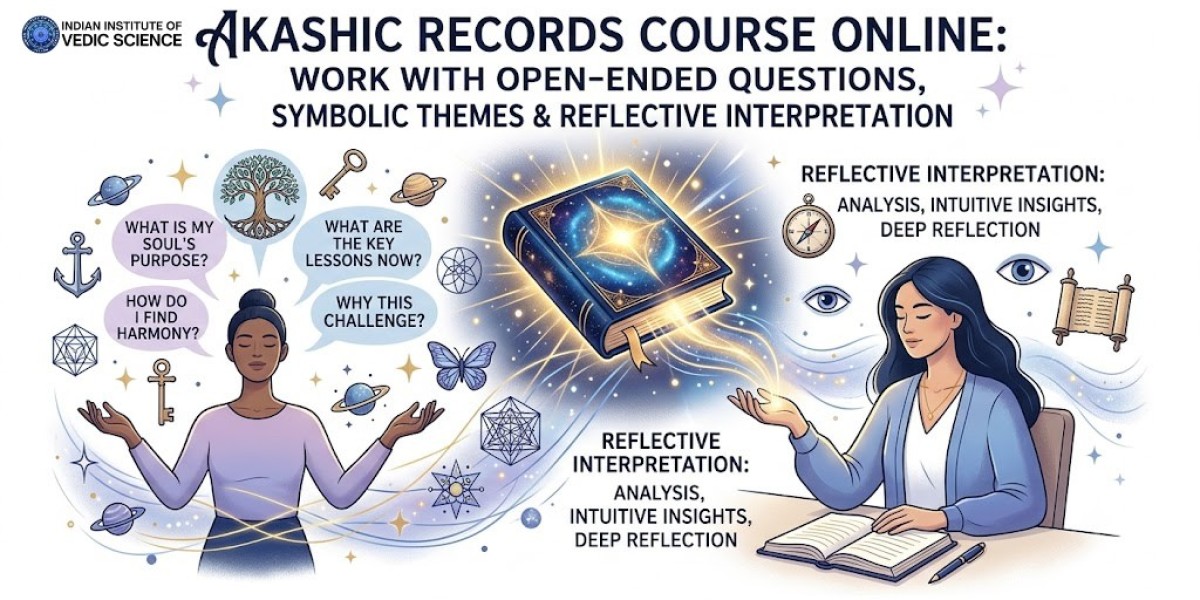


Akashic Records Course Online: How to Work With Open-Ended Questions, Symbolic Themes & Reflective Interpretation During a Reading
Working with Akashic Records is often described in spiritual traditions as a process of exploring symbolic information, personal reflection and questions about life experiences. Within this framework, the quality of a reading depends not only on the questions asked but also on how the practitioner approaches the themes, interprets symbolic impressions and communicates insights responsibly.
Open-ended questions can help create space for reflection instead of encouraging rigid, predetermined answers. Symbolic themes may include recurring patterns, emotional responses, relationships, personal values and perceived opportunities for growth. Learning to explore these themes without jumping to conclusions is an important part of developing a structured reading practice.
An akashic records course can introduce learners to the traditional concepts, preparation methods, questioning techniques and reflective practices associated with this subject. For students interested in exploring spiritual learning systematically, the Indian Institute of Vedic Science (IIVS) offers a setting in which to investigate traditional knowledge systems and related learning opportunities.
Whether you are a beginner or someone looking to develop a more consistent approach, understanding open-ended questions and symbolic interpretation can help you approach Akashic Records readings with greater clarity, self-awareness and responsibility.
What Are Akashic Records in Spiritual Traditions?
The Akashic Records are described in some modern spiritual traditions as a metaphysical repository of information connected with experiences, consciousness or the journey of the soul. Different practitioners explain the concept in different ways, and there is no scientific evidence establishing that such a repository exists or that practitioners can objectively access it.
For learners, the subject can be approached as a spiritual or reflective framework rather than a verified method of discovering hidden facts. Within that framework, a reading may involve contemplation, guided visualisation, symbolic impressions and questions intended to encourage personal insight.
The purpose of learning a structured method is to understand how a reading is prepared, how questions are framed and how interpretations are communicated. A practitioner should distinguish personal impressions from verifiable information and avoid presenting spiritual interpretations as guaranteed facts about another person's past, future or private experiences.
A well-organised akashic records course online can help learners understand these distinctions while introducing the terminology and reflective techniques used within the practice.
Why Open-Ended Questions Matter During an Akashic Records Reading
The way a question is framed can influence the direction of a reflective session. Questions that demand a definite answer may encourage a reader to interpret every impression as confirmation of an existing belief. Open-ended questions, by contrast, invite exploration and leave room for more than one possible interpretation.
1. Replace Yes-or-No Questions With Exploratory Questions
Consider the question, “Will my career improve this year?” It asks for a prediction and encourages a definitive answer.
A more reflective alternative might be, “What strengths could I explore as I consider my next career step?” This question directs attention towards values, skills and possible actions rather than treating a reading as a reliable forecast.
Similarly, instead of asking, “Is this person responsible for my problems?” a learner could explore, “What patterns in this relationship would benefit from closer reflection?”
Open-ended questions do not guarantee accurate insights. Their value is that they encourage consideration, self-examination and thoughtful discussion.
2. Focus on One Theme at a Time
Questions become difficult to interpret when they combine several unrelated concerns. For example, asking about career, family, finances and relationships in one sentence may produce an unclear reading.
A more structured approach begins with one subject. The practitioner can then explore related themes through follow-up questions.
If the original subject is career development, possible questions might include:
What personal strengths would I like to develop?
Which assumptions may be influencing my current decisions?
What practical options deserve further investigation?
What small action could help me gain clarity?
These questions provide a framework for reflection without requiring the practitioner to claim supernatural certainty.
3. Use Neutral Language
Questions that contain strong assumptions can influence interpretation. Asking, “Why is someone blocking my success?” already assumes that another person is responsible.
A neutral alternative is, “What factors may be affecting my progress, and which of them can I address?” This wording makes space for personal circumstances, practical obstacles and alternative explanations.
Learners should practise recognising assumptions in their own questions before beginning a reading.
4. Ask Questions That Encourage Personal Agency
A reflective reading is most useful when it helps someone consider their choices rather than surrender decision-making to an external authority.
For instance, “What should I do immediately?” can be reframed as, “What options can I evaluate, and what information would help me choose responsibly?”
This distinction is particularly important when a reading concerns health, financial decisions, employment or relationships. Spiritual reflection should not replace qualified professional advice or evidence-based decision-making.
How to Recognise Symbolic Themes During a Reading
Symbolic themes are recurring ideas, images or associations that emerge during a reflective practice. Within Akashic Records traditions, practitioners may describe impressions involving journeys, doors, light, water, family connections, repeated situations or other symbolic elements.
The meaning of a symbol is not necessarily universal. A door might suggest a new possibility to one person and uncertainty to another. Its relevance depends on the individual's context, cultural associations and the question being explored.
1. Identify the Symbol Before Interpreting It
Begin by describing the impression as clearly as possible. If a person reports visualising a bridge, record the bridge as the image rather than immediately deciding that it represents a major life transition.
Separating observation from interpretation makes it easier to consider several possible meanings.
2. Explore Personal Associations
Ask what the symbol means to the person receiving the reading. A bridge may remind them of a childhood experience, a difficult decision, a journey or a recent event.
These associations may provide useful material for reflection, but they do not prove that the symbol carries a supernatural message.
A thoughtful practitioner avoids imposing a personal interpretation on someone who does not recognise or relate to it.
3. Look for Recurring Themes Without Forcing Connections
Some sessions may involve repeated images or similar ideas. A learner can note these patterns and ask whether they connect meaningfully with the person's stated concerns.
However, repetition alone does not establish that a pattern has a hidden cause. Practitioners should remain open to alternative explanations and allow the person to decide whether an interpretation feels relevant.
4. Distinguish Symbolism From Factual Claims
A symbolic impression about a family relationship should not be presented as proof of a past event. Similarly, an image associated with a future opportunity should not be described as a guaranteed prediction.
This distinction helps maintain ethical boundaries and protects the reflective nature of the practice.
A Step-by-Step Framework for Reflective Interpretation
Learners can use a consistent process to make their readings more organised.
Step 1: Establish the Intention
Begin by clarifying what the person wants to explore. An intention might involve understanding a recurring concern, examining personal values or reflecting on a decision.
Avoid promising access to hidden truths or guaranteed answers.
Step 2: Prepare a Neutral, Open-Ended Question
Keep the question specific enough to provide direction but broad enough to allow reflection. For example, “What aspects of my current situation would benefit from greater awareness?” provides more room for exploration than a question that assumes a particular cause.
Step 3: Follow the Chosen Reflective Practice
Different Akashic Records traditions use different preparation methods. These may include quiet contemplation, prayer, visualisation or other guided spiritual exercises.
A learner should understand the method taught within their chosen framework and use it consistently. Such exercises can be meaningful as spiritual practices, but they should not be represented as scientifically proven ways of accessing an objective record of the universe.
Step 4: Record Images, Words and Impressions
Write down the impressions that arise without immediately assigning a definitive meaning. Recording them in their original form helps prevent later interpretations from changing the initial observation.
Step 5: Explore Several Possible Meanings
Consider the context of the question, personal associations and alternative explanations. Ask which interpretations are useful for reflection and which rely on assumptions that cannot be verified.
Step 6: Summarise the Reading Carefully
Conclude by summarising the themes discussed and identifying practical questions the person may wish to consider. Avoid presenting the summary as an unquestionable instruction or a guaranteed statement about the future.
Step 7: Identify a Grounded Next Step
A reflective session may lead to a practical action, such as writing down priorities, having a conversation, gathering information or considering available options.
The individual should remain responsible for their decisions and seek qualified professional support where appropriate.
Example: Exploring a Recurring Relationship Theme
Imagine that a person wants to understand why similar disagreements seem to occur in several relationships. During a reflective exercise, the practitioner notices a recurring symbolic image of a closed door.
An overly certain interpretation might claim that the door proves someone is hiding information or that a specific event from the past caused the problem.
A more careful approach begins with the image itself. The practitioner might ask, “What does a closed door represent to you?” or “Are there situations in which you find it difficult to communicate your needs?”
The person might associate the image with hesitation, privacy, uncertainty or the need for boundaries. They can then explore whether any of these ideas connect with their own experiences.
The image does not establish the cause of the disagreements. Instead, it becomes a starting point for reflection, allowing the person to examine their experiences without being pressured to accept a predetermined explanation.
This example demonstrates how open-ended questions and symbolic themes can work together within a responsible reflective practice.
Common Mistakes to Avoid During Akashic Records Readings
Treating Every Impression as a Fact
Images, words and intuitive impressions can have personal significance, but they are not automatically evidence of external events. Clearly distinguish what was experienced from what is inferred.
Asking Leading Questions
Questions that assume betrayal, hidden enemies or a predetermined outcome can encourage biased interpretations. Use neutral wording that allows multiple explanations.
Imposing Symbolic Meanings
A practitioner should not insist that a symbol means the same thing for everyone. Ask about personal associations and acknowledge uncertainty.
Making Guaranteed Predictions
Avoid promising certainty about relationships, health, finances, career outcomes or future events. A reading should not replace evidence-based information or professional guidance.
Creating Dependence on Repeated Readings
Spiritual reflection should support personal agency rather than encourage someone to rely on repeated sessions for every decision. Help participants identify their own questions, options and next steps.
How to Choose an Akashic Records Course
A structured learning programme can help beginners understand the subject's terminology, preparation methods, questioning techniques and approaches to symbolic interpretation.
When comparing an akashic records course online with an in-person option, review the syllabus, lesson format, instructor guidance and opportunities for practice. A useful programme should explain how to frame questions, document impressions, interpret recurring themes and communicate uncertainty responsibly.
Learners exploring an akashic records online course should also check whether the programme is suitable for beginners or assumes previous experience. Those considering an akashic records certification course should verify the issuing organisation, assessment requirements and meaning of the credential.
A structured programme in akashic records training may introduce guided exercises, reflective journaling and practice sessions. Before enrolling in akashic records classes, ask how the sessions are organised and what learning resources are included.
The akashic records course fees should be evaluated alongside the depth of the curriculum, instructor support, duration and practical components. Comparing the best akashic records course options requires more than looking at promotional claims; prospective students should assess whether the teaching approach matches their goals.
If you are researching an akashic records reading course or an akashic reading course, examine how the programme explains the reading process, open-ended questions and ethical communication.
Students looking for akashic records training online may prefer a format that allows them to review lessons at a convenient pace. Those comparing an akashic records course india should verify the provider's current syllabus, course availability, delivery method and enrolment conditions.
The broader range of akashic records courses can differ significantly in terminology and teaching philosophy. A course may use spiritual practices, guided visualisation or reflective exercises, so understanding its approach before enrolment is important.
If your interests include akashic record reading online, check whether the programme provides practical examples or opportunities to practise the method. Learners exploring akashic records reading should understand how to record impressions and discuss interpretations without presenting them as verified facts.
Likewise, akashic record reading training should provide clear guidance on asking neutral questions, respecting personal boundaries and acknowledging the limitations of symbolic interpretation.
Akashic Records Course Fees and Learning Expectations at IIVS
For relevant IIVS learning programmes, the indicative fee range is ₹45,000–₹60,000. The exact fee for an Akashic Records programme should be confirmed directly with the institute, along with its current duration, syllabus, format and inclusions.
Before enrolling, ask whether the programme includes guided sessions, learning materials, practice opportunities and instructor support. Clarify any certificate or completion requirements instead of assuming that every programme provides the same credential.
A well-matched course should help you understand its subject more clearly and practise the techniques it teaches. Be cautious of any programme that guarantees supernatural abilities, certain access to hidden information or predetermined life outcomes.
Begin Your Akashic Records Learning Journey With IIVS
Working with open-ended questions, symbolic themes and reflective interpretation requires patience, clear communication and an awareness of the limits of personal impressions. A structured approach can help learners organise their practice, explore multiple meanings and avoid presenting spiritual interpretations as unquestionable facts.
The Indian Institute of Vedic Science (IIVS) offers learning opportunities for people interested in traditional spiritual subjects. Review the available programme details, clarify the current fees and discuss your learning objectives before choosing a course.
If you want to explore Akashic Records through a structured learning pathway, connect with IIVS to understand the available options and find a programme aligned with your interests.
Book your free counselling to discuss your learning goals and take the next step in your spiritual learning journey with IIVS.
Frequently Asked Questions
What is an Akashic Records reading?
In modern spiritual traditions, an Akashic Records reading is described as a process of exploring symbolic impressions and themes associated with personal or spiritual experiences. Its metaphysical claims have not been scientifically established.
Why are open-ended questions useful?
They encourage exploration without forcing a yes-or-no answer or assuming a particular explanation. They can help participants reflect on personal values, recurring concerns and possible next steps.
How should symbolic themes be interpreted?
Start by recording the symbol, explore the person's own associations and consider multiple possible meanings. Avoid treating an interpretation as proof of a hidden event or a guaranteed prediction.
How much does an Akashic Records course cost at IIVS?
The indicative fee range for relevant IIVS programmes is ₹45,000–₹60,000. Contact the institute to confirm the current Akashic Records course fee, duration and included learning resources.
Is an Akashic Records certification course suitable for beginners?
Some programmes are designed for beginners, while others may expect prior experience. Check the syllabus, entry requirements, practice format and certificate conditions before enrolling.
Can a reading replace professional advice?
No. Spiritual reflection should not replace qualified medical, mental health, legal or financial guidance. Important decisions should be based on appropriate evidence and professional advice where needed.






