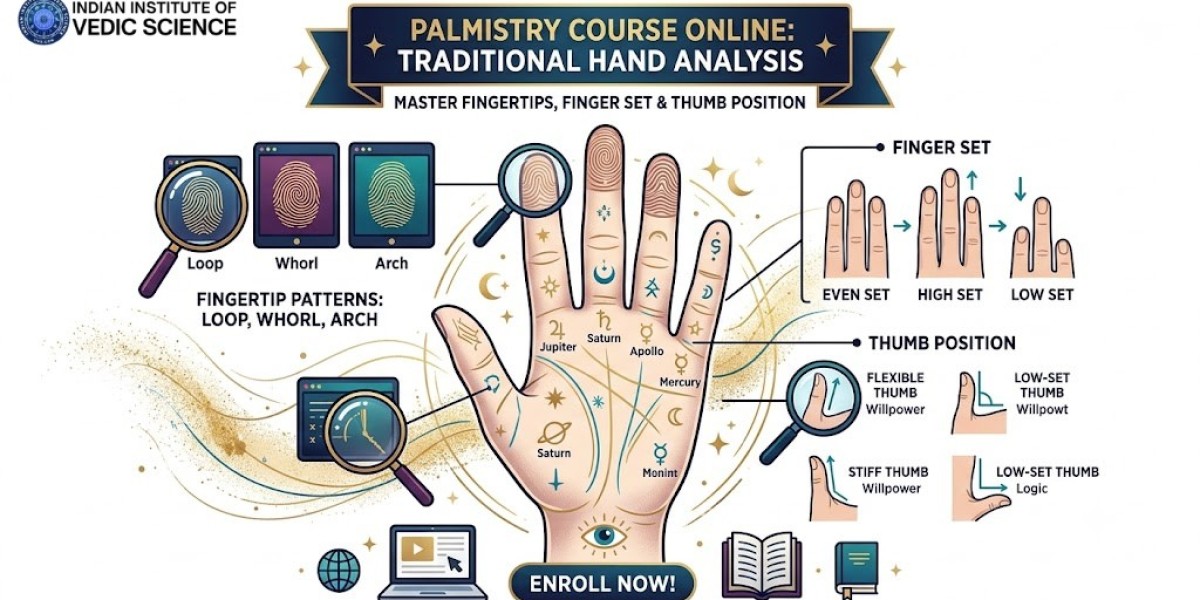


Palmistry Course Online: How to Examine Fingertip Patterns, Finger Set & Thumb Position in Traditional Hand Analysis
Palmistry is a traditional practice that interprets the lines, shapes, fingers and other features of the hand through an established symbolic framework. Beyond the major palm lines, fingertip patterns, finger placement and thumb position are important areas of study because they help learners understand how different hand features are traditionally examined together.
For beginners, these details can initially seem complicated. A fingertip may appear rounded, square or tapered, fingers may be closely grouped or widely spaced, and the thumb may sit at different angles relative to the palm. Learning how to observe these features systematically can help students build a more organised approach to traditional hand analysis.
A structured palmistry course online can introduce these concepts step by step, helping learners move beyond memorising individual signs and develop a consistent method of observation. At the Indian Institute of Vedic Science (IIVS), students interested in traditional knowledge systems can explore learning opportunities designed to build their understanding of subjects such as palmistry and astrology.
Whether you are exploring palmistry for personal interest or considering more advanced study, understanding fingertip patterns, finger set and thumb position provides a useful foundation for examining the hand within traditional palmistry.
What Is Palmistry and Why Are Hand Features Important?
Palmistry, also called palm reading or chiromancy, is a traditional interpretive practice involving the examination of the hand. Depending on the school of palmistry, practitioners may consider palm lines, mounts, finger proportions, fingertip shapes, flexibility, spacing and thumb structure.
Many beginners start by learning the Life Line, Head Line, Heart Line and Fate Line. However, a broader study of the hand also considers features that exist beyond the main lines.
For example, two hands may have similar major lines but differ in finger length, fingertip shape or thumb flexibility. In traditional palmistry, these differences may be interpreted as additional symbolic details that contribute to an overall reading.
The purpose of systematic observation is to avoid interpreting one feature in isolation. Instead, learners examine several characteristics together and consider how traditional interpretations relate to the particular hand being studied.
It is important to remember that palmistry is a cultural and symbolic practice rather than a scientifically validated method for determining personality, predicting events or diagnosing health conditions. Its interpretations should therefore be presented as traditional beliefs, not as guaranteed facts about an individual.
How to Examine Fingertip Patterns in Traditional Palmistry
Fingertips are among the visible features that palmistry learners may study before moving to more detailed hand interpretation. Their shapes can vary naturally, and traditional systems often group them into broad categories.
1. Square Fingertips
Square fingertips generally have a relatively straight upper edge and a structured appearance. In traditional palmistry, they are often associated symbolically with practicality, organisation and a preference for order.
When examining a square fingertip, observe the overall outline rather than focusing on a single photograph or viewing angle. The natural shape of the finger, nail and surrounding skin can influence how the fingertip appears.
A learner should also compare the fingertips across the hand. One finger may look more square than another, and these variations can be recorded as part of a general observation.
2. Rounded Fingertips
Rounded fingertips have a softer, curved outline. Traditional interpretations sometimes associate this shape with adaptability, flexibility or a balanced approach to different situations.
However, a rounded fingertip does not establish that a person possesses any particular personality trait. It is simply a feature that some palmistry traditions assign symbolic meaning to.
Students should learn to describe what they actually see before considering what a traditional interpretation might suggest. This distinction between observation and interpretation helps make readings more consistent.
3. Tapered Fingertips
Tapered fingertips gradually narrow towards the tip. In some palmistry traditions, this shape is associated symbolically with imagination, sensitivity or an interest in aesthetic expression.
When examining tapered fingertips, compare the shape of the fingertip with the rest of the finger. Do not confuse a naturally narrow finger with a fingertip that genuinely tapers towards its end.
A structured approach makes it easier to identify differences between fingertip categories and understand how they are discussed in traditional palmistry.
4. Pointed Fingertips
Some traditional descriptions distinguish pointed fingertips from rounded or tapered ones. A pointed fingertip has a more pronounced narrowing towards the tip.
The exact terminology can differ across palmistry traditions, so learners should follow the definitions used by their chosen learning framework. Consistent terminology is particularly important when comparing examples or practising with other students.
5. Recording Fingertip Observations
An effective way to practise is to create a simple observation record for each hand. Note the shape of each fingertip, whether the shapes appear consistent across the fingers and any visible differences between the two hands.
Separate the visual description from the traditional interpretation. For example, write “the index fingertip appears square” before adding that a particular palmistry tradition may associate square shapes with practicality.
This method helps prevent premature conclusions and encourages a disciplined approach to learning.
Understanding Finger Set and Finger Spacing
Finger set refers broadly to how the fingers emerge from the palm and how they are positioned in relation to one another. Traditional palmistry may examine finger spacing, alignment, relative length and the overall arrangement of the hand.
These features should be observed naturally. Asking someone to stretch their fingers widely can change the appearance of the hand and make comparisons less reliable.
1. Closely Positioned Fingers
Some hands naturally have fingers that rest close together. Traditional palmistry may interpret this arrangement symbolically in terms of caution, structure or a preference for security.
Such associations are not scientific conclusions about a person's behaviour. Finger spacing can also reflect ordinary anatomical variation, joint mobility and the position of the hand.
For learning purposes, the important skill is to recognise the arrangement consistently and understand how it is described in the relevant palmistry tradition.
2. Widely Spaced Fingers
When the fingers naturally rest farther apart, some palmistry traditions associate the arrangement with independence, openness or freedom of expression.
The reader should not assume that wide spacing proves a person is independent or financially adventurous. Instead, the feature can be recorded and discussed as one element within a traditional interpretive framework.
3. Differences Between Individual Fingers
Palmistry learners may also examine how individual fingers align with their neighbours and whether there are noticeable differences in their natural positions.
The index finger, middle finger, ring finger and little finger are often studied in relation to traditional symbolic associations. However, their positions should not be interpreted as definitive evidence of character, intelligence or future outcomes.
A careful reader compares the entire hand rather than drawing strong conclusions from a single finger.
4. Examining Finger Set Systematically
A consistent observation process can make practice easier:
Observe the hand in a relaxed position.
Note the natural spacing between the fingers.
Compare the alignment of neighbouring fingers.
Record visible differences without assigning immediate meaning.
Review the interpretations used in the particular palmistry system being studied.
This sequence encourages accurate description before interpretation and makes it easier to discuss observations clearly.
How to Examine Thumb Position in Palmistry
The thumb has a distinctive position and structure compared with the other fingers. In traditional palmistry, students may examine its placement, angle, apparent flexibility and proportions.
Thumb position is not a reliable scientific measure of willpower, decision-making ability or personality. Nevertheless, it remains an established area of symbolic study within many traditional hand-reading systems.
1. Thumb Angle
When the hand is relaxed, the thumb may appear to extend at a relatively narrow or wide angle from the palm. Traditional palmistry sometimes associates a more open angle with openness or independence, while a narrower angle may be interpreted in terms of restraint or caution.
These associations vary between schools of palmistry. The reader should therefore understand the specific interpretive framework being followed rather than applying one meaning universally.
For practical observation, examine the thumb in a comfortable, natural position. Avoid forcing the thumb outward or comparing hands photographed from different angles.
2. Thumb Flexibility
Some people can bend their thumbs more easily than others. Traditional palmistry may discuss flexibility symbolically in relation to adaptability, while a less flexible thumb may be associated with firmness or consistency.
However, thumb flexibility is influenced by physical anatomy and joint mobility. It should not be treated as proof of a person's psychological characteristics.
Learners should also avoid asking anyone to perform movements that cause discomfort. Observation should remain comfortable and respectful.
3. Thumb Proportions
Traditional palmistry may consider the thumb's overall length and its proportions relative to the palm and fingers. Some systems also distinguish between the sections of the thumb and assign symbolic meanings to their relative appearance.
The terminology and interpretations can differ, so a learner should use a consistent reference framework. Avoid measuring the thumb in isolation and treating the result as a definitive indicator of an individual's abilities.
4. Thumb Placement in the Overall Hand
Thumb position becomes more meaningful within traditional analysis when considered alongside other visible characteristics.
For example, a learner may record the thumb angle, the spacing between the fingers and the shapes of the fingertips. These observations can then be compared with the palm lines and other features included in the chosen system.
The goal is not to generate an unquestionable prediction. It is to understand how different features are traditionally described and how a practitioner constructs a coherent symbolic interpretation.
How Fingertips, Finger Set and Thumb Position Work Together
The most important learning principle is that palmistry involves more than identifying isolated signs. Fingertip shape, finger spacing and thumb position can be studied together to develop a broader description of the hand.
Imagine a practice hand with mostly square fingertips, moderate finger spacing and a thumb that rests at a relatively open angle.
A traditional palmistry interpretation might discuss the square fingertips in connection with practicality, the spacing in connection with personal independence and the thumb angle in connection with openness. A different palmistry school may explain the same features differently.
A responsible learner records the visible characteristics first, acknowledges that interpretations vary and avoids treating the combined reading as a verified personality assessment.
This process also makes it easier to compare two hands without assuming that people with similar features must share the same personality or life experiences.
Common Mistakes Beginners Should Avoid
Interpreting One Feature in Isolation
A single fingertip or thumb position should not be used to make sweeping claims about a person. Traditional hand analysis considers multiple features and the interpretive framework being followed.
Confusing Observation With Interpretation
“Wide finger spacing” is an observation. “This person values independence” is a traditional interpretation. Keeping these statements separate makes the reading clearer and more transparent.
Assuming Every Palmistry School Uses the Same Definitions
Terminology and symbolic meanings may differ across traditions. Students should understand the definitions used in their course rather than mixing incompatible interpretations without explanation.
Making Medical or Guaranteed Predictions
Palm features should not be used to diagnose medical conditions, determine someone's future with certainty or make high-stakes decisions about relationships, finances or employment.
Skipping Practical Exercises
Reading descriptions is helpful, but learners also benefit from practising observations, documenting differences and explaining their interpretations in clear language.
How to Choose a Palmistry Course Online
A structured learning programme can help students understand traditional hand-analysis concepts in a logical sequence. When evaluating palmistry courses in india, look for a syllabus that covers foundational terminology, palm lines, mounts, finger proportions, fingertip categories, thumb characteristics and practical interpretation.
People who want to learn palmistry online should check whether lessons are organised for beginners and whether the course offers opportunities to practise with examples. Those who want to learn palm reading online may also benefit from instruction that explains how to connect different hand features without relying on rigid assumptions.
A suitable palm reading online programme should make its learning objectives clear and explain how students can develop their observation skills. If you are comparing a palm reading course online with an in-person option, consider lesson accessibility, instructor support, learning materials and opportunities to ask questions.
The right palmistry online course should match your current experience and learning goals. Beginners may prefer a programme that explains the basics carefully, while experienced learners may look for more detailed work on interpreting combinations of features.
If you are searching for the best palmistry institute in india, compare the actual course content, instructor background, support arrangements, fee transparency and student learning experience. Avoid choosing solely on the basis of promotional claims or guaranteed outcomes.
Palm Reading Course, Certification and Fees
Some learners want to study palmistry for personal interest, while others want a more structured educational experience. Before enrolling in a palm reading course, check the programme duration, curriculum, practical exercises and any available assessment or feedback.
If you are considering a palm reading certification, verify which organisation issues the certificate, what requirements must be completed and whether the credential represents course participation, successful assessment or another form of recognition.
For relevant IIVS learning programmes, the indicative fee range is ₹45,000–₹60,000. The exact fee for a specific palmistry programme, along with its duration and inclusions, should be confirmed directly with IIVS before making an enrolment decision.
A transparent course description should explain what is included in the price and what students can reasonably expect to learn. Compare the teaching structure and practical support rather than judging a programme by price alone.
Can You Study Palmistry Alongside Astrology?
Some learners are interested in exploring multiple traditional knowledge systems. Palmistry focuses on interpreting features of the hand, whereas astrology traditionally examines celestial placements and their symbolic relationships.
Students researching astrology certification courses should first identify their learning goals and compare the scope of each programme. An astrology certificate course online may introduce foundational concepts, while an astrology diploma course online may offer a longer or more extensive curriculum, depending on the provider.
Anyone considering an online astrology course with certificate should verify the issuing organisation, syllabus, course duration and certificate requirements before enrolling.
When evaluating the best astrology courses, do not rely exclusively on rankings or advertising. The best astrology courses online will depend on factors such as course structure, teaching support and the student's existing knowledge.
Likewise, those comparing the best astrology courses in india online or the best online astrology courses in india should examine curriculum depth, learning format, transparent pricing and opportunities for guided practice.
These programmes are separate from palmistry training, so check each course's requirements and fees independently. Studying more than one discipline may broaden your knowledge, but each subject should be learned through its own terminology and methods.
Start Your Palmistry Learning Journey With IIVS
Understanding fingertip patterns, finger set and thumb position can help learners build a more systematic approach to traditional hand analysis. By observing carefully, distinguishing visible features from symbolic meanings and considering the hand as a whole, students can develop a clearer understanding of palmistry concepts.
The Indian Institute of Vedic Science (IIVS) provides learning opportunities for people interested in traditional spiritual subjects. Explore the available course details, review the curriculum and confirm the current fee before selecting a programme that aligns with your goals.
If you are ready to develop your knowledge of palmistry through structured learning, connect with IIVS to discuss the available options.
Book your free counselling to explore the right learning pathway for your interests and begin your palmistry learning journey with IIVS.
Frequently Asked Questions
What is examined in traditional palmistry besides palm lines?
Learners may examine fingertip patterns, finger spacing, finger proportions, thumb position, flexibility and other visible hand features, depending on the palmistry tradition being studied.
Can beginners learn palmistry online?
Yes. Beginners can start with a structured course that explains foundational concepts and provides opportunities to practise identifying and describing hand features.
Why is thumb position studied in palmistry?
Traditional palmistry systems may assign symbolic meanings to thumb angle, placement and flexibility. These interpretations are part of the tradition and should not be treated as scientifically established personality assessments.
How much does a palmistry course cost at IIVS?
The indicative fee range for relevant IIVS programmes is ₹45,000–₹60,000. Contact IIVS to confirm the current fee, course duration and inclusions for the specific palmistry programme.
Does a palm reading certification guarantee professional recognition?
No. Recognition depends on the issuing organisation and the context in which the certificate is used. Prospective students should verify the credential's status and the requirements for completing the programme.
Can palmistry predict someone's future with certainty?
Palmistry is a traditional interpretive practice, not a scientifically established method for predicting future events. Its symbolic interpretations should not replace evidence-based advice or professional guidance.






