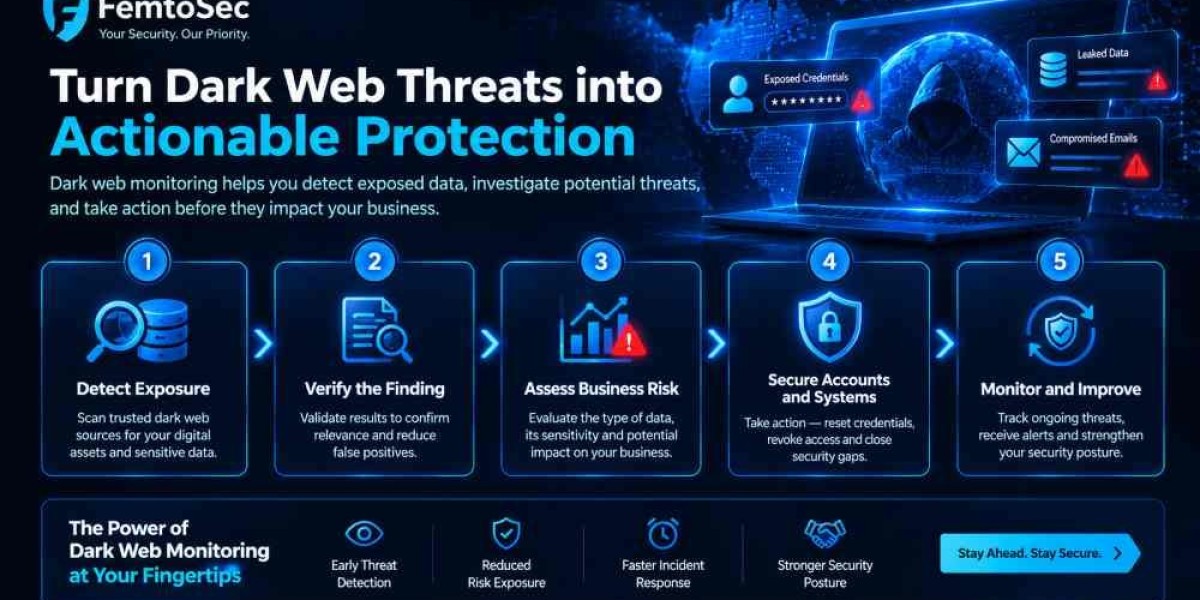


Businesses face increasing cybersecurity risks as cybercriminals exploit stolen credentials, leaked databases, compromised accounts, and confidential information. These threats may originate outside an organization's network, making them difficult to identify through traditional security tools alone.
The dark web can contain information associated with stolen business data, compromised credentials, and underground marketplaces. If exposed information remains undetected, attackers may use it for phishing, account takeover, fraud, or unauthorized access to corporate systems.
This is why dark web monitoring is an important component of a proactive cybersecurity strategy. It helps organizations identify potential external data exposures, investigate relevant findings, and take appropriate action to reduce security risks.
Businesses can explore dark web monitoring services to understand how external exposure monitoring can complement their existing security controls.
What Is the Dark Web?
The dark web is a part of the internet that generally requires specialized software or configurations to access. Although it has legitimate privacy-related uses, some websites, forums, and marketplaces are associated with the distribution of stolen information and other illicit activities.
Cybercriminals may use these channels to share or sell:
Stolen usernames and passwords.
Compromised corporate email accounts.
Leaked customer and employee information.
Confidential business documents.
Information connected to compromised systems.
Records associated with third-party data breaches.
Not every reference to a business represents an active threat. Organizations need to validate findings and assess their relevance before deciding how to respond.
Why Businesses Need Dark Web Monitoring Services
Traditional cybersecurity tools focus on protecting systems, monitoring activity, and detecting suspicious behavior within an organization's environment. However, compromised information may circulate externally before the business becomes aware of an exposure.
Professional dark web monitoring services can provide additional visibility into potential threats involving organizational information.
1. Detect Exposed Credentials
Employee credentials may be exposed through phishing attacks, malware infections, password reuse, or third-party breaches.
When relevant credentials are discovered, security teams can reset affected passwords, revoke active sessions, review account activity, and strengthen multi-factor authentication.
2. Identify Potential Data Leaks
Sensitive business information may become exposed through cyberattacks, insecure systems, or incidents involving suppliers and service providers.
Monitoring relevant external sources can help organizations identify potential references to leaked information and investigate whether a security incident has occurred.
3. Reduce Account Takeover Risks
Attackers may attempt to reuse stolen credentials to access email accounts, cloud platforms, and business applications.
Identifying credible exposures can help organizations prioritize affected accounts and take corrective action before further misuse occurs.
4. Strengthen Cyber Threat Awareness
External threat intelligence can help security teams understand potential risks involving their domains, employees, digital assets, and business information.
For a broader security approach, organizations may also consider FemtoSec's red teaming services, which can help evaluate defenses through authorized adversarial testing within an agreed scope.
5. Support Incident Response
Monitoring alerts can provide useful information when investigating possible data exposure or account compromise.
Organizations should establish clear procedures for validating findings, assigning responsibilities, securing affected accounts, and documenting remediation activities.
How Dark Web Monitoring Solutions Work
Effective dark web monitoring solutions typically follow a structured process that connects external intelligence with practical security action.
Step 1: Define the Monitoring Scope
Identify the digital assets and information that require monitoring. These may include corporate domains, employee email addresses, selected brand identifiers, and other approved organizational assets.
Step 2: Search Relevant External Sources
Monitoring systems and analysts examine available intelligence sources for information associated with the defined assets.
Source coverage varies between providers, and no service can guarantee that every private forum, marketplace, or leaked dataset will be discovered.
Step 3: Validate Potential Exposures
Potential matches should be reviewed to determine whether they are accurate, relevant, and associated with a credible security concern.
Validation helps distinguish genuine exposures from outdated information, duplicates, and unrelated records.
Step 4: Assess the Risk
Security teams evaluate the type of information exposed, its sensitivity, whether credentials may still be active, and the potential impact on business operations.
For example, an exposed administrator account may require more urgent attention than an outdated reference to an inactive email address.
Step 5: Generate Actionable Alerts
Relevant findings should be communicated to the appropriate security or IT personnel with enough context to support investigation and remediation.
Step 6: Remediate and Review
Depending on the finding, remediation may include password resets, session revocation, access reviews, suspicious activity investigations, and improvements to security controls.
Organizations should also review recurring findings to identify weaknesses that require longer-term attention.
Key Features to Look for in Dark Web Monitoring Solutions
When evaluating providers, businesses should consider the following capabilities:
Credential exposure detection: Identifies potential exposure of employee or corporate credentials.
Asset coverage: Monitors agreed domains, identifiers, and organizational assets.
Alert validation: Helps distinguish relevant findings from false positives.
Risk prioritization: Communicates the potential severity and urgency of identified exposures.
Actionable reporting: Provides information that supports investigation and remediation.
Incident response integration: Establishes clear procedures for escalating significant findings.
Privacy safeguards: Handles sensitive monitoring information appropriately.
Recurring monitoring: Supports ongoing checks according to the organization's requirements.
Businesses should confirm the provider's source coverage, service limitations, reporting arrangements, and response responsibilities before selecting a solution.
Who Can Benefit from Dark Web Monitoring?
Financial Services and Fintech
Financial organizations manage sensitive customer information, employee credentials, and critical digital systems. Monitoring may help identify potential exposures that require investigation.
Technology and SaaS Companies
Technology businesses often depend on cloud platforms, developer accounts, and customer databases. Identifying exposed credentials can help security teams investigate risks to internal systems and customer environments.
E-commerce Businesses
Online retailers may face threats involving customer accounts, employee credentials, and third-party platforms. Monitoring can provide additional information when investigating possible account compromise.
Healthcare and Professional Services
Organizations handling confidential records may use monitoring to identify potential exposures that require further security or privacy review.
Enterprises with Third-Party Dependencies
Suppliers and service providers can introduce additional exposure risks. Organizations should consider third-party security as part of their broader risk management program.
Dark Web Monitoring vs. Traditional Cybersecurity
Dark web monitoring complements other cybersecurity controls rather than replacing them.
Security Measure | Primary Purpose |
Dark web monitoring | Identifies potential external exposure of business information |
Endpoint protection | Detects or blocks malicious activity on supported devices |
Vulnerability assessment | Identifies weaknesses in systems and applications |
Penetration testing | Tests whether selected weaknesses can be exploited |
Multi-factor authentication | Adds verification beyond a password |
Incident response | Coordinates investigation, containment, and recovery |
Organizations can combine these capabilities according to their risk profile. Businesses that need broader governance and regulatory support can also explore FemtoSec's compliance services.
Best Practices for Effective Dark Web Monitoring
Prioritize critical accounts. Focus on administrators, privileged users, and accounts that access sensitive business information.
Enable multi-factor authentication. MFA helps reduce unauthorized access risks when passwords are exposed.
Respond quickly to credible alerts. Establish procedures for validating findings, securing accounts, and investigating suspicious activity.
Maintain an accurate asset inventory. Keep records of important domains, applications, accounts, and digital identifiers.
Review third-party risks. Consider how suppliers and external platforms handle business information.
Train employees. Encourage secure password practices, phishing awareness, and prompt reporting of suspicious activity.
Protect monitoring data. Restrict access to sensitive findings and handle information according to appropriate security and privacy requirements.
Review recurring exposures. Repeated findings may indicate weaknesses in access management, password practices, or third-party security.
How Dark Web Monitoring Supports a Broader Cybersecurity Strategy
Dark web monitoring is most useful when integrated into a broader security program that includes preventive controls, threat detection, and incident response.
Organizations may combine monitoring with identity security, vulnerability management, security testing, and governance processes to improve their overall risk management.
Businesses that need additional cybersecurity leadership and strategic guidance can learn more about FemtoSec's vCISO services for VARA compliance.
Organizations working with blockchain applications may also consider smart contract auditing as a separate security measure for identifying vulnerabilities in smart contract code.
Each capability addresses different risks, so businesses should select services based on their systems, operational needs, and applicable obligations.
Why Choose FemtoSec for Dark Web Monitoring?
Businesses need a clear process for identifying potential external exposures, evaluating findings, and deciding what actions are appropriate.
FemtoSec's dark web monitoring services offer a starting point for organizations looking to explore external exposure monitoring as part of their cybersecurity strategy.
Before selecting a service, businesses should confirm its monitoring scope, available intelligence sources, reporting arrangements, privacy safeguards, and response responsibilities.
Conclusion
Exposed credentials, leaked business information, and compromised accounts can create significant cybersecurity risks. Dark web monitoring helps organizations improve visibility into potential external exposures and investigate findings that may affect their systems, employees, and customers.
However, monitoring alone cannot prevent every cyberattack or guarantee that all leaked information will be discovered. Its value comes from combining relevant intelligence with strong security controls, timely investigation, and effective remediation.
By integrating dark web monitoring into a broader cybersecurity strategy, businesses can make more informed security decisions and strengthen their ability to respond to potential threats.
Explore dark web monitoring services to learn more about monitoring potential data exposures and supporting business cybersecurity.
Frequently Asked Questions
1. What is dark web monitoring?
Dark web monitoring is a cybersecurity process that searches relevant external sources for potential exposure of information associated with an organization, including credentials and business data.
2. What do dark web monitoring services detect?
Depending on the scope and source coverage, they may identify exposed credentials, references to leaked information, compromised accounts, and other potential threats involving monitored assets.
3. What are dark web monitoring solutions?
Dark web monitoring solutions are services or technologies used to search relevant external sources, identify potential exposures, validate findings, and support security investigations.
4. Can dark web monitoring prevent cyberattacks?
Monitoring cannot prevent every attack. It can help organizations identify potential exposures and take action to reduce the risk of credential misuse or further compromise.
5. How often should a business monitor the dark web?
The appropriate frequency depends on the organization's risk profile, monitoring scope, and service capabilities. Recurring monitoring can help identify new exposures over time.
6. What should a business do if its credentials are exposed?
The organization should validate the finding, reset affected passwords where appropriate, revoke suspicious sessions, strengthen authentication, and review account activity for signs of unauthorized access.
7. Is dark web monitoring useful for small businesses?
Yes. Small businesses may benefit when they depend on online accounts, handle sensitive information, or face meaningful risks from credential theft and data exposure.