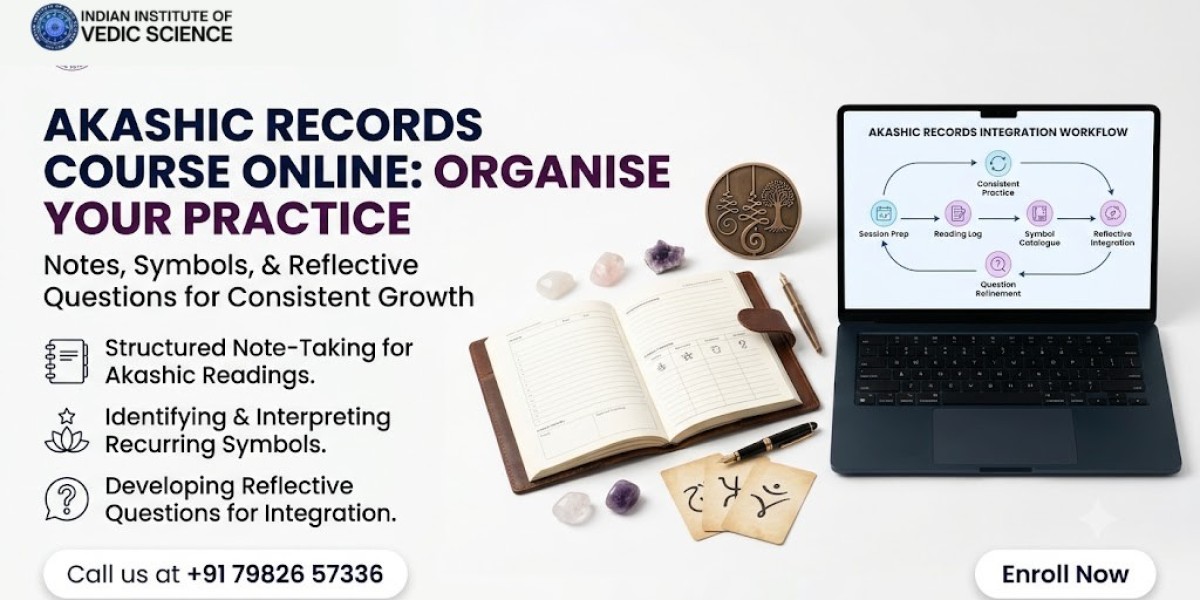


Akashic Records Course Online: How to Organise Reading Notes, Recurring Symbols and Reflective Questions for Consistent Practice
Exploring the Akashic Records is a spiritual practice associated with the idea of a symbolic or energetic record of experiences, thoughts and events. People interested in this subject often want to understand how to approach a reading, reflect on recurring themes and maintain a consistent personal practice. However, developing a thoughtful approach requires more than learning a set of concepts. It also involves recording observations carefully, distinguishing impressions from interpretations and reviewing notes without allowing expectations to determine every conclusion.
An akashic records course online can introduce learners to the concepts, reflective exercises and journaling methods associated with this spiritual tradition. By learning how to organise reading notes, recognise recurring symbols and formulate meaningful questions, students can build a more structured approach to their practice.
For beginners, an organised learning process can make spiritual exploration easier to review and understand. Rather than treating every impression as a definite message, learners can document what they experienced, consider different interpretations and reflect on how their understanding develops over time.
The Indian Institute of Vedic Science (IIVS) provides a platform for people exploring traditional knowledge systems and spiritual learning. Before selecting a programme, prospective learners should understand the nature of Akashic Records practice, the skills they want to develop and the importance of approaching personal reflections with care.
What Are the Akashic Records?
In some spiritual and esoteric traditions, the Akashic Records are described as a metaphysical repository of information associated with souls, experiences or the journey of consciousness. Different teachers explain the concept in different ways, and there is no single universally accepted interpretation of what the Records represent.
People who explore this tradition may use meditation, guided visualisation, prayer, contemplation or structured reflective exercises as part of their practice. Some describe their experiences through images, words, emotions, colours or symbolic impressions.
These experiences can be personally meaningful, but claims that the Akashic Records provide objectively verifiable information about past lives, other people or future events have not been scientifically established. A responsible learning approach therefore distinguishes spiritual belief and personal experience from independently verified facts.
A structured akashic records course can help learners understand the terminology used within a particular teaching framework and develop a consistent process for reflection. It should also encourage students to consider alternative explanations, respect personal boundaries and avoid treating subjective impressions as unquestionable truth.
Why Choose an Akashic Records Online Course?
An online programme can make it easier to study spiritual concepts at a manageable pace. Learners may be able to revisit lessons, practise guided exercises and maintain a journal alongside their coursework.
An akashic records online course is particularly useful when the curriculum includes repeatable exercises rather than relying exclusively on theoretical explanations. Students can review their notes after a session, compare their reflections across different dates and identify patterns in the way they describe their experiences.
A suitable programme should ideally explain the learning process, establish clear expectations and provide opportunities to ask questions. It should also distinguish between the instructor's spiritual framework and claims that can be independently verified.
When comparing an akashic records course online with an in-person programme, consider the teaching format, instructor access, practice assignments, course duration and support available after lessons. Online learning can offer flexibility, but consistent personal practice remains important.
The objective is not to collect as many spiritual interpretations as possible. It is to develop a thoughtful, repeatable and grounded method of recording and reviewing experiences.
The Importance of Organising Akashic Reading Notes
Keeping structured notes is one of the most practical habits a learner can develop. Without a consistent record, it can become difficult to remember what occurred during a session, which questions were asked or how an interpretation developed.
A simple journaling system can help separate the original experience from the meaning assigned to it later. This distinction is particularly useful when learners revisit the same themes repeatedly.
Create a Standard Session Template
Use the same basic template for each practice session. Consistency makes it easier to compare entries and notice changes in your reflective process.
Your template may include:
Date and session details: Record the date, approximate duration and type of exercise.
Intention: Write down the purpose of the session before beginning.
Opening question: Note the specific question or theme you want to explore.
Direct observations: Record words, images, colours, emotions or sensations as you remember them.
Initial interpretation: Describe what the impressions seemed to mean to you at that moment.
Alternative explanations: Consider whether memory, expectation, recent experiences or imagination may have influenced the experience.
Reflection: Record what you learned about your own thoughts, feelings or assumptions.
Follow-up question: Identify a topic that may benefit from further reflection.
This format encourages clear documentation without requiring the learner to decide immediately what every impression means.
Separate Observations from Interpretations
Suppose a learner visualises a doorway during meditation. The observation is that a doorway appeared in the visualisation. An interpretation might be that it symbolises transition, a new opportunity or uncertainty.
Those interpretations may be personally useful, but none is automatically established by the image itself.
Recording the observation and interpretation separately helps learners remain open to multiple meanings. It also reduces the tendency to reinterpret every experience to fit an existing belief.
Review Notes at Regular Intervals
Choose a consistent review schedule, such as once a week or at the end of each month. Read several entries together and identify repeated words, images, questions or emotional themes.
Rather than asking only whether an interpretation was correct, consider broader reflective questions:
Which themes appeared repeatedly?
Did I begin each session with a similar expectation?
Did a recent experience influence the images or emotions I noticed?
Did my interpretation change after I reviewed the notes?
What practical insight can I take from this reflection?
This method transforms journaling from a collection of isolated experiences into a more organised personal learning record.
How to Recognise Recurring Symbols Without Overinterpreting Them
Recurring symbols are often an important part of spiritual journaling. Learners may notice repeated colours, animals, natural settings, numbers, doors, bridges, water or other images.
However, repetition does not automatically establish that a symbol has one fixed meaning. Personal memories, cultural associations, media exposure and expectations can influence which images come to mind.
A thoughtful akashic records reading course should encourage students to explore symbolic associations while remaining aware of these influences.
Build a Personal Symbol Index
Create a dedicated section in your journal for recurring symbols. Each entry can include the symbol, the date it appeared, the session context, your immediate association and other possible interpretations.
For example, if water appears during several sessions, record whether it appeared as a river, ocean, rainfall or still pond. These are different observations, even if they belong to the same broad category.
Next, record what water means to you personally. It might remind you of a childhood memory, a recent trip, calmness, uncertainty or a particular cultural story.
You can also note meanings taught by your course instructor, but keep those separate from your own associations. This prevents a general symbolic definition from replacing your personal observation.
Look for Context Rather Than Frequency Alone
A symbol appearing repeatedly may feel significant, but frequency is only one aspect of the record. The surrounding context may be equally important.
Ask yourself:
What was I thinking about before the session?
Was the symbol associated with a particular emotion?
Did it appear in a similar or different setting?
Was I expecting to see it?
Did the interpretation arise immediately or only after reviewing the notes?
These questions help learners understand how meaning develops during reflection.
Avoid Forcing Every Symbol into a Single Explanation
A common difficulty in spiritual interpretation is confirmation bias: noticing information that supports an existing belief while overlooking details that do not fit.
For instance, a learner who believes that a particular animal represents protection may interpret every appearance of that animal in the same way. An alternative approach is to record the image first and explore several possibilities before deciding which interpretation, if any, feels relevant.
A disciplined journal does not need to resolve every symbol. Sometimes the most accurate note is simply that the image appeared and its meaning remains uncertain.
How to Formulate Better Reflective Questions
The quality of a reflective session often depends on the question a learner brings to it. Broad, emotionally charged or leading questions can encourage vague interpretations that are difficult to evaluate later.
A well-designed question is specific enough to support meaningful reflection while leaving room for different perspectives.
Replace Leading Questions with Open Questions
Consider the difference between asking, “Why is a particular person blocking my spiritual progress?” and asking, “What assumptions or communication patterns am I noticing in this relationship?”
The first question assumes that the other person is responsible for a problem. The second invites the learner to examine their own perceptions and identify practical areas for reflection.
Similarly, instead of asking whether a predetermined event will happen, consider what information, preparation or personal reflection could help you approach the situation thoughtfully.
Use Questions That Encourage Personal Insight
Useful reflective questions may include:
What recurring concern has been occupying my attention?
Which assumptions might be influencing my interpretation?
What do I associate with the image or symbol that appeared?
What alternative explanations should I consider?
What practical action is within my control?
What information do I still need before making a decision?
Which part of this experience remains unclear?
These questions encourage self-awareness rather than dependence on predictions.
Maintain a Question Log
A question log helps learners see how their focus changes over time. Record the original question, why it mattered, what impressions arose and which questions remained unanswered.
At the end of a review period, group related questions under broader themes such as personal growth, relationships, work, emotional responses or spiritual interests.
This can help learners identify recurring concerns in their own thinking. It should not be used to claim that every repeated concern is a message from an external or supernatural source.
A Step-by-Step Method for Consistent Akashic Records Practice
A structured session can help learners develop a regular routine without making the process unnecessarily complicated.
Step 1: Establish a Clear Intention
Before beginning, write one sentence explaining what you want to explore. Keep the intention focused on reflection, self-understanding or a question you can examine responsibly.
Step 2: Prepare a Quiet Environment
Choose a comfortable place where you can focus without unnecessary interruptions. Some traditions include breathing exercises, prayer or meditation as preparation. Follow the method taught by your instructor if it suits your beliefs and wellbeing.
Step 3: Record the Experience Promptly
After the exercise, write down your impressions while they are still fresh. Use simple descriptive language and avoid adding explanations before documenting the original experience.
Step 4: Identify Possible Themes
Review the entry and note any recurring words, emotions, images or ideas. Compare these with earlier entries only after recording the current session independently.
Step 5: Consider Alternative Interpretations
Ask whether a symbol might relate to a memory, recent event, personal concern or cultural association. You do not have to choose one definitive meaning.
Step 6: Identify a Practical Reflection
Conclude by noting one grounded takeaway. This might be a question to research, a conversation to approach thoughtfully or an assumption worth examining.
Step 7: Review Progress Without Expecting Certainty
At regular intervals, review the journal for changes in your questions, interpretations and self-understanding. Progress can mean becoming more consistent and reflective, not necessarily experiencing more vivid images or stronger spiritual impressions.
This process can be practised independently, although a structured course may help learners understand a specific tradition and receive guidance on maintaining their journal.
What to Look for in Akashic Records Training
Not every spiritual programme offers the same learning experience. When comparing akashic records training, look beyond promotional language and examine how the course is organised.
A useful programme should explain its concepts, describe the exercises learners will undertake and clarify what the instructor expects students to develop. Practical journaling, reflective questioning and discussion of interpretation can be valuable components.
When evaluating akashic records classes, ask whether they include guided practice, opportunities to clarify concepts and support for reviewing exercises. Also check whether lessons are live, recorded or delivered through a combination of formats.
For learners who prefer remote study, akashic records training online may provide flexibility and the ability to revisit lessons. However, confirm how questions are answered and whether there is any opportunity for individual feedback.
A well-structured akashic records certification course should explain its completion requirements and assessment process. Students should verify who issues the certificate and what it represents rather than assuming that certification establishes universal professional recognition.
Before enrolling in an akashic reading course, review the syllabus, instructor background, teaching approach, session format and refund or cancellation policy. A clear course outline is more useful than unsupported promises of instant mastery or guaranteed spiritual experiences.
Akashic Records Course Fees: What Should You Budget?
The cost of a programme may depend on its duration, delivery format, instructor involvement, learning materials and level of support. There is no single standard fee for all courses.
For planning purposes, ₹45,000–₹60,000 can be considered an indicative budget range for a broader structured learning programme where the syllabus, teaching support and included resources justify the investment. This is not a verified universal market rate for Akashic Records courses, nor does it confirm the current price of any specific IIVS programme.
When comparing akashic records course fees, ask for a complete breakdown of the total amount and what it includes. Check whether live sessions, recorded lessons, guided exercises, personal feedback, assessments or additional resources are part of the package.
If you are comparing different akashic records courses, evaluate the learning experience alongside the fee. A higher price does not automatically mean better instruction, and a lower price does not necessarily mean a course lacks value.
Anyone searching for the best akashic records course should first define what they want to learn. A beginner may prioritise clear explanations and foundational exercises, while someone with prior experience may prefer a programme focused on advanced reflection and consistent practice.
People researching an akashic records course india should also confirm the provider's location, online or offline format, support arrangements, language of instruction and enrolment process. These details help establish whether a course is appropriate for the learner's practical needs.
Exploring Akashic Records Alongside Astrology
Some learners explore Akashic Records alongside astrology and other traditional or spiritual subjects. Although these fields have different concepts and methods, learners may be interested in studying more than one system as part of a broader personal learning journey.
An online astrology course with certificate may suit someone who wants to explore astrology through structured online lessons. However, the curriculum, assessment and certificate arrangements should be checked independently of any Akashic Records programme.
When comparing the best astrology courses, consider the actual syllabus and how clearly the course explains its learning outcomes. The best astrology courses online for one student may not be the right choice for another, depending on prior experience, available study time and preferred teaching format.
Likewise, people searching for the best astrology courses in india online or the best online astrology courses in india should examine instructor information, practical exercises, course support and fee transparency instead of relying exclusively on rankings or promotional claims.
Students comparing the best online astrology classes or the best online course for astrology should also clarify whether a programme is introductory, intermediate or advanced.
For beginners, the best way to learn astrology is to follow a coherent curriculum, practise consistently, ask questions and understand the limits of interpretive claims. Similar principles apply to Akashic Records study: structured learning and reflective practice are more useful than expecting immediate certainty.
At IIVS, prospective learners can explore available programmes and ask the team for guidance about relevant courses.
Begin Your Learning Journey with IIVS
A consistent Akashic Records practice depends on more than collecting impressions. It involves documenting experiences carefully, examining recurring symbols in context, asking thoughtful questions and reviewing interpretations without assuming certainty.
By building a structured journal and following a repeatable process, learners can make their personal reflections easier to understand and revisit. A suitable course can provide a framework for learning the concepts, practising the exercises and developing a more organised approach to spiritual study.
If you are exploring Akashic Records or other traditional knowledge systems, review the available programmes, learning formats and course details before choosing your next step.
Visit the Indian Institute of Vedic Science at https://iivs.com/ to explore available learning options and discuss your interests with the team.
Book your free counselling. Connect with IIVS to understand the available courses, clarify your learning goals and identify a suitable path for your educational journey.
Frequently Asked Questions
1. What is an Akashic Records course?
An Akashic Records course introduces learners to concepts and practices associated with the Akashic Records in spiritual and esoteric traditions. Depending on the programme, it may include guided reflection, meditation, journaling, symbolic interpretation and question-setting exercises.
2. Can beginners join an Akashic Records online course?
Many introductory programmes are designed for beginners, although entry requirements vary. Review the syllabus to check whether previous meditation or spiritual-study experience is expected.
3. Why should I maintain notes during Akashic Records reading?
Notes help preserve the details of a session, separate observations from interpretations and support later reflection. They can also make recurring questions and symbolic associations easier to review.
4. How do I interpret recurring symbols?
Record the symbol, its context, your immediate associations and alternative explanations. Compare entries over time without assuming that repetition proves a particular supernatural message or fixed meaning.
5. What is the difference between Akashic Records reading and training?
An Akashic Records reading generally refers to an individual session or interpretive experience. Training focuses on learning the concepts, exercises and reflective methods associated with the practice. The precise distinction depends on the provider.
6. What is the expected Akashic Records course fee?
Fees vary by provider and programme. ₹45,000–₹60,000 is an indicative planning range for a broader structured learning programme, not a confirmed standard fee. Always verify current pricing and inclusions directly with the course provider.
7. Does an Akashic Records certification guarantee professional recognition?
No. A certificate may document course completion, but recognition depends on the issuing organisation and the context in which it is used. Check the programme's assessment and certification details before enrolling.
8. Are Akashic Records scientifically proven?
The concept of the Akashic Records as a metaphysical repository has not been scientifically established. Personal experiences may be meaningful within a spiritual framework, but they should not be presented as independently verified information or guaranteed predictions.







