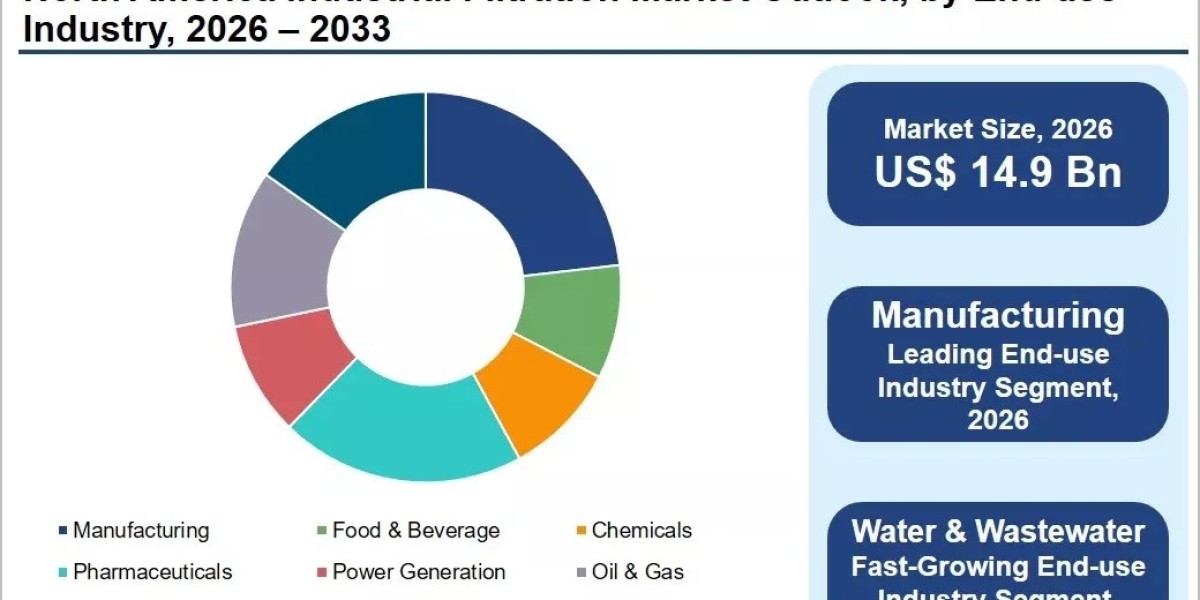


The North America industrial filtration market is witnessing steady expansion as manufacturing facilities, energy producers, chemical processors, and water treatment operators invest in advanced filtration technologies. The market is expected to be valued at US$14.9 billion in 2026 and projected to reach US$22.0 billion by 2033, expanding at a CAGR of 5.7% between 2026 and 2033. Increasing emphasis on environmental compliance, workplace safety, operational efficiency, and industrial wastewater management is encouraging the adoption of sophisticated air and liquid filtration systems across industrial facilities.
The United States is expected to remain the leading geographical market within North America, supported by its extensive industrial infrastructure, established manufacturing sector, and substantial investment in environmental protection technologies. Liquid filtration represents a major application segment because of its importance in industrial water treatment, chemical processing, and manufacturing operations, while air filtration continues gaining importance in facilities requiring effective dust and emission control. Growing demand for high-performance filter media, automated filtration equipment, and energy-efficient solutions is creating opportunities for manufacturers and technology providers.
Sample Link: https://www.persistencemarketresearch.com/samples/37528
Key Highlights from the Report
- The North America industrial filtration market is projected to reach US$22.0 billion by 2033, expanding at a CAGR of 5.7%.
- Increasing environmental regulations and industrial emission control requirements are supporting filtration equipment demand.
- Liquid filtration remains a significant application area due to industrial wastewater treatment and process purification requirements.
- The United States is expected to lead regional demand through its established manufacturing and industrial infrastructure.
- Advanced membrane filtration, cartridge filters, and automated filtration systems are gaining industrial adoption.
- Growing investment in sustainable manufacturing and water reuse technologies is creating long-term market opportunities.
Market Segmentation: Product Types, Applications, and End-Use Industries
The North America industrial filtration market is segmented by filtration type, product category, filter media, end-use industry, and country. Based on filtration type, the market includes air filtration and liquid filtration systems. Air filtration equipment removes dust, particulate matter, fumes, and airborne contaminants from industrial environments, while liquid filtration technologies support water purification, chemical separation, and process fluid management.
By product type, the market includes bag filters, cartridge filters, membrane filters, filter presses, electrostatic precipitators, and other specialized filtration equipment. Cartridge and bag filters are commonly used because of their adaptability and relatively straightforward maintenance. Membrane filtration technologies, including ultrafiltration and reverse osmosis, are particularly relevant where high-quality process water or advanced contaminant separation is required.
Based on end-use industry, the market covers chemicals and petrochemicals, food and beverages, pharmaceuticals, power generation, metals and mining, automotive manufacturing, and water treatment. Each industry requires filtration systems designed around specific operating conditions, contaminant characteristics, and performance standards.
Regional Insights: United States, Canada, and Mexico
The United States industrial filtration market is expected to account for a substantial portion of regional demand. Its large manufacturing base, extensive chemical processing operations, power generation infrastructure, and wastewater treatment requirements create opportunities for advanced filtration solutions. Industrial modernization and investment in semiconductor manufacturing, pharmaceuticals, and specialized chemicals further support demand for high-performance filtration equipment.
Canada represents an important market, particularly across oil and gas, mining, pulp and paper, food processing, and municipal-industrial water treatment applications. Environmental protection priorities and operational requirements encourage investment in filtration systems capable of handling challenging process conditions.
Mexico offers growth opportunities through expanding automotive production, electronics manufacturing, food processing, and industrial infrastructure development. Manufacturers seeking improved production quality and efficient resource utilization are increasingly considering modern filtration technologies. However, adoption rates depend on industrial investment, operating budgets, and local regulatory requirements.
Market Drivers: Environmental Compliance and Industrial Modernization
Environmental protection requirements are among the major factors supporting the North America industrial filtration market. Industrial facilities must manage air emissions, wastewater discharge, and process contaminants while meeting applicable environmental and workplace safety standards. These requirements encourage investment in reliable filtration equipment and regular replacement of filtration components.
Industrial modernization also supports market expansion. Manufacturing facilities increasingly require cleaner process fluids, controlled operating environments, and dependable equipment performance. Effective filtration can reduce equipment contamination, protect downstream machinery, and improve manufacturing consistency.
Water conservation is another important demand driver. Industrial operators are exploring wastewater recycling and process water reuse to reduce freshwater consumption and manage operating costs. Advanced filtration technologies play an essential role in these applications, particularly where water quality must meet demanding production requirements.
Market Restraints: Equipment Costs and Maintenance Requirements
High installation and operating costs remain important challenges for industrial filtration equipment suppliers. Advanced membrane systems, automated filtration units, and specialized filter media can require considerable capital expenditure. Smaller manufacturers may delay investments when expected operational savings do not justify immediate equipment replacement.
Maintenance requirements also influence purchasing decisions. Filter replacement, membrane fouling, pressure losses, cleaning procedures, and energy consumption contribute to total ownership costs. In demanding industrial applications, inappropriate equipment selection can result in frequent maintenance and reduced operating efficiency.
Additionally, differences in industrial processes and contaminant characteristics complicate filtration system design. Manufacturers often require customized solutions, technical assessments, and specialized maintenance support, increasing implementation complexity.
Market Opportunities: Smart Filtration and Sustainable Industrial Operations
Digital monitoring and automated filtration technologies are creating opportunities for equipment manufacturers. Connected sensors can track pressure differences, flow rates, and operating conditions, helping facility managers identify maintenance requirements and monitor filtration performance.
Predictive maintenance and automated cleaning systems may reduce unplanned downtime and improve equipment reliability. These capabilities are particularly valuable in continuous industrial operations where filtration interruptions can affect production schedules.
Sustainable industrial practices also present opportunities. Demand for water recycling, reduced waste generation, and energy-efficient filtration systems encourages innovation in membrane materials, reusable filter components, and optimized equipment designs.
The expansion of high-purity manufacturing applications, including semiconductor production, pharmaceutical processing, and specialty chemicals, could further strengthen demand for advanced filtration solutions.
Company Insights: Key Players in the North America Industrial Filtration Market
The competitive landscape includes multinational filtration technology providers and specialized manufacturers offering air filtration, liquid filtration, membrane separation, and industrial purification solutions.
- Donaldson Company, Inc.
- Parker Hannifin Corporation
- Pall Corporation
- 3M Company
- MANN+HUMMEL Group
- Camfil Group
- Eaton Corporation
- Pentair plc
- Filtration Group Corporation
- Ahlstrom Oyj
- Freudenberg Filtration Technologies
- Alfa Laval AB
- Nederman Holding AB
- CECO Environmental Corp.
- Graver Technologies
These companies compete through filtration efficiency, product reliability, technological capabilities, service networks, and industry-specific solutions. Product development, strategic acquisitions, and partnerships remain important approaches for strengthening market positioning.
Recent Developments in Industrial Filtration Technologies
Development 1: Expansion of High-Performance Filtration Solutions
Industrial filtration suppliers are increasingly emphasizing advanced filter media, membrane technologies, and application-specific filtration equipment. Innovation focuses on improving contaminant removal, extending filter service life, and reducing operating costs in demanding industrial environments.
Development 2: Growing Integration of Smart Monitoring Technologies
The industry is moving toward digitally monitored filtration systems incorporating connected sensors, automated controls, and performance analytics. These technologies support maintenance planning, improve operational visibility, and help industrial facilities optimize filtration performance.
Conclusion: Future Outlook of the North America Industrial Filtration Market
The North America industrial filtration market is positioned for sustained growth as manufacturers prioritize environmental compliance, operational efficiency, and sustainable resource management. With market revenue projected to increase from US$14.9 billion in 2026 to US$22.0 billion by 2033, opportunities are emerging across air purification, liquid filtration, industrial wastewater treatment, and advanced manufacturing applications.
The United States is expected to remain a major contributor to regional demand, while Canada and Mexico offer additional opportunities through industrial modernization and infrastructure investment. Although equipment costs and maintenance requirements present challenges, innovation in membrane technologies, connected filtration systems, and energy-efficient equipment will continue influencing market development. Companies delivering reliable, cost-effective, and application-specific filtration solutions are well positioned to benefit from the evolving industrial landscape.