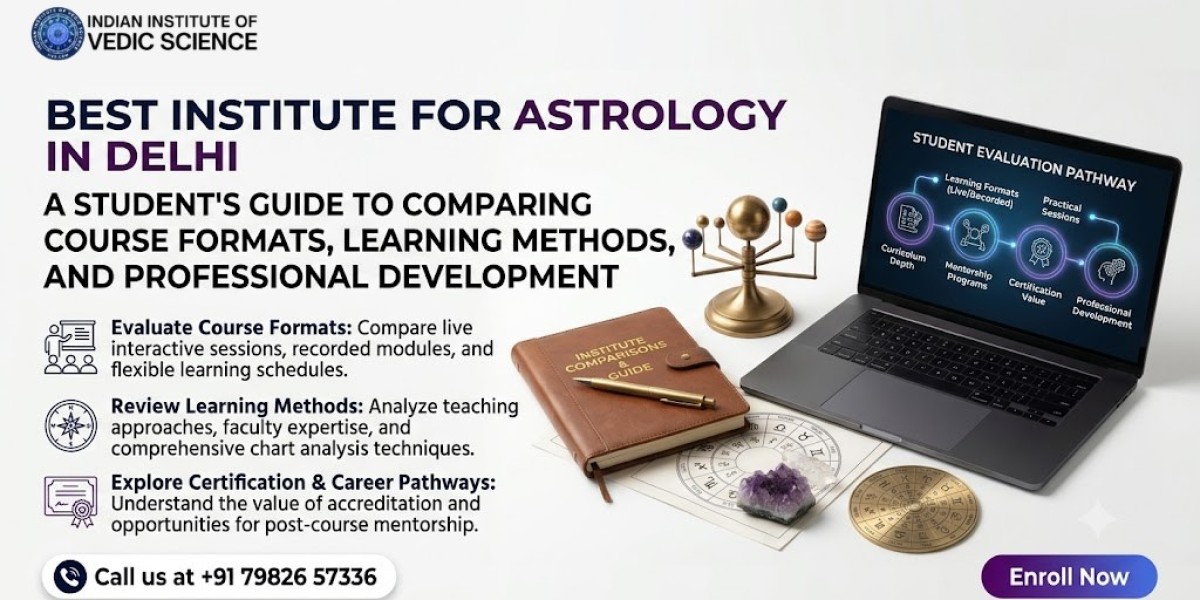


Best Institute for Astrology in Delhi: A Student’s Guide to Comparing Course Formats, Learning Methods, Certification and Professional Development
Choosing the right astrology institute is an important step for anyone who wants to study traditional Jyotish, understand birth charts, and develop a structured approach to astrological interpretation. With several learning options available, students may find it difficult to compare course formats, teaching methods, syllabus coverage, certification, and opportunities for further development.
Searching for the best institute for astrology in Delhi should involve more than comparing advertisements or selecting the first institute that appears in search results. A suitable learning programme should match your experience level, learning goals, available time, and expectations from astrology education. It should also explain what you will study, how practical learning will take place, and what support will be available when you encounter difficult concepts.
Students exploring an astrology course in Delhi may consider classroom-based learning, live online classes, recorded lessons, or a blended format. Each option has different advantages, and the best choice depends on how you learn most effectively. Some students prefer direct interaction with instructors, while others need the flexibility to study alongside employment, business, or family responsibilities.
The Indian Institute of Vedic Science (IIVS) offers a learning environment for people interested in Vedic sciences and related subjects. Before choosing any programme, students should review the available course details, curriculum, teaching format, faculty guidance, certification terms, and admission information.
This guide explains how to compare astrology institutes and make an informed decision based on educational value rather than promotional claims alone.
1. Define Your Learning Goals Before Selecting an Institute
Before comparing institutions, identify why you want to learn astrology. Your objective will influence the course level, syllabus, duration, and type of practical guidance you need.
Some learners want to understand their own birth charts and become familiar with traditional astrological concepts. Others want to study systematically, interpret charts with greater confidence, or explore whether astrology could become part of their professional development.
If you are a beginner, look for a programme that introduces fundamental concepts gradually. A structured Vedic astrology course should explain foundational terminology before expecting students to interpret complex charts independently.
Your learning goals might include:
Understanding the basic principles of Jyotish and its traditional terminology.
Learning about zodiac signs, planets, houses, and their relationships.
Understanding how birth charts are constructed and organised.
Exploring planetary placements, aspects, and chart combinations.
Practising a structured method of chart interpretation.
Developing the ability to explain interpretations clearly and responsibly.
Building a foundation for further study and continued practice.
Students who already understand the basics may need a more advanced curriculum with detailed case discussions and opportunities to practise interpretation.
When evaluating the best astrology institute in India, avoid assuming that one institution will suit every learner. Instead, compare its teaching approach with your current knowledge, personal objectives, and preferred learning style.
2. Compare Classroom, Online, and Blended Course Formats
Course format can significantly influence your learning experience. Before enrolling, confirm whether the institute offers the specific format you need and whether the advertised programme is currently available.
Classroom-based learning
In-person learning can be helpful for students who prefer a structured timetable, direct interaction, and immediate clarification of questions. Classroom discussions may also make it easier to participate in group exercises and receive feedback during practical sessions.
However, classroom learning requires you to consider commuting time, travel costs, location, and schedule compatibility. Students travelling from outside Delhi should also calculate accommodation and other expenses where relevant.
If you live nearby and benefit from face-to-face interaction, compare the location, class timings, batch size, and practical teaching arrangements before making a decision.
Live online learning
Astrology classes online can provide flexibility for students who cannot regularly travel to an institute. Live sessions may allow learners to interact with instructors, ask questions, and participate in discussions from different locations.
Before choosing an online programme, check whether sessions are interactive, how attendance works, whether study materials are provided, and what happens if you miss a class.
Ask whether practical exercises are included and whether the instructor reviews student work. A live video session is more useful when it supports active learning rather than relying entirely on one-way lectures.
Recorded courses
Recorded lessons can be useful for learners who need flexible study hours or want to revisit complicated topics. Students can pause lessons, take notes, and review specific concepts before moving forward.
However, recorded content may provide limited opportunities for immediate clarification unless the course includes instructor support, discussion sessions, or scheduled assessments.
Blended learning
A blended programme combines elements of live instruction, independent study, and practical exercises. It may suit learners who want flexibility without losing opportunities for interaction.
When comparing online astrology courses, evaluate the actual learning experience rather than assuming that online or classroom delivery is automatically superior.
The most suitable format is the one that gives you access to clear instruction, consistent practice, relevant feedback, and a manageable study routine.
3. Examine the Syllabus and Its Learning Sequence
A well-organised syllabus helps students understand what they will learn and how each topic connects to the next. Do not select an institute based solely on the number of topics listed in its course description.
A long syllabus is not necessarily better if students do not receive enough time to understand and practise the material. Likewise, a shorter programme may be useful for introductory learning but may not provide the depth required for advanced interpretation.
When reviewing an astrology syllabus, look for clearly defined learning stages.
Foundational concepts
Beginners should understand the terminology and basic structure of the astrological system being taught. In a Jyotish-focused programme, this may include the twelve zodiac signs, nine commonly discussed grahas, twelve houses, the ascendant, and the structure of a birth chart.
The instructor should explain the role of each concept and demonstrate how these elements relate to one another.
Planetary and house interpretation
Students should learn how planetary placements and house meanings are traditionally interpreted. They should also understand that individual factors are generally considered in relation to the wider chart rather than treated as isolated predictions.
A useful curriculum explains the reasoning behind an interpretation and encourages students to examine different chart factors systematically.
Chart-reading practice
Practical work is important because memorising definitions does not automatically develop interpretation skills. Students should have opportunities to apply concepts to sample charts and explain how they reached their conclusions.
Ask whether the course includes guided exercises, worked examples, case discussions, or assignments.
Advanced topics
Depending on the course, advanced learning may include planetary periods, divisional charts, aspects, yogas, timing techniques, or other traditional methods. The syllabus should identify which topics are covered and the depth expected from students.
If you are evaluating an astrology certification course, check whether the programme includes assessments and practical work or focuses primarily on theoretical lectures.
A transparent syllabus makes it easier to compare programmes fairly and determine whether the learning outcomes match your expectations.
4. Evaluate the Teaching Method, Not Just the Topic List
Two institutes may teach similar subjects but deliver very different learning experiences. Teaching quality depends on how clearly concepts are explained, how lessons are organised, and whether students receive opportunities to apply what they learn.
A useful learning method should move beyond memorisation.
For example, an instructor might first explain the traditional meaning of a house, then introduce a sample chart, identify the relevant planetary placements, and demonstrate how different factors are considered together. Students can subsequently complete a similar exercise and discuss their reasoning.
This process helps learners understand the method behind an interpretation instead of simply copying a conclusion.
When comparing teaching methods, consider the following:
Are complex concepts explained using clear examples?
Does the instructor connect foundational concepts with advanced topics?
Are students encouraged to ask questions?
Are practical exercises included throughout the programme?
Is feedback available on assignments or chart interpretations?
Can students revisit lessons or learning materials when necessary?
Are assessments used to identify gaps in understanding?
Students who want to learn astrology online should pay particular attention to the interaction available outside scheduled lessons. Ask whether doubts can be discussed during sessions, through a designated support channel, or in additional mentoring sessions.
The goal is to select an educational environment that supports progressive learning, not simply access to a large collection of lessons.
5. Understand the Role of Practical Birth Chart Interpretation
Birth chart interpretation is an important part of many astrology learning programmes. It requires students to bring together concepts learned in separate lessons and apply them within a consistent framework.
A useful course should explain how to approach a chart step by step. Students should understand the chart structure, identify relevant placements, examine relationships between different factors, and develop an interpretation supported by the method being taught.
Practice should be progressive. Beginners may start with identifying signs, houses, and planetary positions before moving towards more complex examples.
As their understanding develops, they can practise explaining how multiple chart factors are traditionally interpreted together. Instructors can use these exercises to highlight common mistakes, clarify terminology, and demonstrate alternative interpretations.
When comparing institutes, ask whether students receive opportunities to:
Work with sample birth charts.
Follow a repeatable interpretation process.
Explain the reasoning behind their conclusions.
Review examples with instructor guidance.
Receive constructive feedback on practical assignments.
Recognise the limitations of interpreting individual placements in isolation.
Responsible teaching should also distinguish traditional astrological interpretation from scientifically established evidence. Astrology is a traditional belief and interpretive system, and its predictive claims should not be presented as scientifically guaranteed outcomes.
A strong learning experience encourages students to understand the tradition, practise carefully, and communicate interpretations without promising certainty about health, finances, relationships, or other important life outcomes.
6. Review Faculty Experience and Mentorship Availability
Faculty guidance can make a meaningful difference, particularly when students begin applying theoretical concepts to unfamiliar charts.
When evaluating an astrology institute in Delhi, review the publicly available information about instructors, their teaching experience, areas of specialisation, and approach to student learning.
Relevant questions include whether instructors have experience teaching beginners, whether they explain concepts systematically, and whether they can demonstrate the methods included in the syllabus.
Mentorship is another consideration. Some programmes offer scheduled doubt-clearing sessions, feedback on assignments, guided practice, or additional discussions. Others may provide only standard classroom instruction.
Neither arrangement should be assumed without checking the course details.
Before enrolling, clarify:
Who will teach the programme?
How can students ask questions?
Is individual feedback available?
Are additional mentoring sessions included or charged separately?
Can students access support after completing the course?
Are the advertised faculty members responsible for teaching the actual batch?
Do not rely entirely on testimonials or promotional descriptions. A direct conversation with the admissions team can help you understand the learning process and determine whether the available guidance matches your needs.
7. Compare Certification and Course Completion Requirements
Certification is often an important factor for students comparing astrology programmes. However, the value of a certificate depends on what it represents, how it is awarded, and whether the issuing institution's claims are transparent.
A certificate of completion generally indicates that a learner has completed a programme under the issuer's stated conditions. It should not automatically be interpreted as a government licence, statutory professional registration, university degree, or independently recognised qualification.
Before enrolling in an astrology certification course, ask the institution to explain the certificate's status and requirements.
Check whether students must attend a minimum number of sessions, complete assignments, pass an assessment, submit practical work, or meet other course-completion criteria.
You should also confirm the exact name of the issuing organisation and whether any external recognition or affiliation is claimed. If recognition is important to you, verify it directly with the relevant awarding body rather than relying only on advertising.
Consider these questions:
Is certification included in the course fee?
What conditions must students satisfy to receive the certificate?
Is there a written or practical assessment?
Is the certificate issued by the institute or another organisation?
Are any additional examination or certification charges applicable?
What does the certificate actually qualify the student to claim?
A certificate may document your learning, but it does not by itself guarantee employment, clients, income, or professional success. Practical knowledge, communication skills, ethical conduct, and continued learning remain important.
8. Check Course Duration, Fees, and Additional Costs
Course fees should be evaluated alongside the learning experience, not in isolation. A lower price may be attractive, but students should still examine the syllabus, instructor access, study materials, practical work, and support included.
Similarly, a higher fee does not automatically mean a programme provides better education.
When comparing an astrologer course fees structure or a course quotation, request a clear breakdown of the total amount payable. Confirm whether taxes, study materials, assessments, certificates, additional workshops, or mentoring sessions are included.
The duration also matters. A programme that covers many advanced subjects within a short period may require substantial independent study. Ask how many live teaching hours are included, how frequently classes take place, and whether revision time is available.
For budgeting, students may encounter astrology programmes across a broad range of prices. An indicative planning range of ₹45,000–₹60,000 may be useful for some course comparisons, but it is not a verified or universal fee for every astrology institute or IIVS programme. Confirm current fees, available batches, and payment terms directly with the institute.
Before paying, obtain written information about the course format, schedule, fee inclusions, cancellation policy, and refund conditions.
A transparent fee structure helps you compare educational value and avoid unexpected expenses.
9. Explore Specialisations Without Losing Your Foundation
Astrology education includes several approaches and specialised traditions. Students may come across Vedic astrology, KP astrology, Lal Kitab, and other systems while researching courses.
Each approach may use its own concepts, interpretive methods, and learning sequence. Beginners should understand the foundational framework of a programme before attempting to study several systems simultaneously.
A KP astrology course may interest learners who want to explore Krishnamurti Paddhati and its distinctive approach to chart analysis. A Lal Kitab astrology course may appeal to students interested in the concepts and interpretive traditions associated with Lal Kitab.
These subjects should not be treated as interchangeable simply because they fall under the broader category of astrology.
When choosing a specialisation, examine the instructor's expertise, the syllabus, the amount of practical work, and the relationship between the course and your existing knowledge.
If you are new to the subject, a structured foundational programme may be a sensible starting point. You can then decide whether further specialised training aligns with your interests.
10. Assess Career Preparation and Professional Development
Some students study astrology out of personal interest, while others hope to develop their knowledge for a future professional activity. If professional development is one of your objectives, evaluate whether the course helps you build practical skills beyond theoretical understanding.
Relevant skills may include clear communication, structured interpretation, accurate record-keeping, client confidentiality, ethical boundaries, and the ability to explain uncertainty.
A programme may also discuss how practitioners organise consultations, manage expectations, and communicate the scope of their services. These topics can be useful, but their inclusion should be confirmed rather than assumed.
Before enrolling, ask whether professional development is included in the curriculum or whether it is outside the programme's scope.
You should also understand that completing an astrology course does not guarantee employment, a particular income, or a successful independent practice. Results depend on multiple factors, including skill development, experience, local requirements, and the learner's own efforts.
Students interested in professional practice should avoid making unsupported claims or presenting astrological interpretations as substitutes for qualified medical, legal, financial, or mental-health advice.
The purpose of education is to build knowledge and responsible communication, not to promise a specific career outcome.
11. Consider Student Support, Learning Materials, and Accessibility
Learning does not end when a class finishes. Access to organised notes, practice material, revision resources, and clear communication channels can help students consolidate what they have learned.
Before selecting an institute, ask what learning resources are included and how long you can access them. Find out whether lesson recordings are available, if applicable, and whether their access period is limited.
Students attending online classes should also consider the platform, internet requirements, device compatibility, and procedures for dealing with missed sessions.
For classroom programmes, check the venue, class timings, attendance expectations, and whether learning resources are supplied digitally or in print.
If you have a busy schedule, a programme with a clearly communicated timetable and realistic independent-study expectations may be more suitable than one that requires frequent attendance you cannot maintain.
Review the support process before admission. Knowing how to contact the institute, request clarification, and resolve administrative issues can make the learning experience more manageable.
12. Research the Institute's Reputation and Claims Carefully
Online reviews, student feedback, and course descriptions can help you understand an institution, but they should be evaluated thoughtfully.
Look for feedback that explains specific aspects of the learning experience, such as teaching clarity, syllabus organisation, practical exercises, administrative communication, and access to course materials.
Be cautious about testimonials that make extraordinary promises about guaranteed income, certain predictions, instant expertise, or assured professional outcomes.
Also examine whether the institute provides clear information about its courses, faculty, fees, contact channels, and policies. A transparent institution should be able to explain what it offers without requiring prospective students to rely entirely on promotional claims.
When comparing the best astrology institute in Delhi, use consistent criteria across all shortlisted options. Review the same categories for each institute so that your decision is based on comparable information.
You can also request a counselling conversation or course overview before making a financial commitment. Use that opportunity to ask specific questions about your goals, experience level, preferred format, and expected learning outcomes.
13. Why Consider the Indian Institute of Vedic Science?
The Indian Institute of Vedic Science (IIVS) is an option for learners exploring astrology and other Vedic-science subjects. Prospective students can review its course information to understand which programmes align with their interests and learning requirements.
When speaking with the admissions team, explain whether you are a beginner or already have some astrology knowledge. Ask which programme is appropriate for your current level and what learning activities are included.
You should also clarify whether the course provides live classes, recorded material, assignments, mentoring, or post-course support. The availability of these features can vary by programme, so confirm them for the specific course you are considering.
Rather than choosing an institute only because of its name or a promotional claim, compare the actual educational details against your priorities.
The right decision should be based on a clear understanding of the course, the learning method, and the support you will receive.
14. A Practical Checklist Before You Enrol
Before finalising your decision, use the following checklist to compare shortlisted astrology programmes.
Course and curriculum
Does the syllabus match my current knowledge and learning goals?
Are the foundational concepts explained before advanced topics?
Is practical chart interpretation included?
Are the learning outcomes clearly described?
Format and teaching
Is the programme available in a suitable format?
Are the timetable and attendance expectations manageable?
Can I ask questions and receive feedback?
Are the learning materials and recordings clearly explained?
Faculty and support
Are instructor details available?
Is the teaching approach appropriate for beginners or advanced learners?
What mentoring or doubt-clearing support is included?
How can I contact the institute for assistance?
Certification and fees
What does the certificate represent?
What are the course-completion requirements?
What is the total fee, including any additional charges?
Are the payment, cancellation, and refund policies documented?
Professional development
Does the programme match my intended use of the knowledge?
Are ethical communication and practical skills discussed?
Are claims about career outcomes realistic and transparent?
Do I understand what the course can and cannot provide?
This checklist helps you compare institutions based on evidence and educational suitability rather than making a decision based on price, location, or advertising alone.
Finding the best institute for astrology in Delhi requires a careful comparison of course formats, syllabus depth, teaching methods, practical chart interpretation, certification, and ongoing learning support. The right programme should help you build understanding step by step, practise what you learn, and recognise the limits of your knowledge.
Avoid choosing solely on the basis of promotional claims, certificate labels, or the lowest advertised price. Instead, ask clear questions, compare written course details, and select an institute whose educational approach matches your goals and schedule.
If you are exploring astrology education, the Indian Institute of Vedic Science can be one of the options to evaluate. Review its available courses, discuss your requirements with the admissions team, and confirm the latest programme details before enrolling. Or Book your free counselling.
Frequently Asked Questions
How do I choose the best institute for astrology in Delhi?
Compare the syllabus, course format, instructor experience, practical exercises, student support, certification requirements, and total fees. Choose a programme that matches your learning goals and provides transparent information about its teaching methods and outcomes.
Can beginners enrol in an astrology course?
Many programmes are designed for beginners, although prerequisites vary. Before enrolling, confirm whether the course starts with foundational concepts or expects previous knowledge of astrology.
Are online astrology classes suitable for working professionals?
They can be suitable when the schedule, teaching format, and support arrangements fit your routine. Check whether sessions are live or recorded, how attendance works, and whether you can receive feedback on practical exercises.
What should an astrology certification course include?
The curriculum should clearly state the topics taught, expected learning outcomes, and any assignments or assessments. Students should also verify the certificate's issuer, status, and completion requirements.
Does completing an astrology course guarantee a professional career?
No. Completing a course does not guarantee employment, clients, or income. Professional development depends on the knowledge acquired, continued practice, communication skills, ethical conduct, and other individual and market factors.







