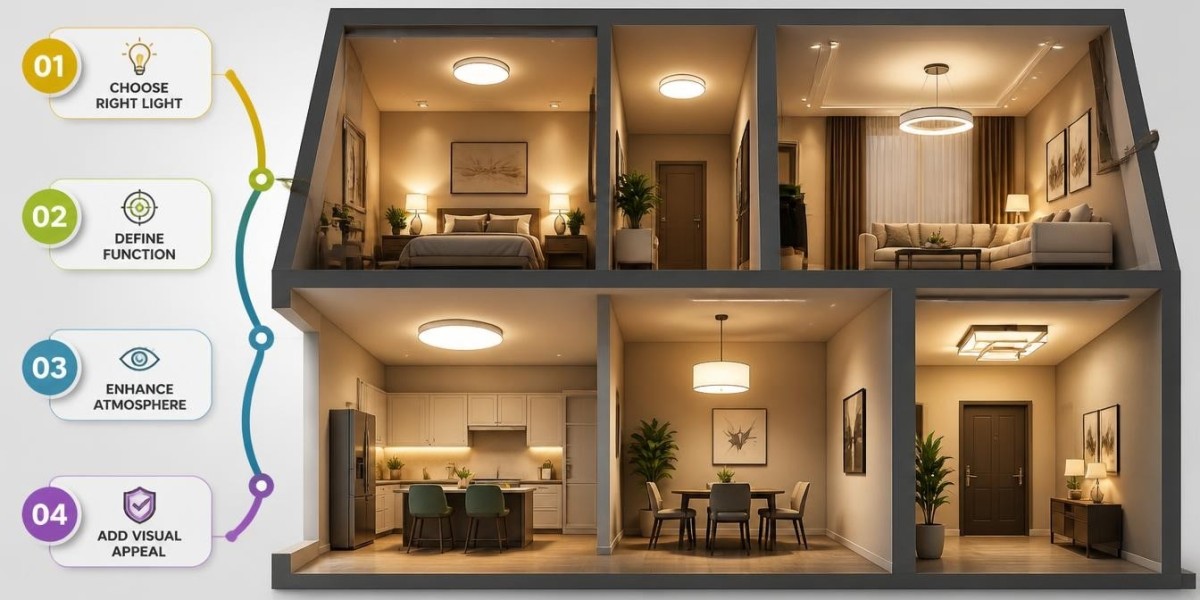


Most people think about a ceiling light in terms of aesthetics. They go to the store and buy the nicest-looking light they can find that fits their interior decor, only to come home to discover that their new purchase dictates the mood of their home on a daily basis. It determines if their living room is cozy or ominous, their kitchens are streamlined and efficient or intimidating and shadowy, and the overall tone of the color of the rest of their decor will be intensified or dulled. Residential ceiling lights have the capability to do a lot more than simply illuminate your home. They determine how a person will experience their surroundings.
This blog shows how ceiling lights can influence a room in these ways and provides some basic guidance on selecting the ideal fixture for your needs.
How Do Residential Ceiling Lights Change The Feel Of A Room?
They change the mood of a room by the color, brightness, and distribution of light. Warm yellow lights can create a feeling of coziness and comfort in a room. A cool white light will make it feel more energetic. A concentrated point of light can create a hard mood in the room, while the glow of many points will create a more comfortable one.
Good residential ceiling lighting should provide multiple sources, since one may not suffice for all activities. For example, a bedroom may only need some subtle lighting, but the hallway may demand more since one may need to see where they are going, especially on the stairs. The kitchen will always need more since it is the place where one cuts and prepares most food. Different home areas may demand different levels of illumination.
What Does Color Temperature Do To A Room's Mood?
The color temperature, measured in Kelvins, determines the color of the white light, warm or cold. Warm colors, according to the U.S. Department of Energy, are 2,700K and 3,000K, and they create a cheerful room, while the 3,000K color sets an atmosphere of coziness at home and in an office.
Color Temperature | How It Feels | Common Use |
2,700K | Friendly and personal | Homes, libraries, restaurants |
3,000K | Warm and pleasing | Homes, lobbies, restaurants |
The same source indicates that such products need to possess a rating of 80 or higher on color rendering index (CRI). This indicator characterizes the ability of the bulbs to reproduce colors, which means that the higher the value, the better. It also becomes clear from a number of facts given above that the quality of lighting directly affects home atmosphere. Thus, with the wrong choice of equipment, it becomes possible to spoil a good mood that can be created by a precisely chosen set of lights and to make the room unnecessarily dark.
How Do Ceiling Lights Help People Use A Room?
They are efficient if they create sufficient illumination in the well-placed spot. The interior functionality is presented through the possibility to perform everyday tasks such as cooking, reading, studying, walking, etc. Having a light source in the center of the room is not an option because it will cast dark areas and shadows. Instead, two or more light sources, such as table and ceiling lamps, would provide the best functionality and be distributed evenly in the room.
Many designers use three layers of light. The first layer consists of general light coming from the ceiling. The second level should be created using task light such as under-cabinet or reading lamps. The third level of lights includes accent lights that are used to highlight selected items such as artwork or detail a wall. The main or ceiling light is the cornerstone in this plan, so residential ceiling lights should be selected first.
In the CSI MasterFormat system, the interior lighting systems are identified as Division 26, section 26 51 00. This section indicates that the lighting systems are part of the house’s electrical plan, and thus, they should be prioritized during the design stage rather than being added at the end of the project.
Are Most Homes Already Using LED Lights?
The number of them is increasing, and the U.S. Energy Information Administration (EIA) tracks the progress in the Residential Energy Consumption Survey. According to the report, only 4 percent of homes were lit primarily by LED light bulbs in 2015, 63 percent in 2024, and 71 percent for houses built in 2020-2024.
This explains why LED ceiling fixtures are becoming a popular choice for new houses and why the majority of ceiling lights sold incorporate LED bulbs. They consume significantly less electricity, last considerably longer, and emit less heat than traditional bulbs. This is especially important in rooms with low ceilings since any heat generated by the fixture will be contained within the room. When buying a fixture, it is important to look at the lumens (brightness), Kelvin (color temperature), and CRI (color rendering).
What Goes Wrong When Only One Light Is Used?
Here is an example. The house had a family room with one big ceiling light in the middle. It was bright, but it was also quite hard on the eyes. The corners were dark, the TV glared, and it was too bright to read on the sofa in the evening.
The designer kept the ceiling light but replaced the bulbs with a 2700K warm white color temperature, dimmed by the dimmer. She also added two floor lamps close to where they were and created a more functional room for reading and watching TV at night. It took little effort or money to adjust the room, and there was no need to run new wiring. The point was that one light source is never enough.
How Do You Choose The Right Ceiling Light?
You choose it by starting with a room and a job, and not the fixture. The following steps will help:
Consider your room's purpose (used for cooking, studying, or sleeping).
Take the measurements of the room and ceiling.
Pick a color temperature based on the room's purpose.
Use 2,700K bulbs in the bedroom and 3,000K ones in the kitchen.
Go with a dimmable option so that you can customize the light intensity.
According to the standard lighting design guideline, small decorative pendants should be placed at half the ceiling height apart from each other. So, for example, in an 8-foot ceiling, small lights should be placed four feet apart. This is only a guideline, but it gives us a good place to begin.
CIRC Lighting can show you the options in a 3D rendering before the installation commences. The client will thus be able to see:
What lighting spread the room will have
How the light will fall on the walls
How warm or cold it will feel
Conclusion
Residential ceiling lights set the mood, provide the functionality, and dictate the appearance of the space. Every aspect is vital, and nothing should be overlooked. The lighting’s color temperature or quality, placement, and number are vital and should not be overlooked. A correctly designed room will always have numerous lighting sources. The designer should be able to determine the most comfortable lumen, Kelvin, and CRI for the room and develop an appropriate scheme based on this information. CIRC Lighting allows owners to experiment with different options in 3D before making a final decision.







