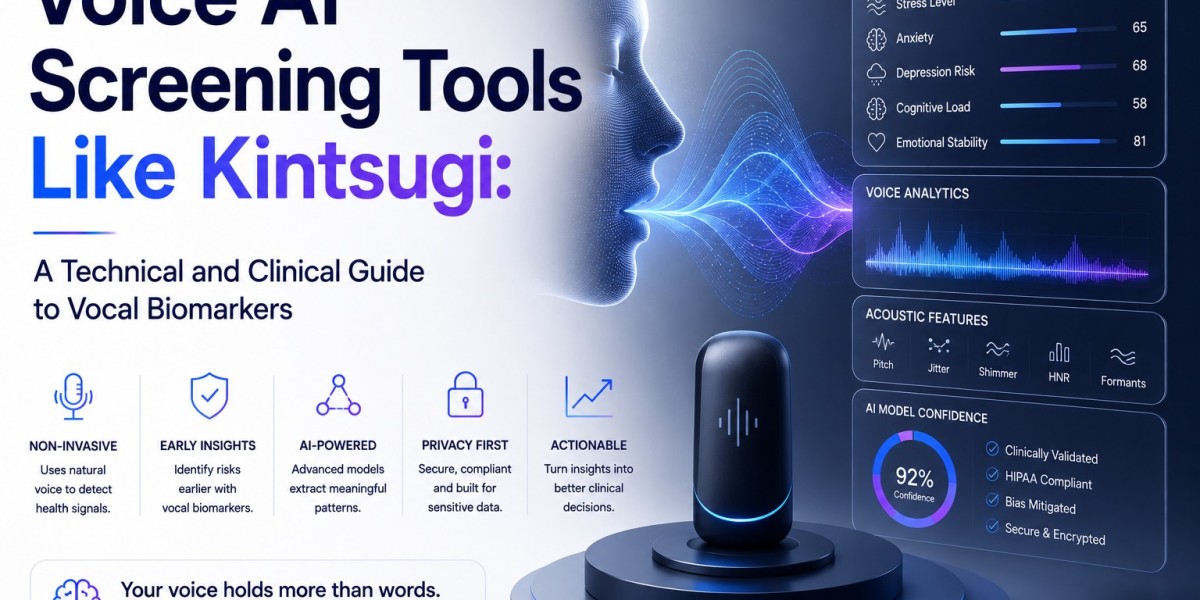


The global healthcare landscape is witnessing a profound shift in how behavioral health conditions are identified and triaged. Traditional mental health assessment relies predominantly on subjective self-reporting instruments—such as the Patient Health Questionnaire (PHQ-9) for depression and the Generalized Anxiety Disorder assessment (GAD-7) for anxiety. While these tools remain standard clinical benchmarks, they are frequently limited by low compliance rates, recall bias, patient hesitation, and the structural shortage of routine mental health screenings during primary care visits.
To address these systemic bottlenecks, digital health engineers and clinical researchers are leveraging vocal biomarkers powered by artificial intelligence. Pioneered by platforms such as Kintsugi Voice, voice AI screening tools analyze raw acoustic signals from short segments of natural speech to detect micro-fluctuations associated with depression and anxiety.
Crucially, these systems operate on non-contextual speech processing. Rather than transcribing or analyzing what a patient says (the linguistic and semantic content), they evaluate how a patient speaks (the acoustic, prosodic, and vocal tract mechanics). This makes vocal biomarker analysis inherently language-agnostic, minimally invasive, and highly resilient against privacy concerns related to personal speech content.
This technical guide explores the underlying biomechanics, acoustic feature processing pipelines, machine learning model architectures, clinical validation criteria, data privacy protocols, and systemic challenges involved in building an enterprise-grade voice AI screening tool.
The Biomechanics of Vocal Biomarkers in Behavioral Health
Human speech production is a complex physiological process requiring fine motor coordination across the central nervous system, respiratory system, larynx, and vocal tract articulation muscles. Neuropsychiatric conditions like clinical depression and anxiety disorders induce measurable physiological alterations in these systems.
1. Neurological and Muscle Alterations
Depression is frequently accompanied by psychomotor slowing and decreased muscle tone (hypotonia) throughout the laryngeal and pharyngeal anatomy. This psychomotor impairment alters the tension of the vocal folds, leading to a reduced range of pitch dynamics, monopitch phrasing, and speech monotonicity.
2. Autonomic Nervous System Dysregulation
Anxiety disorders trigger autonomic nervous system (ANS) hyperarousal, stimulating sympathetic fight-or-flight pathways. This hyperarousal alters subglottal air pressure, increases vocal fold rigidity, causes micro-tremors in laryngeal control, and leads to elevated respiration rates during speech production.
3. Key Acoustic Parameters
Machine learning models capture these subtle neuro-physiological shifts by extracting specific acoustic metrics from the digital audio waveform:
Fundamental Frequency ($F_0$): The primary pitch of the vocal fold vibrations. Reductions in the mean and variance of $F_0$ over time correlate with emotional blunting and depressive affect.
Jitter (Frequency Perturbation): Measures cycle-to-cycle variations in the fundamental frequency:
$$\text{Jitter (Absolute)} = \frac{1}{N-1} \sum_{i=1}^{N-1} \vert{}T_i - T_{i+1}\vert{}$$Where $T_i$ represents the fundamental pitch period length of the $i$-th cycle, and $N$ is the total number of extracted pitch periods. High jitter values reflect irregular vocal fold vibration caused by neuromuscular stress or fatigue.
Shimmer (Amplitude Perturbation): Measures cycle-to-cycle variations in the peak amplitude of the sound wave. Similar to jitter, elevated shimmer indicates glottal instability and vocal tension.
Harmonics-to-Noise Ratio (HNR): Quantifies the ratio between periodic harmonic sound energy (vocal fold closure) and non-periodic noise energy (breathiness or air turbulence). Lower HNR values often reflect breathy, incomplete vocal fold closure common in severe fatigue or depressive states.
Mel-Frequency Cepstral Coefficients (MFCCs): Representations of the short-term power spectrum of a sound, mapping continuous frequencies onto a non-linear Mel scale that mimics human auditory perception:
$$m = 2595 \cdot \log_{10}\left(1 + \frac{f}{700}ight)$$MFCCs capture spectral envelope features that define vocal timbre, formant resonance frequencies, and structural changes in the vocal tract.
Temporal Prosody Features: Quantifiable speech rhythms, including pause-to-speech ratios, average response latency, articulation velocity, and syllable duration distributions. Extended pause durations and reduced articulation rates are hallmark indicators of psychomotor retardation.
Technical System Architecture of a Voice AI Screening Engine
Building a production-ready voice AI screening tool requires a high-throughput, low-latency microservices architecture capable of ingesting raw audio, stripping noise, extracting acoustic features, running model inferences, and pushing risk scores to clinical dashboards in near real-time.
Raw Audio Input ──► Noise Preprocessing ──► Feature Extraction Engine ──► Acoustic ML Inference ──► EHR Integration1. Ingestion and Signal Preprocessing
The ingestion pipeline captures free-form spoken audio (typically 20 to 30 seconds of speech) via web platforms, native mobile applications, or telecommunication gateways. Audio is formatted into standardized single-channel PCM or WAV containers at a sampling rate of 16 kHz or 44.1 kHz.
Preprocessing requires three crucial cleaning stages:
Acoustic Filtering & Denoising: Applying high-pass filters to remove low-frequency mechanical hums (e.g., HVAC units) and adaptive spectral subtraction to suppress ambient room noise.
Voice Activity Detection (VAD): Removing non-speech intervals (coughing, background clicks, extended dead air) using energy-thresholding or neural VAD algorithms to ensure the downstream pipeline processes only true speech segments.
Diarization: Isolating the target speaker’s audio track from multi-speaker conversations (such as a doctor-patient dialogue or a call-center exchange) to ensure external voices do not contaminate the feature set.
2. Feature Extraction Engine
Once the cleaned speech waveform $x[n]$ is isolated, it is windowed into short frames (typically 25 ms frames with a 10 ms step overlap) using a Hamming window function $w[n]$. The Short-Time Fourier Transform (STFT) transforms the time-domain signal into the time-frequency domain:
From this spectrogram, the extraction engine calculates low-level acoustic descriptors (LLDs) across time-series windows. To ensure absolute content-agnostic processing, the pipeline discards speech-to-text components completely, ensuring no transcriptions or semantic tokens are generated or retained.
3. Machine Learning Inference Pipeline
The acoustic feature representation is passed to a specialized deep learning network trained to identify non-linear relationships between vocal feature vectors and clinical severity scales.
Modern architectures utilize one of two core strategies:
Hybrid Feature-Based Deep Learning: Combines hand-engineered acoustic parameters ($F_0$, jitter, shimmer, MFCCs) with Convolutional Neural Networks (CNNs) and Long Short-Term Memory (LSTM) networks or Recurrent Neural Networks (RNNs) to capture temporal transitions in speech prosody.
End-to-End Self-Supervised Models: Models based on fine-tuned speech transformers (such as Wav2Vec 2.0 or Kolmogorov-Arnold Networks) process normalized raw audio waveforms directly, learning latent representations of acoustic biomarkers without manual feature engineering.
The network outputs a continuous output probability score that is converted into severity tiers (e.g., Minimal, Mild, Moderate, Severe) mapped directly to standard PHQ-8 or GAD-7 assessment ranges.
4. API and EHR Integration Layer
To deliver immediate clinical utility, screening systems use RESTful APIs or asynchronous WebSockets to push inference results to healthcare providers. Integration pipelines leverage Fast Healthcare Interoperability Resources (FHIR) and HL7 messaging standards to push objective screening metrics into Electronic Health Records (EHR) platforms like Epic, Cerner, or Athenahealth.
Clinical Validation, Bias Mitigation, and Dataset Requirements
Developing a clinically viable voice AI tool requires moving beyond synthetic lab environments to train models on expansive, multi-demographic real-world data.
Clinical Reality: An AI screening tool is not a diagnostic instrument. It functions as a decision-support and triage mechanism—flagging elevated risk factors to prompt a comprehensive evaluation by a licensed healthcare professional.
1. Training Dataset Scale and Annotations
Machine learning models require tens of thousands of annotated speech samples collected from diverse patient populations. Annotations must be anchored to standardized clinical metrics—such as structured clinical interviews (SCID) conducted by psychiatrists or validated self-report scales (PHQ-8/GAD-7) taken at the exact time of voice recording.
2. Mitigating Algorithmic Bias
Speech characteristics vary dramatically across age groups, biological sexes, regional accents, dialects, and socio-economic backgrounds. If an algorithm is trained primarily on a non-representative demographic, its predictive accuracy degrades sharply when applied to underrepresented groups.
To achieve responsible AI standards, engineers must implement:
Demographic Balancing: Ensuring equal representation across age, gender, ethnicity, and dialectal profiles in training sets.
Acoustic Confounding Control: Separating genuine psychological signals from physical health conditions that alter voice quality (such as upper respiratory infections, asthma, or neurodegenerative conditions like Parkinson’s disease).
Cross-Environment Validation: Testing models across different recording hardware (e.g., high-end studio microphones vs. budget smartphone microphones vs. compressed landline telephone audio) to guarantee consistent performance regardless of hardware capture quality.
3. Performance Metrics
In clinical literature, models are evaluated using Unweighted Average Recall (UAR), Sensitivity (true positive rate), Specificity (true negative rate), and Receiver Operating Characteristic Area Under the Curve (ROC-AUC). High-performing production models generally achieve sensitivity and specificity metrics exceeding 70–75% for detecting moderate-to-severe depressive indicators, significantly outperforming traditional unprompted primary care detection rates.
Security, Privacy, and Regulatory Compliance Frameworks
Because voice data can be classified as both Protected Health Information (PHI) and a biometric identifier under various international legal frameworks, strict security controls must be architected into every layer of the system.
1. Compliance Requirements
HIPAA / HITECH (United States): Requires end-to-end encryption for voice data in transit (TLS 1.3) and at rest (AES-256). Business Associate Agreements (BAAs) must be established across all cloud hosting providers.
GDPR (European Union): Article 9 explicitly classifies biometric data processed for unique identification or health evaluation as special category data, requiring explicit, revocable patient consent and complete data erasure mechanisms ("Right to be Forgotten").
2. De-Identification by Design
The most secure architecture processes audio statelessly. Once the acoustic feature matrix is extracted in volatile memory, the raw audio file is immediately deleted. Because the remaining feature vectors ($F_0$, MFCC matrices) cannot be reverse-engineered to reconstruct original spoken words or identifiable vocal signatures, privacy risks are dramatically reduced.
3. Regulatory Classification (SaMD vs. CDS)
Developers must carefully determine the regulatory scope of their application:
Clinical Decision Support (CDS): If the software provides supplementary risk scores intended for a clinician to review alongside other diagnostic data, it may qualify under FDA non-device CDS guidelines.
Software as a Medical Device (SaMD): If the software directly generates autonomous diagnostic determinations or triage directives without requiring clinical oversight, it is regulated as a medical device requiring formal FDA 510(k) or De Novo premarket approval pathways.
Technical Challenges and Future Directions
While vocal biomarker screening holds immense potential, software engineers and clinical researchers must navigate several ongoing challenges:
Audio Codec Compression: Cellular networks and Voice over IP (VoIP) platforms apply aggressive lossy compression algorithms (such as AMR or Opus) that strip out high-frequency acoustic details above 3.4 kHz. Models operating on telecommunication feeds must be specifically trained on band-limited audio.
Edge-Based Processing: Running feature extraction directly on client devices (iOS/Android) via WebAssembly or ONNX Mobile runtimes eliminates the need to stream raw audio to central cloud servers, maximizing data privacy while reducing infrastructure costs.
Multimodal Integration: The future of behavioral health screening lies in combining voice biomarkers with additional passive digital biomarkers—such as heart rate variability (HRV) from wearables, facial affect processing, and typing dynamics (keystroke latency)—to construct robust, multi-dimensional risk models.
Organizations seeking to explore specialized technical implementations, architectural blueprints, and engineering roadmaps for voice biomarker software can reference detailed industry frameworks on building custom voice AI screening platforms like Kintsugi.
Conclusion
Voice AI screening tools represent a transformative paradigm in preventive mental healthcare. By translating raw acoustic vibrations into objective clinical insights, vocal biomarker engines bridge the gap between subjective self-assessments and timely behavioral health interventions.
Building these platforms requires a sophisticated convergence of signal processing expertise, scalable deep learning pipelines, rigorous clinical bias mitigation, and uncompromising data privacy controls. As acoustic machine learning continues to mature, non-invasive voice screening will increasingly become a standard, passive vital sign in digital health ecosystems worldwide.








