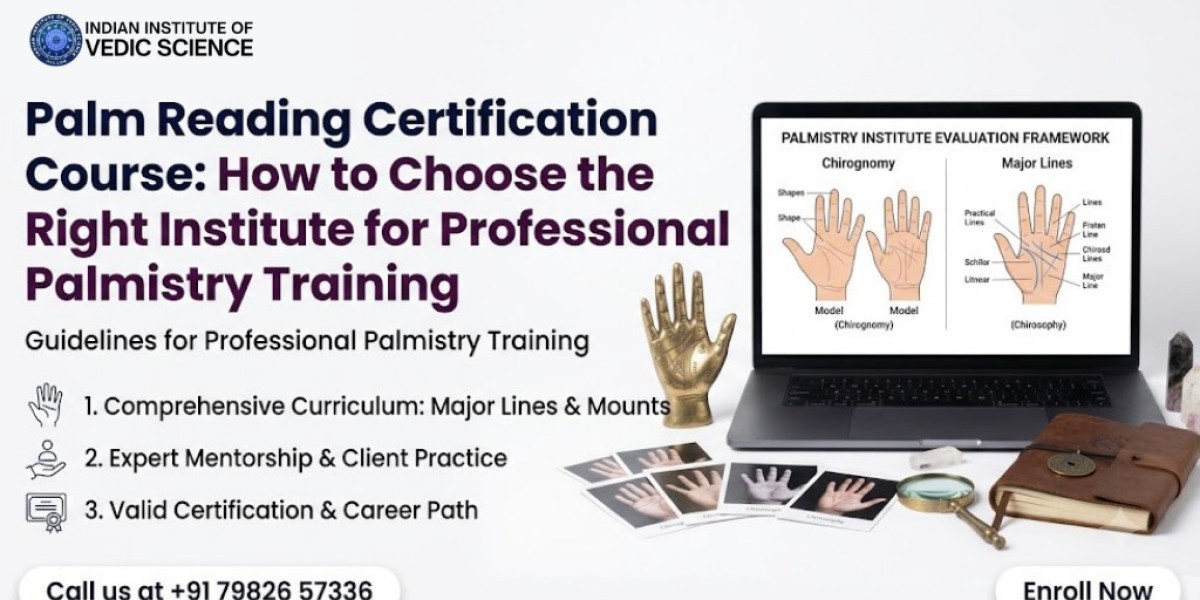


Palm Reading Certification Course: How to Choose the Right Institute for Professional Palmistry Training
Palmistry is a traditional knowledge system that involves studying the structure, lines, mounts, fingers and other features of the human hand. For people interested in traditional interpretation methods, personal learning or specialised spiritual education, palmistry offers an opportunity to explore how different hand features are understood within established palm-reading traditions.
However, learning palmistry professionally requires more than memorising the meanings of the heart line, head line or life line. Students need to understand hand classification, major and minor lines, mounts, finger structures, traditional interpretation methods and practical analysis techniques. They also need opportunities to apply theoretical knowledge through guided exercises.
This is why choosing the right palm reading certification programme is an important decision. A structured training programme can help beginners understand the subject progressively while developing observation, interpretation and communication skills.
With the availability of online education, students can now explore a palmistry course online without necessarily travelling to a physical institute. However, the quality of courses, syllabus coverage, instructor guidance, practical training and certification arrangements can differ significantly.
Before enrolling, you should understand what a professional palmistry programme should teach, how to evaluate an institute, what certification represents and how much you should budget for training.
In this guide, we will explore the important factors to consider when selecting a palmistry institute, compare online learning formats, understand practical training requirements and explain how to evaluate course fees before making an admission decision.
1. What Is Palmistry and Why Is Professional Training Important?
Palmistry is traditionally associated with the study and interpretation of different physical features of the hand. These include palm lines, mounts, finger proportions, thumb structure and overall hand shape.
Traditional palmistry systems associate different hand features with symbolic meanings relating to personality, tendencies, experiences and life patterns. Interpretations can vary between schools and traditions, making systematic study particularly important.
A professional training programme introduces students to the terminology, principles and methods used in palmistry.
Instead of interpreting a hand through one isolated feature, students learn to observe multiple elements and understand how traditional interpretations are developed.
Some important areas covered in palmistry include:
Major palm lines, including the heart line, head line and life line.
Minor lines and their traditional associations.
Mounts of the palm.
Different hand shapes and classifications.
Finger lengths, proportions and structures.
Thumb characteristics.
Line patterns, branches and intersections.
Traditional approaches to comparing both hands.
Practical hand observation and interpretation.
Professional training can help students organise this knowledge into a systematic learning process.
Why Should You Learn Palmistry Through a Structured Course?
Beginners often start learning palmistry through online videos, articles and short explanations. These resources can introduce basic concepts, but they may not provide a complete understanding of the subject.
A structured programme offers several advantages.
Organised learning: Students progress from introductory concepts to more detailed topics through a planned syllabus.
Better subject understanding: A course can explain the relationship between palm lines, mounts, fingers and hand structure.
Practical exercises: Students can practise identifying palm features through guided examples and assignments.
Instructor guidance: Learners can ask questions and clarify difficult concepts during classes.
Consistent practice: A structured learning schedule can help students develop familiarity with traditional palm-reading methods.
Certification documentation: Eligible students may receive a course-completion certificate after fulfilling the institute's requirements.
The objective should be to develop a strong understanding of palmistry rather than expecting instant expertise after completing a few lessons.
2. What Should You Check Before Selecting a Palmistry Institute?
Choosing an institute is one of the most important steps in your learning journey.
When comparing different palmistry courses in india, do not focus only on promotional claims, certificates or discounted admission offers. You should evaluate the actual learning experience and determine whether the programme matches your objectives.
Here are the most important factors to examine.
Complete and Detailed Course Syllabus
A reliable programme should provide a clear explanation of the topics included in the course.
Check whether the curriculum covers:
Introduction to palmistry.
Hand shapes and classification.
Major and minor palm lines.
Mounts and their traditional meanings.
Finger and thumb analysis.
Line variations and markings.
Traditional interpretation techniques.
Practical palm-reading exercises.
Case-based learning and revision.
A syllabus should explain what students will learn in each module. Broad descriptions such as beginner-to-advanced training are not enough to evaluate the quality of a programme.
Instructor Experience and Teaching Methodology
The instructor plays an important role in explaining traditional palmistry concepts.
Before enrolling, understand who will conduct the classes and how the subject will be taught.
Consider asking:
Does the instructor explain the concepts step by step?
Are practical examples included?
Can students ask questions during classes?
Is feedback provided on assignments?
Are difficult topics explained using diagrams or visual examples?
An effective teaching approach should encourage students to understand the subject instead of simply memorising interpretations.
Practical Training Opportunities
Palmistry is a visual and observation-based subject. Therefore, practical learning should form an important part of professional training.
Students should have opportunities to identify palm lines, examine hand structures, study mounts and practise describing traditional interpretations.
A programme that focuses entirely on theoretical explanations may not provide sufficient opportunities to apply the knowledge.
Transparent Certification Process
Before paying the admission fee, understand what the certificate represents and what requirements must be fulfilled.
Ask about attendance, assignments, assessments, practical exercises and certificate eligibility.
A course-completion certificate should be clearly distinguished from a government-recognised licence or statutory professional qualification.
Student Support and Learning Resources
Check whether the institute provides learning materials, revision resources, instructor support and opportunities to clarify doubts.
These facilities can be particularly helpful for students studying through online classes.
3. Palmistry Course Online: What Should a Professional Programme Include?
A comprehensive palmistry course online should cover the subject from foundational concepts to practical interpretation.
The course should be organised in a way that helps students understand each feature before combining multiple observations into a complete traditional reading.
The following modules are important when comparing professional training programmes.
Module 1: Introduction to Palmistry
This module introduces the history, background, terminology and basic principles of palmistry.
Students learn about the structure of the hand and the different features studied in traditional palm-reading systems.
Module 2: Hand Shapes and Classification
Students study different hand shapes, palm proportions, finger structures and thumb characteristics.
They learn how traditional classifications are identified and how these features are described.
Module 3: Major Palm Lines
This module focuses on the three commonly studied major lines.
Heart Line: Traditionally associated with emotional themes and relationships.
Head Line: Traditionally studied in relation to thinking patterns and intellectual tendencies.
Life Line: Traditionally associated with vitality and general life patterns. It should not be treated as a reliable measurement of lifespan or a medical indicator.
Students learn how to identify these lines, observe their direction and understand their variations.
Module 4: Minor Palm Lines
Students explore secondary lines and other traditional palm markings.
Depending on the syllabus, topics may include the fate line, sun line, Mercury line and other markings.
Learners should understand how these features are identified and how their traditional meanings are interpreted in context.
Module 5: Mounts of the Palm
This module introduces the major mounts and their traditional associations.
Students learn about the mounts of Venus, Jupiter, Saturn, Apollo, Mercury, Moon and Mars.
They also study how different mounts are observed alongside palm lines and other hand features.
Module 6: Finger and Thumb Analysis
Learners study finger length, shape, spacing, proportions and thumb structure.
This module helps students develop a broader understanding of hand classification and traditional interpretation.
Module 7: Practical Palm Reading
Practical exercises help students apply theoretical concepts.
These may include identifying major lines, observing mounts, comparing hand structures and preparing organised interpretations.
Module 8: Case-Based Learning
Students review different hand patterns and practise explaining their observations.
Assignments and instructor feedback can help learners improve their understanding and avoid common interpretation mistakes.
Before admission, verify that these modules are actually included in the institute's current syllabus.
4. Learn Palmistry Online: How Does Online Training Work?
Online education has made specialised learning more accessible to students across India.
If you want to learn palmistry online, you can explore programmes that offer live instructor-led classes, recorded sessions or a combination of both.
The right format depends on your schedule, learning preferences and the level of instructor interaction you need.
Live Online Classes
Live classes allow students to interact directly with instructors.
They can ask questions, discuss examples and clarify difficult concepts during scheduled sessions.
This format may be particularly useful for students who prefer guided learning and regular interaction.
Recorded Lessons
Recorded sessions allow learners to revisit topics and revise concepts at their own pace.
Students can review explanations of palm lines, mounts, finger structures and interpretation methods whenever they need additional revision.
Hybrid Learning
Some programmes combine live sessions with recorded learning material.
This approach can provide the flexibility of digital resources while retaining opportunities for instructor interaction.
What Should You Verify?
Before selecting an online programme, confirm:
Class schedule and frequency.
Total course duration.
Availability of recordings.
Access to learning materials.
Practical assignments.
Instructor interaction.
Doubt-clearing arrangements.
Certificate eligibility requirements.
A strong online learning experience should combine theoretical instruction with opportunities for visual observation and practical application.
5. Learn Palm Reading Online: Why Practical Experience Matters
Students who want to learn palm reading online should pay particular attention to the practical component of a programme.
Understanding the definition of a palm line is only the first step. Learners must also develop the ability to identify different features on actual hands and describe them using appropriate terminology.
Identifying Different Palm Lines
Students should practise locating the heart line, head line and life line.
They should learn to distinguish between different lines and observe their direction, depth, length and continuity.
Studying Line Variations
Palm lines can have different patterns, including branches, intersections, breaks and variations in appearance.
Practical exercises should help learners recognise these features and understand how they are traditionally described.
Understanding Mounts
Students should practise identifying the location of different mounts and observing their development.
They should understand how mounts are considered alongside other hand features.
Comparing Hand Structures
Learners can practise examining both hands and understanding the traditional methods used for comparison.
The objective is to develop systematic observation rather than making assumptions from a single feature.
Preparing Structured Interpretations
A useful practical exercise involves preparing a written interpretation based on observed features.
Students should distinguish between visible observations and traditional symbolic meanings.
This approach encourages clarity and responsible communication.
6. Palm Reading Online: What Makes a Training Programme Effective?
The effectiveness of online palmistry training depends on how well the institute combines theory, visual learning and practice.
When evaluating palm reading online programmes, consider the following aspects.
Visual explanations: Diagrams and hand illustrations can make it easier to understand different palm features.
Realistic examples: Different hand patterns can help students understand variations in lines and structures.
Practical assignments: Students should have opportunities to identify and describe palm features.
Instructor feedback: Feedback can help learners understand mistakes and improve their observations.
Revision resources: Recorded classes and study material can support continued learning.
Clear learning objectives: Every module should explain what students are expected to understand by the end of the lesson.
A programme should not promise guaranteed professional success or instant mastery. Skill development depends on consistent study, practice and responsible application.
7. Palm Reading Course Online: How to Compare Different Institutes
When searching for a palm reading course online, students may find programmes with different durations, syllabuses, teaching methods and certification arrangements.
A proper comparison should focus on learning value rather than promotional language.
Compare Course Content
Check whether the syllabus includes the fundamentals of palmistry and progresses towards practical interpretation.
A programme should clearly explain its modules, teaching sequence and expected learning outcomes.
Compare Class Formats
Understand whether classes are live, recorded or hybrid.
Choose a format that suits your schedule and provides enough opportunities for instructor interaction.
Compare Practical Training
Ask how practical learning is conducted.
Check whether students receive assignments, example-based exercises and feedback.
Compare Certification
Understand the certificate's issuing institution, completion requirements and eligibility criteria.
Compare Student Support
Check whether learners can access instructors, learning resources and doubt-clearing sessions.
Compare Total Cost
Evaluate the fee in relation to course duration, syllabus, practical training and available academic support.
This process can help you identify a programme that matches your requirements.
8. Palmistry Online Course Fees: What Should You Expect?
Course fees are an important part of the admission decision.
The cost of a palmistry online course depends on factors such as syllabus depth, course duration, instructor involvement, class format, practical training, learning material and certification arrangements.
For learners comparing structured specialised training programmes, an indicative budget of ₹45,000–₹60,000 may be considered for relevant offerings. However, this should not be treated as a fixed or universal fee for every palmistry course. The current fee for a particular programme must be confirmed directly with the institute.
Before enrolling, check what the total fee includes.
Consider whether it covers:
Complete course modules.
Live instructor-led sessions.
Recorded lessons, if available.
Digital study materials.
Practical assignments.
Instructor feedback.
Revision support.
Course-completion certification.
Any additional learning resources.
A lower-priced course may provide introductory material, while a more comprehensive programme may include additional practical exercises and instructor guidance.
Do not judge a programme only by its fee. Evaluate the syllabus, teaching methodology and actual learning support before making a decision.
9. Palm Reading Course: What Does Certification Actually Mean?
A palm reading course may offer a completion certificate after students fulfil the requirements established by the institute.
A certificate can document that a learner has completed a particular programme. However, its meaning depends on the issuing institution and the conditions attached to the course.
Before admission, ask:
Is the certificate issued by the institute?
What is the certificate title?
Is attendance compulsory?
Are practical assignments required?
Is there an assessment?
What are the course-completion criteria?
Are there any additional certificate charges?
Is the certificate available digitally or in physical form?
Students should not assume that every institute-issued certificate is a government-recognised qualification or professional licence.
A certificate can support your learning record, but it does not automatically guarantee employment, income, clients or professional recognition.
Practical knowledge, continued study, communication skills and ethical conduct remain essential.
10. How Much Practical Training Should a Palmistry Course Provide?
Practical exposure is one of the most important aspects of professional palmistry education.
Students should not be expected to develop interpretation skills only by reading theoretical descriptions.
A structured programme should provide opportunities to apply the concepts introduced in each module.
Important practical activities may include:
Hand identification exercises: Students practise locating major and minor lines.
Mount observation: Learners identify different mounts and understand their traditional associations.
Finger analysis: Students examine finger proportions, shapes and spacing.
Line interpretation: Learners practise describing line variations and patterns.
Case-based exercises: Students study different hand examples and prepare organised observations.
Revision assignments: Learners revisit previous modules and improve their understanding through repeated practice.
The amount and format of practical training vary by institute. Therefore, ask for details about the actual assignments and feedback arrangements before enrolling.
11. How to Identify the Best Palmistry Institute in India?
People searching for the best palmistry institute in india should evaluate the quality of the educational experience rather than relying on rankings or promotional claims.
A suitable institute should provide transparent information about its courses and explain what students can expect after enrolment.
Consider these selection criteria.
Curriculum Transparency
The institute should provide a detailed syllabus and explain the modules covered in the programme.
Instructor Guidance
Students should understand who teaches the course and how questions and doubts are addressed.
Practical Learning
Check whether practical exercises form part of the programme.
Online Learning Support
Understand the class schedule, recordings, learning material and support arrangements.
Fee Transparency
Confirm the total course fee, payment structure and additional charges, if any.
Certification Details
Verify the issuing institution and course-completion requirements.
Realistic Course Outcomes
Avoid programmes that guarantee income, clients or specific predictions. Professional learning should focus on knowledge and practical skill development.
The right institute is one whose syllabus, teaching approach and learning support match your requirements.
12. Palmistry and Astrology: Should You Explore Both Subjects?
Many students interested in traditional knowledge systems also explore astrology.
Although palmistry and astrology are different disciplines, both involve learning specialised concepts and understanding traditional interpretation methods.
Palmistry focuses on hand structure, lines, mounts, fingers and their traditional associations.
Astrology focuses on planets, zodiac signs, houses, birth charts and other astrological concepts.
If you are interested in learning astrology separately, an astrology certificate course online may provide a structured introduction to the subject.
Students looking for an astrology diploma course online can compare programmes based on curriculum depth, duration, class format and certificate requirements.
An online astrology course with certificate should clearly explain the syllabus and the requirements for receiving the certificate.
People comparing the best astrology courses should evaluate the quality of teaching, practical learning and subject coverage rather than relying only on promotional claims.
The best astrology courses online should provide an organised learning structure and explain concepts progressively.
Students searching for the best astrology courses in india online should examine whether the course matches their experience level and learning objectives.
Similarly, learners comparing the best online astrology courses in india should check the institute's teaching format, instructor support, course material and certification process.
The best online astrology classes should offer clear explanations and opportunities to clarify difficult concepts.
When selecting the best online course for astrology, consider whether it covers foundational concepts before introducing more advanced interpretation methods.
For beginners, the best way to learn astrology is to understand planets, zodiac signs and houses before progressing towards birth chart interpretation.
Palmistry and astrology can be studied independently or as part of a broader interest in traditional knowledge systems. However, learning one subject does not automatically provide professional training in the other.
13. Learning and Professional Opportunities After Palmistry Training
After completing a structured programme, students may continue exploring palmistry through personal study, practice and educational activities.
However, course completion does not automatically guarantee professional employment or income.
Personal Learning
Some students study palmistry to understand traditional methods and develop their personal knowledge.
They may continue revising the syllabus and exploring different approaches to hand analysis.
Guided Practice
Learners can practise with willing participants and document their observations.
Regular practice can help them become more comfortable with palmistry terminology and traditional interpretation methods.
Independent Consultation Services
Students who develop adequate knowledge and practical experience may consider independent consultation services.
They should communicate the nature and limitations of traditional interpretations clearly and avoid presenting palmistry as a substitute for qualified medical, legal, financial or psychological advice.
Educational Content Development
Learners may share educational content about palmistry through articles, videos, social media and other platforms.
Topics can include palm line identification, hand classification, traditional meanings and beginner learning concepts.
Responsible educational communication can help readers understand the subject without exaggerated claims.
14. Why Consider Indian Institute of Vedic Science (IIVS) for Palmistry Training?
The Indian Institute of Vedic Science (IIVS), a unit of Vedant FaithTech Group Pvt. Ltd., offers specialised learning opportunities in traditional knowledge systems and related subjects.
For students interested in palmistry, exploring an organised training programme can help them understand the curriculum, teaching format and available learning support.
Prospective students can enquire with IIVS about the current palmistry programme and clarify important details before admission.
These may include:
Palmistry syllabus and course modules.
Class schedule and duration.
Online learning format.
Practical palm-reading exercises.
Instructor guidance.
Doubt-clearing arrangements.
Certification requirements.
Current course fees and payment options.
IIVS also offers learning opportunities in subjects such as astrology, numerology, Vastu and other specialised areas of traditional knowledge.
Students interested in exploring more than one subject can review the available programmes separately and select courses according to their learning objectives.
For fee-related decisions, confirm the current palmistry programme fee directly with IIVS. An indicative ₹45,000–₹60,000 budget may be relevant to certain structured training offerings, but the exact fee and inclusions should be verified before enrolment.
15. Common Mistakes to Avoid When Choosing Palmistry Training
Before enrolling in a palmistry programme, avoid these common mistakes.
Selecting a course only because of its low fee: Compare the syllabus, practical training and instructor support before making a decision.
Ignoring the course curriculum: Check whether the programme covers the essential concepts of palmistry.
Choosing based only on certification: Understand what the certificate represents and what completion requirements apply.
Ignoring practical learning: Palmistry involves visual observation, so practical exercises are important.
Expecting instant expertise: Developing familiarity with hand analysis requires consistent study and practice.
Assuming professional income is guaranteed: A course can provide foundational knowledge, but professional opportunities depend on several individual and external factors.
Not checking the institute's details: Verify the course duration, syllabus, fee and certificate arrangements before paying.
A careful approach can help you select a programme that matches your expectations.
Conclusion: Choose Structured Palmistry Training for a Strong Learning Foundation
Choosing the right palmistry institute requires more than comparing course fees or checking whether a certificate is provided. Students should carefully examine the curriculum, instructor guidance, practical training, class format, student support and certification requirements.
A structured palmistry course online can help beginners understand hand shapes, major and minor lines, mounts, finger structures and traditional interpretation methods. However, developing practical confidence requires regular observation, assignments and continued learning.
Before enrolling, compare the available palmistry courses in india, understand what each programme offers and verify the complete fee structure. An indicative ₹45,000–₹60,000 budget may apply to certain structured programmes, but always confirm the actual course fee and inclusions directly with the institute.
If you are planning to develop your knowledge of palmistry through organised training, explore the available learning opportunities at the Indian Institute of Vedic Science (IIVS).
Understand the course structure, discuss your learning goals and get clarity about the training format, practical exercises, certification and admission requirements.
Book your free counselling with IIVS to learn more about the palmistry programme and available training options.
Indian Institute of Vedic Science (IIVS)
A unit of Vedant FaithTech Group Pvt. Ltd.
Email: support@iivs.in
Location: Sector 63, H-Block, Noida.
Frequently Asked Questions
Q1. What is a palm reading certification course?
A palm reading certification course is a structured learning programme that teaches students about hand shapes, palm lines, mounts, fingers and traditional interpretation methods. A certificate may be issued after completing the institute's required learning activities.
Q2. Can beginners enrol in an online palmistry course?
Yes. Beginners can start with a foundational programme that explains hand structure, major lines, mounts and basic interpretation. Previous experience is not necessarily required for introductory training.
Q3. How do I choose the right palmistry institute?
Compare the syllabus, instructor experience, practical exercises, online class format, student support, course fees and certification requirements. Verify the details before admission.
Q4. How much does professional palmistry training cost?
Fees depend on course duration, syllabus, practical training and certification arrangements. An indicative budget of ₹45,000–₹60,000 may be relevant to certain structured training programmes, but the current palmistry course fee should be confirmed with the institute.
Q5. Is an online palmistry course suitable for professional learning?
An online programme can provide structured theoretical lessons, visual examples and practical assignments. Its suitability depends on the syllabus, instructor interaction and opportunities to practise.
Q6. What topics are included in a palm reading course?
Common topics include hand shapes, major and minor palm lines, mounts, finger analysis, thumb structure, traditional interpretations and practical exercises. Exact modules differ between institutes.
Q7. Does a palm reading certificate guarantee professional opportunities?
No. A course-completion certificate documents that a learner has fulfilled the institute's requirements. It does not guarantee employment, income, clients or professional recognition.
Q8. Can I learn palmistry and astrology together?
Yes. Both subjects can be studied separately as part of a broader interest in traditional knowledge systems. However, they have different foundations and require their own structured training.
Q9. How long does it take to learn palmistry?
The duration depends on the course syllabus, class schedule and individual learning pace. Understanding the fundamentals is the first step; developing practical confidence requires continued study and practice.
Q10. Why is practical training important in palmistry?
Practical exercises help students identify hand features, observe line variations, study mounts and apply traditional interpretation methods. They also provide opportunities to improve through feedback and revision.







