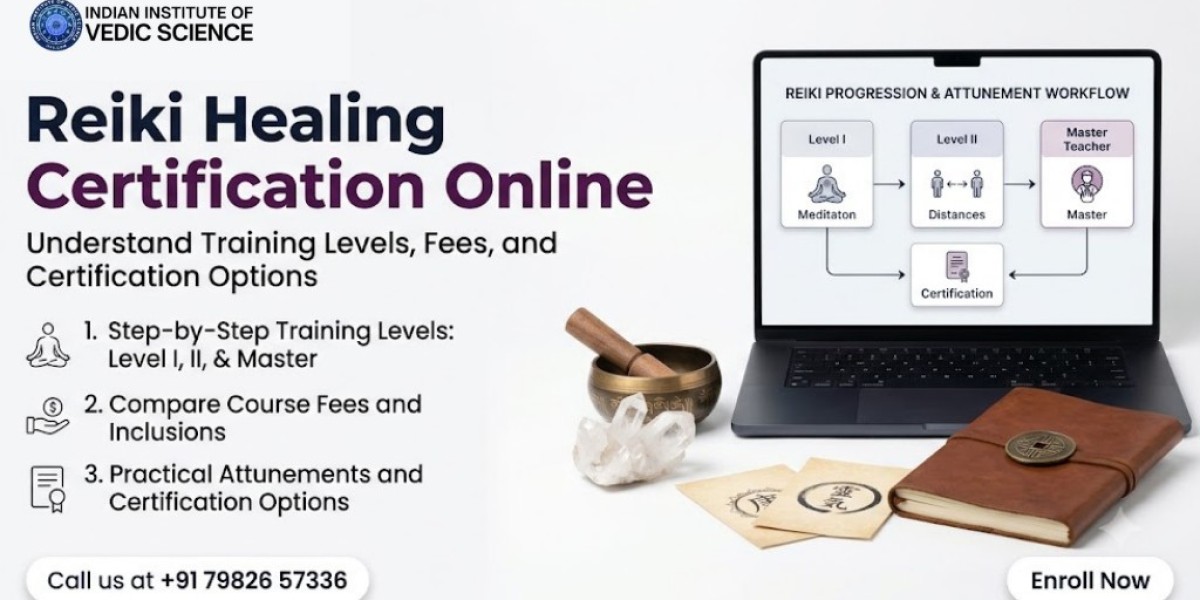


Reiki Healing Certification Online: Compare Training Levels, Course Fees, Practical Sessions and Certification Options
Reiki is a traditional Japanese energy-based practice that focuses on relaxation, mindfulness and the practice of gentle hand placements. It has attracted interest among people who want to explore holistic wellness approaches, personal development and traditional healing systems. For beginners, learning Reiki involves understanding its background, principles, training levels, hand positions, practical methods and the responsibilities associated with offering sessions.
If you are interested in learning this practice, choosing a structured reiki healing course can help you understand the subject progressively. However, not every programme offers the same training levels, practical exposure, instructor guidance or certification arrangements. Before enrolling, it is important to understand what each level involves and how the training is delivered.
A well-organised programme should introduce the foundations of Reiki, explain its traditional principles, provide guided practice and clarify the requirements for progressing through different levels. Students should also understand the limitations of Reiki and avoid presenting it as a substitute for qualified medical care.
Today, learners can explore a reiki healing certification online programme from different locations without necessarily attending a physical classroom. Online learning may provide flexibility, but students should carefully check how practical demonstrations, supervised exercises and instructor interaction are included.
In this guide, we will explain the different Reiki training levels, compare certification options, discuss practical sessions, understand course fees and identify the factors to consider when selecting an institute. We will also explore how Reiki relates to broader holistic and traditional knowledge studies.
1. What Is Reiki Healing and Why Do People Learn It?
Reiki is a Japanese practice associated with relaxation, mindfulness and gentle hand placement. The word Reiki is commonly understood through the Japanese terms rei and ki, which are associated with spiritual or universal energy in traditional explanations.
In Reiki practice, a practitioner generally places their hands lightly on or near different areas of the body, following a particular method taught during training. Some practitioners also use Reiki as part of personal meditation and relaxation routines.
People explore Reiki for different reasons:
To understand a traditional Japanese wellness practice.
To develop a regular relaxation and mindfulness routine.
To explore holistic wellness education.
To learn traditional Reiki principles and techniques.
To study hand placements and session structure.
To develop knowledge for personal practice.
To explore further training in holistic wellness subjects.
It is important to understand that Reiki should not be presented as a scientifically established treatment for medical conditions. It should not replace diagnosis, medication, therapy or other care provided by qualified healthcare professionals.
Why Is Structured Reiki Training Important?
Beginners may find information about Reiki through videos, articles and online discussions. However, learning through disconnected resources may leave important gaps in understanding.
A structured programme can help learners study the subject in a planned sequence.
It may provide:
Foundational knowledge: Students learn the background, principles and terminology associated with Reiki.
Training-level clarity: Learners understand the differences between introductory and advanced levels.
Practical demonstrations: Instructors explain hand placements and session procedures.
Guided exercises: Students can practise techniques included in their programme.
Ethical understanding: Training can introduce appropriate boundaries, consent and responsible communication.
Certification guidance: Students understand the requirements for completing each training level.
The purpose of structured training should be to develop informed understanding and responsible practice rather than promise guaranteed health outcomes.
2. What Should You Learn in a Reiki Healing Course?
Before enrolling in a reiki healing course, review the syllabus carefully. A comprehensive programme should explain both the theoretical foundations and practical aspects of Reiki.
Introduction to Reiki and Its Background
Students should begin by understanding the origins and development of Reiki as a traditional Japanese practice.
This module may introduce its historical background, basic terminology and the principles commonly discussed in Reiki education.
Understanding the background helps learners recognise the context in which the practice developed.
The Five Reiki Principles
Many Reiki teaching traditions introduce five principles that encourage reflection on everyday attitudes and behaviour.
These principles are commonly expressed through ideas such as:
Living without unnecessary anger.
Reducing worry.
Practising gratitude.
Working with sincerity.
Showing kindness and respect.
Students should understand how these principles are introduced in their training tradition and how they may be incorporated into personal reflection.
Understanding Reiki Hand Positions
Hand placement is an important part of practical Reiki training.
Students may learn different hand positions used during a session, including positions around the head, shoulders, torso, arms and legs.
A structured programme should explain the purpose and sequence of the positions according to the teaching method being followed.
Understanding Session Preparation
A Reiki session requires appropriate preparation and communication.
Students should learn how to explain the practice, obtain consent, respect personal boundaries and create a comfortable environment.
Training should also clarify that clients can decline any part of a session and that touch-free approaches may be used when preferred.
Practical Session Structure
Students should understand how a session is organised, how long it may take and how hand positions are selected according to the training method.
They should also learn how to communicate respectfully before and after a session without making unsupported medical claims.
3. Compare the Different Reiki Training Levels
One of the most important factors when selecting a programme is understanding its training levels.
Many Reiki teaching traditions organise learning into multiple stages. The exact names, curriculum and progression requirements may differ between schools and instructors.
Before enrolling, ask the institute to explain which system it follows and what each level includes.
Reiki Level 1: Foundation and Personal Practice
The first level generally introduces beginners to the foundational principles of Reiki.
Common learning areas may include:
Introduction to Reiki and its background.
The five Reiki principles.
Basic hand positions.
Personal practice methods.
Session preparation.
Basic relaxation exercises.
Responsible practice and consent.
Some Reiki traditions include an attunement or initiation process at this level. Students should ask the instructor how this is conducted and whether it is included in the course.
Level 1 is generally intended to establish a foundation for understanding and practising the methods taught in that particular tradition.
Reiki Level 2: Further Techniques and Practice
The second level may introduce additional methods and more structured practice.
Depending on the teaching tradition, students may study symbols, their traditional uses, distance-practice methods and techniques for organising sessions.
Training may include:
Revision of foundational concepts.
Introduction to Reiki symbols.
Traditional symbol applications.
Distance-practice concepts.
Session intention and preparation.
Guided practice exercises.
Discussion of ethical responsibilities.
Students should verify the actual syllabus because the methods and requirements can vary between Reiki schools.
Reiki Level 3: Advanced Learning or Master-Level Training
Some Reiki traditions offer an advanced or master-level programme.
This stage may introduce advanced concepts, further practice methods and additional responsibilities associated with teaching or guiding other learners.
Depending on the system, the curriculum may cover:
Advanced Reiki concepts.
Master-level symbols or methods.
Further practice techniques.
Teaching principles.
Attunement-related learning, where applicable.
Responsible student guidance.
Training and assessment requirements.
Not every programme uses the same level structure. Some institutes offer different combinations or names for advanced training.
Before enrolling, confirm whether a master-level course includes teaching preparation or focuses only on advanced personal practice.
4. Reiki Healing Certification: What Does It Mean?
A reiki healing certification generally refers to documentation issued by an instructor or institute after a student completes the requirements of a particular training programme.
Certification arrangements can differ significantly.
Some programmes provide separate certificates for individual levels, while others may offer a completion certificate after a combined course.
Before admission, students should ask:
Who issues the certificate?
Which Reiki training level does it represent?
Is attendance compulsory?
Are practical sessions required?
Is an assessment included?
Are there any additional certification charges?
Does the certificate include the programme title?
What are the requirements for advanced-level progression?
It is important to distinguish an institute-issued training certificate from a government-issued professional licence or regulated healthcare qualification.
A Reiki certificate documents the completion of a particular programme according to the institute's requirements. It does not establish medical qualifications or guarantee professional recognition, employment or income.
Students should also understand that completing a course does not automatically make them qualified to diagnose or treat medical conditions.
5. Reiki Healing Certification Online: What Should an Online Programme Offer?
A reiki healing certification online programme can provide access to specialised learning from different locations. However, online training should be evaluated according to its actual teaching format and practical components.
Reiki involves demonstrations and guided practice, so students should understand how these elements are included in an online programme.
Live Instructor-Led Sessions
Live classes allow students to interact with instructors, ask questions and discuss the techniques introduced during training.
They can be useful for clarifying hand positions, session preparation and the traditional principles being taught.
Recorded Learning Resources
Recorded lessons may help students revise concepts and revisit demonstrations.
They can be particularly useful when learners want to review the sequence of hand positions or revise the theoretical material.
Practical Demonstrations
A good programme should explain how practical demonstrations are conducted.
Students should be able to see the techniques clearly and understand the sequence of activities involved in a session.
Instructor Guidance
Ask whether learners can contact instructors to clarify doubts and receive feedback on practical exercises.
Certification Requirements
Confirm whether certification is based on attendance, practical participation, assignments or other requirements.
Online and In-Person Components
Some programmes may offer entirely online learning, while others may include optional or compulsory in-person activities.
Ask for written confirmation of the exact format before enrolling. Do not assume that every online certification programme includes the same practical arrangements.
6. Reiki Healing Classes: What Happens During Practical Sessions?
The quality of practical training is an important factor when comparing reiki healing classes.
Students should have opportunities to understand the methods being taught rather than relying entirely on theoretical explanations.
Practical sessions may cover the following areas.
Session Preparation
Learners study how to prepare a comfortable environment and explain the process to participants.
This includes communication, consent and respect for personal preferences.
Hand Position Demonstrations
Instructors may demonstrate the hand positions used in their teaching tradition.
Students learn the sequence and understand how to practise the techniques appropriately.
Guided Practice
Depending on the programme format, learners may participate in supervised practice exercises.
They should understand the difference between practising a traditional technique and making claims about medical effects.
Feedback and Revision
Instructor feedback can help students improve their understanding of hand placements, session organisation and communication.
Ethical Responsibilities
Practical training should include discussion of appropriate boundaries.
Students should learn to avoid making medical promises, discouraging professional treatment or presenting Reiki as a replacement for healthcare.
Before enrolling, ask how practical sessions are conducted and whether students receive feedback.
7. Reiki Healing Training: What Skills Should You Develop?
A structured reiki healing training programme should help students understand the practice and develop responsible learning habits.
Important areas include:
Knowledge of Reiki principles: Understand the traditional principles and how they are introduced in the course.
Hand placement techniques: Learn the positions and methods included in the selected training system.
Session organisation: Understand preparation, communication and the general structure of a session.
Mindfulness and self-reflection: Explore the role of personal reflection and relaxation practices.
Consent and boundaries: Respect participant preferences and understand the importance of informed consent.
Communication skills: Explain what a session involves without making exaggerated claims.
Continued practice: Develop a regular revision and learning routine.
These skills can help students build a foundation for personal practice and further education.
8. Reiki Healing Course Fees: How Much Should You Budget?
One of the most common questions students ask is about reiki healing course fees.
The total cost depends on the training level, course duration, instructor involvement, teaching format, practical sessions, learning materials and certification arrangements.
A foundation-level course may have a different fee structure from a programme that includes multiple training levels or advanced instruction.
For learners comparing structured holistic education programmes, an indicative budget of ₹45,000–₹60,000 may be considered for relevant training offerings. However, this is not a fixed or universal market price for every Reiki course. The actual fee for the specific programme and training level should be confirmed directly with the institute.
When comparing fees, consider what is included:
Number of training levels.
Total class duration.
Live instructor-led sessions.
Recorded learning material.
Practical demonstrations.
Guided exercises.
Study resources.
Instructor support.
Certification arrangements.
Any additional charges.
Do not select a programme based only on its advertised price.
A more comprehensive programme may include additional modules, practical sessions and instructor guidance, while an introductory programme may cover only the foundations.
Before making payment, request details of the complete fee structure, payment schedule, course duration and certificate requirements.
9. How to Choose the Best Reiki Certification Programme?
Students comparing the best reiki certification options should focus on the actual quality and structure of the training.
A certificate alone is not enough to evaluate a programme. The syllabus, instructor experience, practical arrangements and ethical teaching approach are equally important.
Consider these factors.
Verify the Training Tradition
Ask which Reiki system or teaching tradition the institute follows.
Different schools may use different terminology, level structures and training methods.
Review the Complete Syllabus
Check whether the programme explains its modules and training levels clearly.
Understand Practical Requirements
Find out whether demonstrations, guided exercises and supervised practice are included.
Check Instructor Credentials and Experience
Understand who will conduct the programme and how they guide students through the training.
Confirm Certification Details
Ask who issues the certificate and what requirements students must fulfil.
Review Student Support
Check whether students can clarify doubts, access learning material and receive feedback.
Look for Responsible Teaching
Avoid programmes that promise guaranteed cures, guaranteed income or guaranteed professional success.
A credible educational programme should communicate realistic learning outcomes and explain the limitations of the practice.
10. Reiki Healing Training Online: How to Evaluate the Learning Format
A reiki healing training online programme may be suitable for students who prefer learning from home or have limited time for travelling.
However, the online format should not compromise clarity or practical understanding.
Check whether the programme provides:
Clearly structured live classes.
Recorded sessions for revision.
Demonstrations of hand positions.
Opportunities to ask questions.
Practical assignments.
Instructor feedback.
Clear instructions for any required in-person activities.
Transparent certification conditions.
Students should also check the technology requirements, class timings and access duration for recorded resources.
The objective is to select a programme that makes the learning process understandable and provides sufficient guidance.
11. Reiki Healing Learn Online: Is It Suitable for Beginners?
People who want to reiki healing learn online can begin with an introductory programme if it is designed for learners without previous experience.
A beginner-friendly course should explain the background and terminology before introducing more detailed methods.
Students should not feel pressured to enrol directly in advanced training without understanding the foundational concepts.
A sensible learning progression may involve:
Understanding Reiki and its traditional background.
Learning the foundational principles.
Studying basic hand positions.
Understanding session preparation and consent.
Practising the techniques taught in the course.
Revising foundational concepts.
Exploring further training when appropriate.
Before enrolling, ask whether the institute provides a clear progression from beginner-level learning to advanced modules.
12. Learn Reiki Healing: What Should You Know Before Starting?
If your objective is to learn reiki healing, it is useful to prepare by understanding what the training involves.
You do not necessarily need previous experience in holistic wellness or other traditional knowledge systems to begin a foundation-level programme.
However, you should be willing to study the concepts, participate in practical exercises and understand the responsibilities associated with the practice.
Before starting, consider the following:
Understand the purpose of training: Decide whether you are interested in personal learning, traditional practice or further education.
Check the course structure: Understand the different levels and what each one covers.
Ask about practical sessions: Find out how demonstrations and exercises are organised.
Understand certification: Confirm the certificate requirements and issuing institution.
Keep realistic expectations: Reiki should not be treated as a replacement for medical care or a guaranteed solution to health concerns.
Plan for regular practice: Learning a traditional method requires continued revision and consistency.
A clear understanding of these points can help you choose a suitable programme.
13. Reiki and Occult Science Courses: Understanding the Connection
Some students interested in Reiki also explore other traditional and specialised knowledge systems.
Reiki is generally studied within holistic wellness education, while occult science is a broader category commonly used for subjects involving traditional esoteric systems and specialised interpretative practices.
Learners researching occult science courses fees should compare the syllabus, course duration, training format and certification arrangements of each programme.
The cost of an occult science course may vary depending on the subject, depth of study and practical components.
Students exploring occult science courses online should check whether the programme offers live instruction, recorded lessons, assignments and instructor guidance.
An occult sciences course may cover one or more specialised subjects, depending on the institution's curriculum.
Before enrolling in any such programme, understand exactly which disciplines are included. Do not assume that Reiki certification automatically covers other occult or spiritual subjects.
Similarly, students should evaluate each course independently because different subjects require different learning methods and practical skills.
14. Reiki and Astrology: Can You Explore Both Subjects?
Students interested in traditional knowledge systems may also explore astrology as a separate area of study.
Reiki and astrology have different foundations. Reiki training focuses on a traditional energy-based practice, hand placements and session methods, while astrology involves planets, zodiac signs, houses and birth chart interpretation.
If you want to study astrology separately, an astrology certificate course online may introduce the foundations of the subject.
An astrology diploma course online may offer a broader curriculum, depending on the institution and programme.
Students considering an online astrology course with certificate should verify the syllabus, class format, practical exercises and certificate requirements.
When comparing the best astrology courses, look for a structured curriculum and clear teaching methodology rather than relying only on promotional claims.
The best astrology courses online should explain concepts progressively and provide opportunities to practise chart interpretation.
Learners searching for the best astrology courses in india online should compare instructor guidance, class schedules and course content.
Similarly, people evaluating the best online astrology courses in india should confirm whether the programme is suitable for beginners or designed for experienced learners.
The best online astrology classes should provide clear explanations, organised lessons and opportunities to clarify doubts.
When choosing the best online course for astrology, consider the depth of the syllabus, practical learning and certification arrangements.
For beginners, the best way to learn astrology is to start with foundational concepts such as planets, zodiac signs and houses before progressing towards birth chart interpretation.
Reiki and astrology can both be explored as separate learning interests, but completing one programme does not provide training or certification in the other.
15. Career and Learning Opportunities After Reiki Training
After completing Reiki training, students may continue developing their knowledge through personal practice, further education and responsible exploration of holistic wellness activities.
However, completing a Reiki course does not guarantee employment, income or a specific number of clients.
Personal Practice
Some learners study Reiki primarily for personal reflection, relaxation and continued learning.
They may revisit foundational concepts and practise the methods taught by their instructor.
Further Reiki Training
Students may explore additional levels if their training tradition provides a progression pathway.
Before advancing, they should understand the eligibility requirements and whether previous-level practice is expected.
Holistic Wellness Learning
Learners may also explore related subjects as separate programmes.
These may include meditation, relaxation practices and other areas of holistic wellness education.
Independent Wellness Sessions
Some individuals may consider offering sessions after developing sufficient training and understanding of the responsibilities involved.
They should communicate clearly about the nature of Reiki, obtain consent and avoid medical claims or promises of cures.
Educational Content and Awareness
Students may share educational information about Reiki principles, traditional practices and learning experiences through articles, videos or social media.
Responsible communication is important when discussing wellness subjects.
16. Why Consider Indian Institute of Vedic Science (IIVS) for Reiki Training?
The Indian Institute of Vedic Science (IIVS), a unit of Vedant FaithTech Group Pvt. Ltd., provides specialised learning opportunities in traditional knowledge systems and related subjects.
For individuals interested in Reiki and holistic wellness education, exploring a structured programme can help clarify the curriculum, training format and available learning support.
Prospective students can enquire with IIVS about the current Reiki programme and confirm important details before admission.
These may include:
Reiki training levels and syllabus.
Course duration and class schedule.
Online and live learning options.
Practical sessions and demonstrations.
Instructor guidance and doubt clarification.
Certification requirements.
Current fee structure.
Admission and payment arrangements.
IIVS also offers learning opportunities in subjects such as astrology, numerology, Vastu and other specialised areas of traditional knowledge.
Students interested in multiple disciplines should explore each course separately and understand its individual syllabus and training requirements.
For fee-related decisions, confirm the current Reiki programme fee directly with IIVS. An indicative ₹45,000–₹60,000 budget may be relevant to certain structured training offerings, but the exact fee for the Reiki programme, included levels and certification arrangements should be verified before enrolment.
17. Common Mistakes to Avoid Before Enrolling in Reiki Training
Before selecting a Reiki programme, avoid these common mistakes.
Choosing only by price: A low fee does not necessarily mean the course offers the training you need. Compare the syllabus and practical components.
Ignoring training levels: Understand whether the programme covers foundation-level learning, advanced training or multiple levels.
Assuming all Reiki systems are identical: Training methods, terminology and progression requirements can differ between teaching traditions.
Overlooking practical sessions: Check how demonstrations and exercises are included in the programme.
Assuming certification guarantees professional success: A certificate documents course completion, not guaranteed income, employment or client acquisition.
Believing medical claims without evidence: Reiki should not replace qualified healthcare or be presented as a guaranteed treatment.
Not checking instructor guidance: Confirm how students can ask questions and receive feedback.
Ignoring certificate conditions: Understand the attendance, practical and assessment requirements before admission.
A careful comparison can help you select a programme that matches your learning goals.
Conclusion: Choose Structured Reiki Training with Clear Certification and Practical Learning
Choosing the right Reiki programme requires more than comparing certificates or advertised fees. Students should understand the training levels, syllabus, practical sessions, instructor guidance and certification requirements before enrolling.
A structured reiki healing course can help beginners understand traditional Reiki principles, hand placements, session preparation and responsible practice. Online learning can provide flexibility, but the quality of demonstrations and practical guidance should remain important considerations.
Before making a decision, compare the available programmes, understand what each training level includes and confirm the total fee. An indicative ₹45,000–₹60,000 budget may be relevant to certain structured offerings, but the exact fee and certification options should always be verified directly with the institute.
If you are interested in exploring Reiki through organised learning, consider the available programmes at the Indian Institute of Vedic Science (IIVS).
Understand the course structure, discuss your learning objectives and get clarity about practical sessions, training levels, certification and admission requirements.
Book your free counselling with IIVS to understand the available Reiki training options and take the next step in your learning journey.
Indian Institute of Vedic Science (IIVS)
A unit of Vedant FaithTech Group Pvt. Ltd.
Email: support@iivs.in
Location: Sector 63, H-Block, Noida.
Frequently Asked Questions
Q1. What is a Reiki healing certification course?
A Reiki healing certification course is a structured programme that introduces students to Reiki principles, traditional methods, hand positions and practical learning. A certificate may be issued after completing the institute's requirements.
Q2. Can beginners enrol in a Reiki healing course?
Yes. Beginners can start with a foundation-level programme if it is designed for learners without previous Reiki experience. The course should explain the background and basic methods before introducing advanced concepts.
Q3. What are the different Reiki training levels?
Many Reiki teaching traditions offer foundation, intermediate and advanced or master-level training. The exact structure, terminology and progression requirements vary between schools.
Q4. How much do Reiki healing courses cost?
Fees depend on the training levels, duration, practical sessions, instructor involvement and certification arrangements. An indicative ₹45,000–₹60,000 budget may apply to certain structured programmes, but the current fee for a specific Reiki course should be confirmed with the institute.
Q5. Is online Reiki certification useful?
Online training can provide structured lessons and demonstrations. Its suitability depends on the quality of instruction, practical arrangements, student support and certificate requirements. Students should confirm whether any in-person activities are required.
Q6. Are practical sessions necessary in Reiki training?
Practical sessions help learners understand hand positions, session preparation and the techniques included in their training. The format may vary between programmes.
Q7. Does Reiki certification qualify someone to treat medical conditions?
No. An institute-issued Reiki certificate is not a medical qualification. Reiki should not be presented as a replacement for diagnosis or treatment by qualified healthcare professionals.
Q8. Can I learn Reiki online without previous experience?
Yes. A beginner-friendly programme can introduce the foundational concepts and methods. Students should check the syllabus and practical teaching arrangements before enrolling.
Q9. What should I check before choosing a Reiki institute?
Compare the training system, syllabus, instructor experience, practical sessions, course duration, fees, student support and certification requirements.
Q10. Can I study Reiki along with astrology or occult science?
Yes. These subjects can be explored through separate programmes. However, each has its own syllabus and learning requirements, so students should evaluate each course independently.






