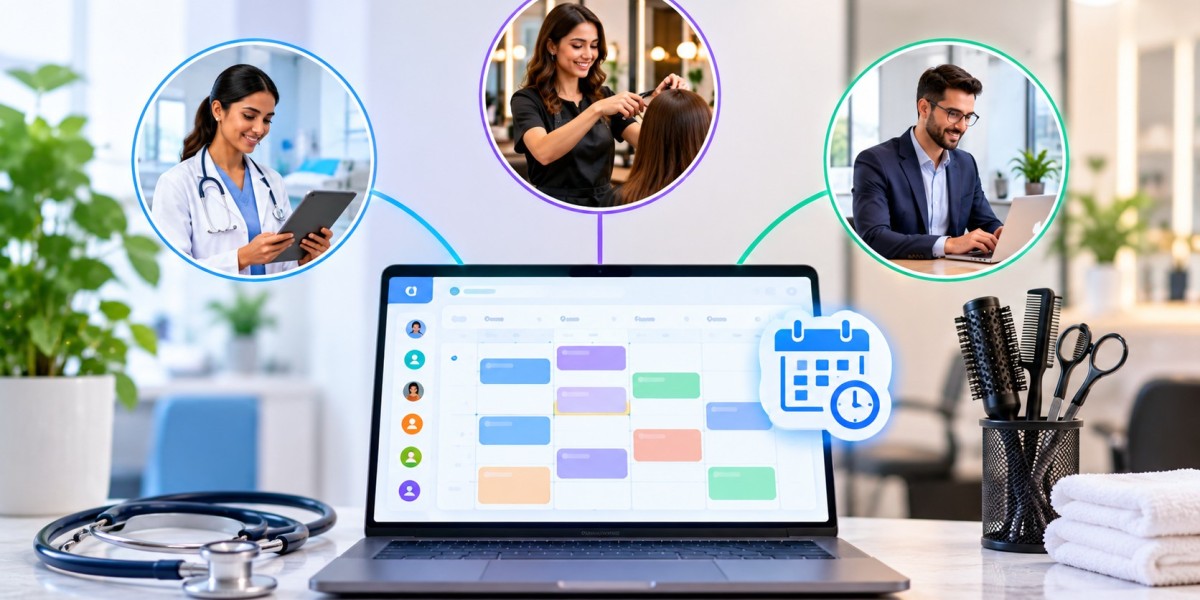


A missed appointment in a dental clinic costs more than an empty chair — it disrupts the entire day's patient flow. A double-booked stylist loses a repeat client to a competitor. A consulting firm that manually coordinates meeting rooms, partner availability, and client preferences wastes hours every week on logistics that should be automated. These are not isolated operational headaches; they are symptoms of disconnected scheduling and client management systems.
The best scheduling CRM software solves this by combining appointment booking, client relationship data, and automated communications into a single platform tailored to your industry's workflow. This article compares six leading scheduling CRM platforms built for healthcare providers, salon and spa operators, and professional services firms. You will learn which features matter most for your vertical, how these tools differ in practice, and what to evaluate before committing to a platform.
What Is Scheduling CRM Software and Why Does It Matter?
Scheduling CRM software combines appointment booking, client relationship management, and automated communications into a unified platform. It matters because fragmented scheduling and client data create no-shows, double bookings, and missed follow-ups — problems that directly reduce revenue and client retention across healthcare, salons, and professional services.
Traditional scheduling tools handle one function: placing appointments on a calendar. They do not track client history, automate reminders based on behavioural patterns, or connect booking data to broader relationship management workflows. A scheduling CRM closes this gap by treating every appointment as a data point within a larger client lifecycle.
When a patient books a follow-up consultation, the system already knows their treatment history, preferred time slots, and communication preferences. When a salon client reschedules a colour appointment, the platform adjusts stylist availability and sends a confirmation through the client's preferred channel. When a law firm schedules a discovery call, the CRM logs the interaction against the client's matter file and triggers the next step in the engagement sequence.
This integration eliminates the manual data transfer between separate booking tools, spreadsheets, and client databases that most growing businesses still rely on. The result is fewer scheduling errors, stronger client relationships, and operational visibility that standalone calendars simply cannot provide.
Why Healthcare, Salons, and Professional Services Need Industry-Specific Scheduling CRMs
Each industry operates under distinct scheduling constraints — healthcare requires compliance-aware booking and provider credentialing, salons need resource-linked service durations, and professional services demand multi-party coordination across time zones. A generic scheduling tool cannot address these vertical-specific requirements without extensive customisation, making industry-adaptive scheduling CRM software a practical necessity.
Healthcare Scheduling Requirements
Healthcare scheduling involves regulatory obligations that do not exist in other industries. Patient data must be handled in compliance with privacy regulations, appointment types vary dramatically in duration and resource requirements, and provider availability is constrained by clinical rotations, on-call schedules, and credentialing windows. A scheduling CRM for healthcare must support multi-provider calendars, referral tracking, and automated patient communications that respect consent preferences. The platform also needs to handle recurring appointment series for ongoing treatments, waitlist management for high-demand specialists, and integration with electronic health record systems where applicable.
Salon and Spa Scheduling Requirements
Salon scheduling is fundamentally resource-driven. Every appointment ties a specific service to a specific staff member, a specific room or station, and a specific set of products. A colour correction appointment may require three hours and a senior stylist, while a basic trim needs thirty minutes and any available chair. The scheduling CRM must calculate service durations dynamically, prevent resource conflicts, and allow clients to book based on stylist preference. Commission tracking, package management, and retail upselling at the point of booking are additional requirements that separate salon-grade platforms from generic tools.
Professional Services Scheduling Requirements
Professional services firms — including law practices, consulting agencies, accounting firms, and financial advisory practices — face scheduling complexity driven by multi-party coordination. A single client engagement may involve partners, associates, external counsel, and the client's own team, all operating across different time zones and availability windows. The scheduling CRM must support round-robin assignment, meeting room and resource allocation, matter-based or project-based calendar views, and automated follow-up sequences that keep engagements moving without manual intervention.
6 Best Scheduling CRM Software Platforms Compared
The best scheduling CRM software platforms for healthcare, salons, and professional services include Fresha, SimplePractice, Meon, Acuity Scheduling, Jane App, and Vagaro. Each platform addresses different vertical priorities, pricing models, and scalability requirements, making the right choice dependent on your specific industry, team size, and operational complexity.
1. Fresha
Fresha is a subscription-free scheduling and business management platform designed primarily for salons, spas, barbershops, and wellness businesses. Its core strength lies in its marketplace model: clients can discover and book services through the Fresha app, giving smaller businesses built-in client acquisition alongside scheduling functionality. The platform handles staff calendars, service menus with variable pricing, inventory tracking, and payment processing. Fresha's commission-based revenue model on new client bookings makes it attractive for businesses that want to avoid fixed monthly costs during early growth stages. However, its healthcare and professional services capabilities are limited, and businesses with complex multi-location or compliance-heavy requirements may outgrow its feature set.
2. SimplePractice
SimplePractice is built specifically for health and wellness practitioners, including therapists, psychologists, dietitians, and allied health professionals. The platform combines scheduling with electronic health records, telehealth video sessions, insurance claim management, and HIPAA-compliant client portals. Its scheduling module supports intake form automation, appointment reminders, and cancellation policy enforcement. SimplePractice excels in solo and small-group practice environments where clinical documentation and billing are as important as appointment management. Its limitations become apparent for businesses outside the health and wellness vertical, as the platform's workflows, terminology, and compliance features are tightly coupled to clinical practice requirements.
3. Meon
Meon is an AI-powered scheduling CRM platform designed to serve multiple industries from a single adaptive infrastructure. Its scheduling engine uses intelligent allocation logic to match appointments with the right staff member, resource, and time slot based on historical booking patterns and real-time availability. The platform includes industry-adaptive client profiles that restructure data fields and workflows depending on whether the user operates a clinic, salon, or professional services firm.
Meon's multi-channel automated reminder system sends confirmations and follow-ups through WhatsApp, SMS, and email, reducing no-show rates by reaching clients on their preferred communication channel. The staff and resource scheduling module handles complex allocation scenarios including shift rotations, room assignments, and equipment dependencies. A client self-service booking portal allows end users to book, reschedule, and cancel appointments without staff intervention, while the real-time scheduling dashboard provides managers with no-show analytics, utilisation reports, and capacity planning insights.
For businesses evaluating Appointment Scheduling CRM Software in India, Meon offers a particularly relevant combination of multi-industry flexibility, localised communication channel support, and AI-driven scheduling intelligence that adapts to diverse operational requirements.
4. Acuity Scheduling (by Squarespace)
Acuity Scheduling, now part of the Squarespace ecosystem, is a versatile appointment booking platform suitable for a wide range of service businesses. Its strengths include flexible appointment type configuration, intake form customisation, payment integration, and time zone detection for international clients. Acuity works well for consultants, coaches, tutors, and small healthcare practices that need straightforward scheduling without the overhead of a full CRM system. Its integration with Squarespace websites provides a seamless booking experience for businesses already using the platform for their online presence. The trade-off is that Acuity's CRM capabilities remain relatively basic compared to purpose-built scheduling CRM platforms, and businesses requiring advanced client lifecycle management may need to supplement it with additional tools.
5. Jane App
Jane App is a clinic management platform built for multidisciplinary health practices, including physiotherapy, chiropractic, massage therapy, and mental health clinics. The platform combines online booking, charting, billing, and insurance processing within a single interface. Jane's scheduling module supports multiple practitioners across different disciplines, room and equipment allocation, and class or group session management.
Its charting system includes discipline-specific templates, making it particularly valuable for practices that employ professionals with different documentation requirements. Jane App is strongest in the Canadian and North American healthcare markets, and its feature set reflects the regulatory and billing requirements of those regions. Businesses outside healthcare will find limited applicability.
6. Vagaro
Vagaro is a comprehensive business management platform serving salons, spas, fitness studios, and wellness businesses. Beyond scheduling, Vagaro includes point-of-sale processing, payroll management, marketing automation, and a client-facing marketplace similar to Fresha. Its scheduling engine supports class bookings, package management, and multi-location coordination. Vagaro's breadth of features makes it a strong all-in-one option for beauty and wellness businesses that want to consolidate operations into a single platform. The platform's complexity can be a drawback for smaller operations that need only scheduling and basic CRM functionality, and its healthcare and professional services capabilities are minimal.

Key Features to Evaluate by Industry
The best scheduling CRM software for your business depends on which industry-specific features directly address your operational bottlenecks. Healthcare practices should prioritise compliance and clinical integration, salons should focus on resource-linked booking and commission tracking, and professional services firms need multi-party coordination and engagement-based scheduling.
Healthcare-Specific Scheduling Features
Healthcare organisations should evaluate scheduling CRM platforms against several non-negotiable requirements. Patient data privacy compliance is the baseline — the platform must support encryption, access controls, and audit trails consistent with applicable regulations in your jurisdiction. Appointment type configuration must accommodate the wide variation in clinical visit lengths, from fifteen-minute medication reviews to two-hour surgical consultations.
Provider scheduling must account for rotating shifts, on-call obligations, and credentialing restrictions that determine which practitioners can see which patient types. Automated patient reminders should be configurable to respect consent preferences and communication channel choices, and the platform should support waitlist automation to fill last-minute cancellations without manual outreach.
Salon-Specific Scheduling Features
Salon and spa operators should look for scheduling CRM platforms that treat services, staff, and physical resources as interconnected variables. The system must calculate appointment durations based on the specific service combination a client selects, not just a flat time block. Stylist preference booking is essential — clients often choose their service provider as much as their service, and the scheduling engine must honour these preferences while optimising overall capacity.
Commission calculation tied to completed appointments, package and membership management, and retail product integration at the point of booking are features that directly impact revenue in salon environments. Multi-channel reminders, particularly through WhatsApp in markets where it is the dominant messaging platform, significantly reduce no-show rates in the beauty and wellness sector.
Professional Services Scheduling Features
Professional services firms require scheduling CRM capabilities that extend well beyond simple time-slot booking. Round-robin and skills-based assignment ensure that incoming client requests are routed to the appropriate team member based on expertise, availability, and current workload. Meeting room and video conferencing integration eliminates the friction of coordinating physical and virtual meeting logistics separately.
Engagement-based calendar views allow project managers to see all appointments related to a specific client matter or project in a single timeline, rather than navigating individual staff calendars. Automated follow-up sequences that trigger after meetings — sending recap emails, scheduling the next milestone, or requesting feedback — keep client engagements progressing without relying on manual task management.
Cross-Industry Essentials
Regardless of industry, every scheduling CRM should deliver reliable real-time availability synchronisation across all staff calendars, automated conflict detection, customisable booking rules and buffer times, mobile-responsive client booking interfaces, and reporting dashboards that surface utilisation rates, peak booking periods, and cancellation trends. These foundational capabilities determine whether the platform can scale with your business or will become a constraint as your client volume and team size grow.
How MEON Supports Multi-Industry Scheduling and Client Management
MEON provides an AI-driven scheduling CRM platform that adapts to healthcare, salon, and professional services workflows through industry-specific configurations, multi-channel client communications, and intelligent resource allocation. Its architecture allows businesses to deploy a single platform across diverse operational requirements without maintaining separate tools for each vertical.
MEON's scheduling engine addresses the core challenge that most businesses face when evaluating scheduling CRM options: the gap between generic booking tools and the specific operational logic of their industry. Rather than requiring businesses to force their workflows into a rigid template, MEON's AI-powered smart scheduling engine learns from booking patterns and adjusts allocation recommendations over time.
The platform's industry-adaptive client profiles restructure automatically based on the business type, ensuring that a dental clinic captures medical history and insurance details while a salon captures colour formulas and stylist preferences — all within the same underlying CRM infrastructure. This eliminates the need for separate software investments when a business operates across multiple service categories or expands into new verticals.
MEON's multi-channel reminder system is particularly valuable in markets where client communication preferences vary significantly. By supporting WhatsApp, SMS, and email within a single automation workflow, the platform ensures that reminders reach clients through the channel they actually check, rather than the channel the business finds most convenient to send.
The real-time scheduling dashboard provides operational leaders with no-show analytics, capacity utilisation metrics, and staff performance data that support evidence-based decisions about staffing levels, service pricing, and appointment availability. These insights move scheduling from a reactive administrative task to a strategic operational lever.
How to Choose the Best Scheduling CRM Software for Your Business
Choosing the best scheduling CRM software requires matching your industry's specific scheduling constraints, compliance obligations, and client communication expectations against each platform's capabilities. Evaluate total cost of ownership, integration requirements, scalability, and the depth of CRM functionality beyond basic booking before committing to a long-term platform decision.
Start by mapping your current scheduling workflow in detail. Identify every step from the moment a client requests an appointment to the post-visit follow-up, and note where manual intervention, data re-entry, or communication breakdowns occur. This exercise reveals which features will deliver the highest operational impact rather than which features sound most impressive in a product demo.
Consider your team's technical capacity. A platform with extensive customisation options is only valuable if your team has the time and skills to configure it properly. Conversely, an overly simplified tool may reduce onboarding friction but create limitations within months as your scheduling complexity increases.
Evaluate the platform's communication capabilities against your clients' actual behaviour. If your client base primarily communicates through WhatsApp, a platform that only supports email reminders will underperform regardless of its other strengths. Similarly, if your clients expect online self-service booking with real-time availability, a platform that relies on phone-based scheduling will create friction that drives bookings to competitors.
Assess integration requirements honestly. Your scheduling CRM will need to exchange data with your existing accounting software, marketing platform, and industry-specific tools such as electronic health records or point-of-sale systems. Platforms that offer pre-built integrations with your current technology stack will reduce implementation time and ongoing maintenance costs compared to platforms that require custom API development.
Finally, consider the total cost of ownership over a three-year horizon, not just the monthly subscription fee. Factor in onboarding costs, training time, data migration expenses, and the cost of any supplementary tools you will still need because the scheduling CRM does not cover certain functions. A platform with a higher monthly fee that eliminates two or three other software subscriptions often delivers better long-term value than a cheaper option that requires a fragmented technology stack.
Key Takeaways
- The best scheduling CRM software integrates appointment booking, client relationship data, and automated communications into a single platform, eliminating the data silos that cause no-shows and double bookings.
- Healthcare, salon, and professional services industries each have distinct scheduling requirements — compliance, resource-linked booking, and multi-party coordination respectively — that generic tools cannot address effectively.
- AI-powered scheduling engines, multi-channel reminders, and industry-adaptive client profiles are the differentiating features that separate advanced scheduling CRM platforms from basic booking tools.
- Platform selection should be driven by a detailed analysis of your current scheduling workflow, client communication preferences, and integration requirements rather than feature lists alone.
- Total cost of ownership over a multi-year period, including implementation, training, and supplementary tool costs, provides a more accurate basis for comparison than monthly subscription pricing.
- Multi-channel reminder systems that include WhatsApp alongside SMS and email deliver measurably stronger no-show reduction in markets where messaging app usage dominates client communication.
Conclusion
Selecting the best scheduling CRM software is not a generic technology decision — it is an operational choice that directly affects client retention, staff productivity, and revenue consistency. Healthcare practices need compliance-aware scheduling with clinical integration, salons require resource-linked booking with stylist preference management, and professional services firms depend on multi-party coordination across complex engagement timelines. The platforms compared in this article each serve different segments of this landscape, and the right choice depends on your specific vertical requirements, team size, and growth trajectory.
Evaluate candidates against your actual scheduling workflow, not their feature marketing. Prioritise platforms that solve your most costly scheduling problems first — whether that means reducing no-shows through multi-channel reminders, eliminating double bookings through intelligent resource allocation, or streamlining client intake through self-service portals. The best scheduling CRM software is the one that fits your operations closely enough to be used consistently by your entire team, not the one with the longest feature list.







