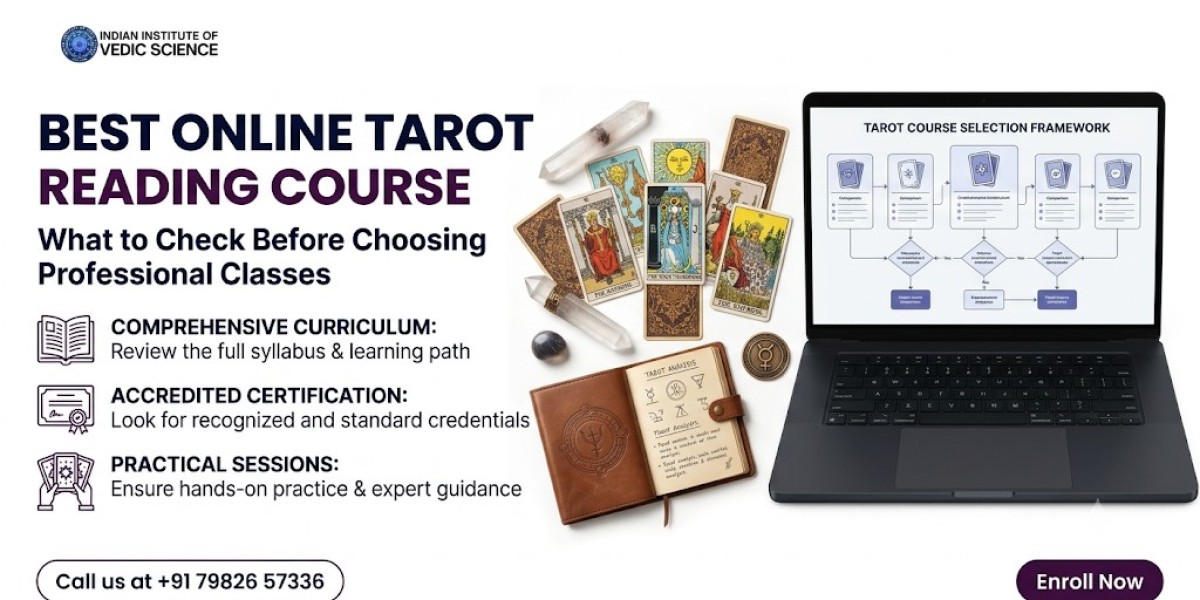


Best Online Tarot Reading Course: What to Check Before Choosing Professional Tarot Card Reading Classes
Choosing the right online course is an important first step for anyone who wants to understand Tarot cards, develop interpretation skills and explore professional opportunities in Tarot reading. With several online programmes, recorded lessons, live classes and certification options available, learners should evaluate more than just the course title or advertised fee before enrolling.
A structured programme should help beginners understand Tarot fundamentals, recognise card symbolism, practise different spreads and develop a logical approach to interpreting readings. It should also provide opportunities to ask questions, discuss practical examples and improve through guided exercises. These elements matter whether someone wants to study Tarot as a personal interest or gradually develop the skills required to offer professional readings.
Searching for the best online tarot reading course often brings up many options. However, the right programme depends on your learning goals, preferred teaching format, available guidance, practical training opportunities and the depth of the syllabus. A course that explains card meanings without helping learners interpret complete readings may not provide the learning experience they expect.
At the Indian Institute of Vedic Science (IIVS), learners can explore educational opportunities in Vedic sciences and related subjects. Understanding how to evaluate a Tarot programme can help prospective students make an informed decision before beginning their learning journey.
This guide explains what to check before selecting professional Tarot classes, how to compare course structures and fees, what practical skills to develop, and how Tarot education relates to the wider field of astrology and holistic learning.
1. Understand What You Want to Learn Before Enrolling
Before comparing different programmes, identify why you want to study Tarot. Your objective will influence the course structure, level of training and amount of practical guidance you should look for.
Some learners are interested in understanding Tarot cards for personal development, reflection and exploring symbolic interpretations. Others want a more structured educational experience that helps them develop reading techniques and communicate interpretations clearly.
A beginner-friendly programme should explain the fundamentals before moving towards more complex reading methods. Students should not be expected to memorise dozens of card meanings without understanding how those meanings connect with questions, spreads and surrounding cards.
When researching tarot reading online, consider whether the programme matches your current knowledge and future expectations.
For example, a beginner may need:
An introduction to Tarot and its historical and symbolic background.
An explanation of the structure of a Tarot deck.
Guidance on Major Arcana and Minor Arcana cards.
Basic card meanings and interpretation techniques.
Introduction to common Tarot spreads.
Practice exercises for interpreting cards.
Guidance on asking and understanding questions.
Opportunities to clarify doubts with an instructor.
Learners with some previous experience may want more advanced interpretation exercises, complex spreads and opportunities to practise complete readings.
Your objective should be clear before you compare course fees or certification options. This makes it easier to distinguish a programme that offers structured learning from one that only provides a collection of introductory videos.
2. Check the Complete Tarot Card Reading Course Syllabus
The syllabus is one of the most important factors when evaluating any educational programme. A course should provide a clear learning pathway rather than presenting disconnected information about individual Tarot cards.
A comprehensive tarot card reading course should introduce students to the deck, explain its symbolism and gradually develop their ability to interpret combinations of cards.
Understanding the structure of a Tarot deck
Most traditional Tarot decks contain 78 cards divided into two major sections: Major Arcana and Minor Arcana.
The Major Arcana consists of 22 cards, generally associated with significant themes, experiences, transitions and stages of personal development. The Minor Arcana contains 56 cards divided into four suits.
Students should understand the structure of the deck before moving towards complete readings. This foundation makes it easier to understand why different cards may communicate different themes within a spread.
Learning Major Arcana cards
Major Arcana cards introduce important symbolic themes. Examples include The Fool, The Magician, The High Priestess, The Empress, The Emperor, The Lovers, The Chariot, Strength, The Hermit and The World.
A structured programme should explain more than the commonly assigned meaning of each card. Students should explore:
The visual symbolism within the card.
The central theme represented by the card.
Traditional upright interpretations.
Reversed interpretations, where included in the teaching method.
How the card's meaning changes according to the question.
How it interacts with other cards in a spread.
This helps students move beyond memorisation and develop a more thoughtful interpretation process.
Learning Minor Arcana cards
The Minor Arcana provides another important part of Tarot education. It includes four suits: Wands, Cups, Swords and Pentacles.
Each suit is associated with different symbolic themes. A programme should explain these associations and introduce students to the numbered cards and court cards.
Learners should understand how the suits, numbers and card illustrations contribute to interpretation. For example, the meaning of a card should be considered in relation to the question, surrounding cards and overall spread rather than treated as an isolated definition.
Understanding card combinations
A useful syllabus should gradually introduce card combinations. In an actual reading, multiple cards appear together, and students need to understand how their themes relate to one another.
This is where guided exercises become particularly valuable. Students can compare different combinations, discuss possible interpretations and learn how to build a coherent reading.
Before enrolling, check whether the syllabus covers these areas in sufficient depth and whether learners receive opportunities to practise them.
3. Evaluate the Teaching Method: Live Classes or Recorded Lessons
Online learning provides flexibility, but the teaching format can influence how effectively students understand a subject.
Some programmes offer recorded video lessons, while others provide instructor-led live sessions. Certain learning models combine both formats.
When comparing tarot reading online programmes, understand what each format offers and whether it matches your schedule and learning preferences.
Live instructor-led classes
Live classes allow learners to interact with instructors during scheduled sessions. Students may ask questions, discuss card interpretations and receive explanations when a concept is unclear.
This format can be useful for subjects that involve interpretation and practical application because learners can discuss different approaches instead of relying entirely on pre-recorded explanations.
Before choosing a live programme, check:
Whether classes follow a defined timetable.
How frequently sessions are conducted.
Whether students can ask questions during class.
Whether practical exercises are included.
Whether missed sessions can be accessed later.
How instructors support learners who need additional clarification.
Recorded video lessons
Recorded lessons offer flexibility because learners can study according to their availability. They can revisit difficult concepts, review card meanings and revise previously covered topics.
However, students should check whether recorded content is supported by doubt-clearing sessions or instructor interaction.
A collection of videos may introduce Tarot concepts, but learners may still need guidance when applying those concepts to complete readings.
Hybrid learning
A hybrid programme may combine recorded lessons with live instruction and practical exercises. This can provide flexibility while retaining opportunities for interaction.
The important point is not simply whether a course is live or recorded. It is whether the teaching method supports understanding, practice and consistent learning.
4. Practical Training Should Be a Major Part of the Programme
Understanding card meanings is only one part of learning Tarot. Students also need to develop the ability to interpret cards in context.
A course that focuses entirely on theory may leave learners uncertain about how to approach an actual reading.
When evaluating a tarot card reading course, check whether practical exercises are included throughout the programme.
Practising individual card interpretations
Beginners can start by selecting individual cards and explaining their central themes. They should learn to observe the imagery, identify important symbols and connect the visual elements with traditional interpretations.
This activity develops familiarity with the deck and helps learners become more comfortable discussing card meanings.
Practising different Tarot spreads
A spread determines how cards are arranged and interpreted during a reading. Students should understand why different spreads are used and how positions influence the interpretation of each card.
A structured programme may introduce:
One-card readings for focused questions.
Three-card spreads for exploring different aspects of a situation.
Relationship-oriented spreads.
Career and decision-focused spreads.
Larger spreads for more detailed exploration.
The course should explain the purpose of each spread and provide exercises to help learners understand how card positions work together.
Developing interpretation skills
A complete reading requires students to consider the question, the cards selected, the positions within the spread and the relationship between different symbols.
Students should practise explaining their interpretations in clear, balanced language. They should also learn that Tarot interpretations are subjective and should not be presented as guaranteed predictions or substitutes for professional advice in areas such as health, legal matters or financial decisions.
Receiving feedback
Feedback can help learners identify gaps in their understanding. It may highlight whether they are interpreting cards too literally, overlooking the context of a question or relying excessively on memorised meanings.
Before enrolling, ask whether practical assignments, guided exercises or instructor feedback are part of the learning experience.
5. Check the Instructor's Knowledge and Teaching Experience
The instructor plays an important role in any professional learning programme. A well-organised syllabus is valuable, but the quality of explanations and guidance also influences the learning experience.
Before selecting a course, explore the available information about the instructor and their teaching approach.
Consider whether the instructor:
Explains concepts in a structured and understandable way.
Demonstrates how to interpret cards in different contexts.
Encourages learners to ask questions.
Provides practical examples.
Explains the limitations of Tarot interpretation.
Helps beginners develop their own understanding rather than simply memorising answers.
If instructor profiles, sample lessons or course demonstrations are available, review them before making a decision.
A good learning environment should encourage curiosity, independent thinking and responsible communication. Students should be able to understand the reasoning behind an interpretation instead of depending on fixed statements for every card.
6. Compare Tarot Reading Course Fees and What Is Included
Fees are an important consideration when selecting an online programme. However, choosing a course only because it is inexpensive may not be the right approach.
The overall learning value depends on the syllabus, teaching format, practical sessions, instructor access, learning materials and duration.
When comparing tarot reading course fees, look at the complete programme rather than the advertised amount alone.
What can influence course fees?
Different factors may affect the fee structure of an educational programme:
Number of lessons and total learning hours.
Live classes versus recorded content.
Instructor-led practical sessions.
Availability of study materials.
Doubt-clearing opportunities.
Assignments and feedback.
Course duration.
Additional learning support.
Certification arrangements, where offered.
A course with more guided sessions may have a different fee structure from a self-paced introductory programme.
Questions to ask about the fees
Before making a payment, request clarity on what is included.
Ask whether the quoted amount covers the complete programme, whether there are additional charges for learning materials and whether any separate assessment or certificate fees apply.
Also check the payment schedule, refund policy and access period for recorded lessons.
Compare the complete learning experience
When comparing tarot course fees, avoid making decisions based only on promotional discounts or claims of limited-time availability.
Instead, compare the course content, teaching support and practical learning opportunities.
A transparent institute should be able to explain the programme structure and associated charges before enrolment.
7. Understand Certification and Course Completion Requirements
Some learners prefer programmes that provide a certificate after completing the course. Certification may serve as documentation of participation or completion, depending on the institute's policies.
However, a certificate alone does not establish practical competence or guarantee professional success.
Before selecting a programme, understand what the certificate represents and what students must complete to receive it.
Check the following:
Whether the programme provides a certificate.
Whether attendance is required.
Whether assignments or assessments are included.
Whether practical exercises form part of course completion.
Whether there are specific completion requirements.
Which organisation issues the certificate.
Whether the certificate is a course-completion document or represents another form of recognition.
Students should avoid assuming that every online Tarot certificate has the same status or meaning.
Professional development depends on actual understanding, ethical practice, communication skills and continued learning. Certification can document an educational experience, but it should not replace these essential elements.
8. Learn Ethical and Responsible Tarot Reading Practices
Professional learning should include responsible communication. Tarot readings often involve personal questions, emotional situations and decisions that matter to individuals.
Learners should understand how to communicate interpretations without creating unnecessary fear, pressure or unrealistic expectations.
An educational programme should encourage students to:
Respect the privacy of people seeking readings.
Avoid making absolute guarantees about future events.
Communicate uncertainty honestly.
Avoid frightening or manipulative statements.
Respect personal boundaries.
Avoid presenting Tarot as a replacement for medical, legal or financial professionals.
Encourage individuals to make their own informed decisions.
These principles are important for anyone considering offering readings to other people.
Professionalism is not limited to knowing the meanings of cards. It also involves understanding the responsibility that comes with communicating interpretations.
9. Explore Whether the Course Supports Long-Term Skill Development
Learning Tarot is a gradual process. Students may become familiar with the cards during an introductory programme, but interpretation skills improve through regular practice and revision.
Before choosing a course, consider whether it provides a foundation that can support continued learning.
A useful programme should help students develop the following abilities:
Card familiarity: Recognising the structure, imagery and traditional themes of the Tarot deck.
Interpretation: Understanding how card meanings relate to questions and positions within a spread.
Communication: Explaining interpretations in simple, balanced and understandable language.
Practical application: Using different spreads and practising complete readings.
Critical thinking: Avoiding rigid interpretations and considering the context of each reading.
Ethical awareness: Understanding personal boundaries, privacy and responsible communication.
Students should also develop a regular practice routine. Revisiting cards, maintaining a learning journal and comparing interpretations can help strengthen understanding over time.
A course should provide a starting point for this development rather than suggesting that professional-level ability can be achieved simply by memorising a list of card meanings.
10. How Tarot Learning Connects with the Wider Field of Astrology
Tarot and astrology are distinct subjects. Tarot primarily involves interpreting symbolic cards and their relationships within a spread, whereas astrology studies celestial bodies, planetary placements and their relationship with astrological charts and systems.
However, both subjects attract learners interested in traditional knowledge systems, symbolism, personal reflection and holistic education.
People exploring Tarot may also research other educational opportunities in this field. This is why searches for an astrology certificate course online or an astrology diploma course online may appear alongside searches for Tarot classes.
These programmes should not be treated as interchangeable. A Tarot course focuses on card interpretation, while an astrology course should teach its own concepts, terminology and methods.
Understanding online astrology education
Learners interested in broader Vedic sciences may explore an online astrology course with certificate to understand astrology through a structured curriculum.
When comparing the best astrology courses, students should evaluate the syllabus, instructor guidance, learning format, practical exercises and certification details.
Searches for the best astrology courses online, best astrology courses in india online and best online astrology courses in india often reflect the desire to find organised learning opportunities that are accessible remotely.
However, the word "best" should not be the only basis for selecting a programme. Students should compare the actual educational experience and determine whether the course meets their learning requirements.
Similarly, people researching the best online astrology classes should check whether sessions provide a clear progression from foundational concepts to practical application.
A programme described as the best online course for astrology should still be evaluated through its curriculum, teaching approach and learner support rather than promotional wording alone.
Should you study Tarot and astrology together?
Some learners choose to explore multiple subjects within the wider field of traditional and holistic education. Studying them separately can help build a clearer understanding of each discipline.
For example, a student may begin with Tarot to understand card symbolism and interpretation, then explore astrology to learn about planetary concepts and chart-based analysis.
The subjects may complement a broader personal learning journey, but the methods and knowledge requirements remain different.
If your primary objective is Tarot reading, choose a programme that gives sufficient attention to Tarot rather than selecting a general course that only briefly introduces the subject.
11. Online Learning Accessibility and Student Support
An online programme should be convenient to access and easy to follow. Students may be learning alongside employment, education or other responsibilities, so the course structure should be understandable before enrolment.
Check whether the programme offers a clear timetable, access to learning materials and a defined communication channel for academic questions.
Important considerations include:
Access to classes through a suitable online platform.
Clear instructions for joining sessions.
Availability of recorded lessons, if included.
Communication with instructors or academic support.
Access to notes and learning resources.
Clarity about course duration.
Information about missed classes and revision opportunities.
Students should also understand the technical requirements. A stable internet connection, suitable device and quiet learning environment can make online sessions easier to follow.
A well-organised learning experience should allow students to focus on understanding the subject instead of spending unnecessary time resolving basic access issues.
12. Common Mistakes to Avoid When Selecting a Tarot Course
Choosing a programme without checking its details can lead to mismatched expectations. Before enrolling, avoid these common mistakes.
Selecting a course only because of its low fee
A low fee does not automatically mean a programme offers suitable training. Review the syllabus, teaching format and learning support before comparing prices.
Assuming that memorising card meanings is enough
Memorisation may help beginners become familiar with the deck, but interpretation requires contextual understanding and practice.
Ignoring practical sessions
If a course provides only theoretical information, learners may find it difficult to apply their knowledge. Look for exercises and opportunities to discuss interpretations.
Choosing based only on a certificate
Understand what the certificate represents and what is required to earn it. Focus on the knowledge and practical skills developed during the course.
Overlooking the instructor's teaching approach
Course descriptions may look attractive, but students should also evaluate how clearly concepts are taught and whether questions receive meaningful answers.
Believing unrealistic professional guarantees
Be cautious of claims that promise guaranteed income, instant expertise or certain outcomes from Tarot readings. Skill development requires learning, practice and responsible communication.
Not checking the complete fee structure
Confirm the total cost, additional charges, payment terms and refund conditions before enrolling.
Avoiding these mistakes can help learners select a programme that is better aligned with their expectations.
13. Why Choose a Structured Learning Environment at IIVS?
The Indian Institute of Vedic Science (IIVS), a unit of Vedant FaithTech Group Pvt. Ltd., provides an educational environment focused on Vedic sciences and related learning areas.
For students exploring Tarot and other traditional subjects, the important first step is to understand the course structure, learning objectives and available academic guidance.
Before choosing any programme at IIVS, prospective learners can review the relevant course information and discuss their learning requirements through counselling.
A structured approach to course selection helps students understand:
What subjects are covered in the programme.
Whether the course is suitable for beginners.
How classes are organised.
What practical learning opportunities are available.
What course materials and support are included.
Whether a certificate is provided and what it represents.
What the complete fee structure looks like.
IIVS aims to help learners explore educational opportunities with greater clarity. Rather than choosing a programme based only on advertisements or fee comparisons, students should understand the learning experience and decide whether it matches their personal or professional objectives.
If you are unsure which course aligns with your interests, counselling can help you understand the available learning options and their requirements.
14. How to Make Your Final Decision
After comparing the syllabus, instructors, fees, teaching format and practical sessions, narrow your choices to programmes that match your learning objectives.
Use the following approach before enrolling:
Step 1: Define your objective. Decide whether you want to study Tarot for personal interest, structured learning or gradual professional development.
Step 2: Review the syllabus. Check whether the course includes card structure, Major Arcana, Minor Arcana, spreads, symbolism and interpretation.
Step 3: Evaluate the teaching format. Understand whether the programme offers live classes, recorded lessons or a combination of both.
Step 4: Check practical training. Look for guided exercises, sample readings, assignments and feedback opportunities.
Step 5: Review the instructor. Understand the instructor's subject knowledge and approach to teaching beginners.
Step 6: Compare the fees. Check the complete cost and what is included before making a payment.
Step 7: Understand certification. Confirm the issuing organisation and course-completion requirements.
Step 8: Ask questions. Clarify anything that is unclear about the programme, duration, support or learning resources.
This process can help you make a more informed decision and avoid selecting a course based solely on promotional claims.
Conclusion: Choose a Tarot Course That Builds Understanding and Practical Skills
Selecting an online Tarot programme requires more than comparing course names or promotional fees. Students should understand the syllabus, teaching methodology, instructor support, practical exercises, certification requirements and overall learning experience before making a decision.
A well-structured programme should introduce the Tarot deck systematically, explain Major and Minor Arcana, develop card interpretation skills and provide opportunities to practise different spreads. It should also encourage ethical communication, independent thinking and continued learning.
Whether you are beginning your journey or exploring Tarot as a potential professional skill, focus on building a strong foundation instead of expecting instant expertise.
If you are exploring Tarot or other Vedic science learning opportunities, the Indian Institute of Vedic Science can help you understand the available educational options.
Book your free counselling. Connect with IIVS to discuss your learning interests, understand course details and identify a programme that aligns with your educational goals.
Frequently Asked Questions
1. What should I check before choosing an online Tarot reading course?
Review the syllabus, instructor's teaching approach, class format, practical exercises, student support, course duration, fees and certification details. A structured programme should cover card meanings, symbolism, spreads and interpretation techniques.
2. Can beginners learn Tarot card reading online?
Yes. Beginners can study Tarot through online classes if the programme introduces the subject gradually. Look for lessons covering the deck structure, Major and Minor Arcana, card meanings, spreads and guided practice.
3. What is included in a Tarot card reading course?
The syllabus may include Tarot fundamentals, card symbolism, upright and reversed interpretations, Major and Minor Arcana, different spreads, card combinations and practical reading exercises. Exact coverage varies between institutes.
4. How much are Tarot reading course fees in India?
Tarot reading course fees vary according to the syllabus, duration, instructor involvement, class format, learning materials and practical support. Students should request the current fee structure directly from the institute rather than assuming that every programme has the same price.
5. What is the difference between live Tarot classes and recorded courses?
Live classes provide scheduled interaction with instructors, while recorded lessons offer more flexibility for self-paced study. Some programmes combine both formats to provide flexible learning and opportunities to clarify doubts.
6. Is a Tarot certificate necessary to learn Tarot reading?
A certificate is not necessary for understanding Tarot. However, some learners prefer a programme that provides a completion certificate. Students should check what the certificate represents and focus on developing actual interpretation skills.
7. Can Tarot reading become a professional skill?
Learners can explore Tarot as a professional skill by developing subject knowledge, interpretation abilities, communication skills and ethical practices. Practical experience and continued learning are important, and no course can guarantee professional success.
8. Are Tarot and astrology the same?
No. Tarot involves interpreting cards and their symbolic meanings, while astrology studies celestial placements and astrological systems. They are separate subjects with different learning methods and requirements.
9. Can I study Tarot and astrology online?
Yes. Both subjects are available through online educational programmes. Students should select separate, clearly structured courses according to their learning objectives and check the syllabus and practical training offered.
10. How do I choose between different online Tarot courses?
Compare the curriculum, teaching format, instructor support, practical exercises, course duration, fees and certification arrangements. Choose a programme that matches your current knowledge and learning goals.







