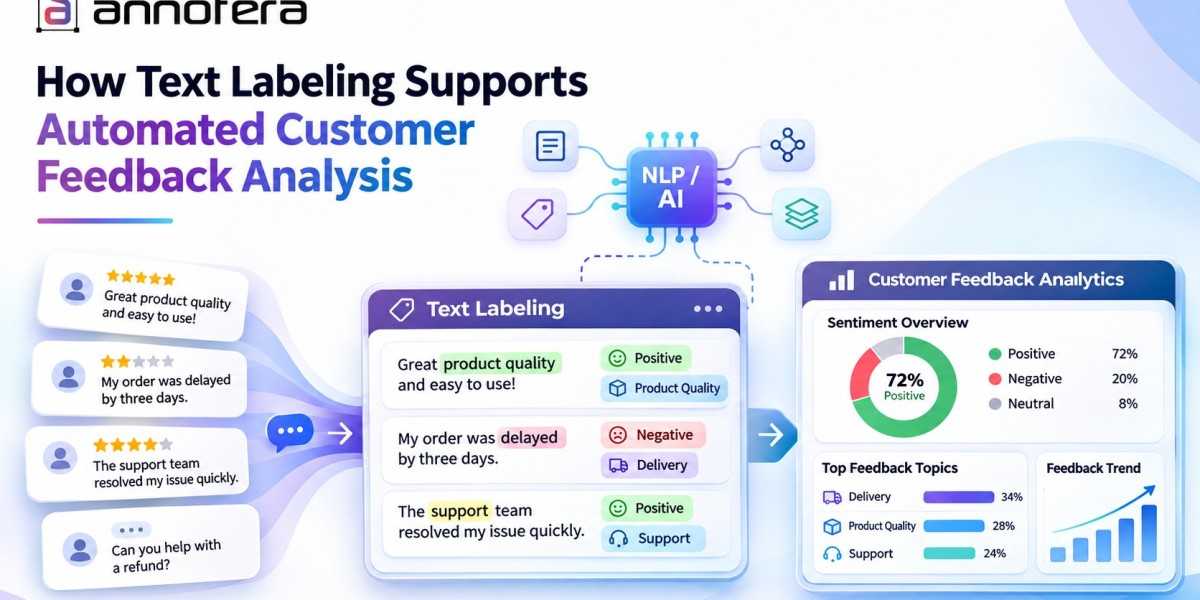


Customer feedback is one of the most valuable sources of information for businesses looking to improve their products, services, and customer experiences. Every day, organizations receive thousands of customer opinions through product reviews, surveys, emails, support tickets, social media comments, and chatbot conversations. While these interactions contain valuable insights, manually reviewing and categorizing such large volumes of unstructured text can be time-consuming and inefficient.
This is where automated customer feedback analysis becomes essential. Powered by Natural Language Processing (NLP), Machine Learning (ML), and Artificial Intelligence (AI), automated feedback analysis helps businesses identify customer concerns, understand sentiment, and recognize recurring patterns. However, the accuracy of these systems depends heavily on the quality of the data used to train them.
Text labeling plays a critical role in making automated customer feedback analysis more accurate and meaningful. By assigning structured labels to customer comments, organizations can train AI models to understand different feedback categories, recognize customer intent, and extract actionable insights from unstructured information.
Understanding Text Labeling in Customer Feedback Analysis
Text labeling is the process of assigning predefined tags or categories to textual information based on its meaning, context, and purpose. In customer feedback analysis, these labels help AI systems understand what customers are communicating rather than simply identifying individual words.
For example, consider the following customer comment:
"The product quality is excellent, but the delivery was delayed by three days."
A text labeling process can identify multiple attributes within this single statement:
Product quality: Positive sentiment
Delivery experience: Negative sentiment
Primary concern: Shipping delay
Customer intent: Expressing dissatisfaction with delivery
These labels convert unstructured customer feedback into organized information that machine learning models can process.
With properly labeled datasets, AI systems can classify incoming feedback, detect recurring complaints, and identify customer expectations with greater consistency.
1. Improves Intent Classification for Customer Feedback
Understanding why a customer is communicating with a business is just as important as understanding what they are saying. This is where intent classification becomes particularly valuable.
Intent classification involves categorizing textual input according to the underlying purpose of a customer's message. Common customer feedback intents include:
Reporting a product defect
Requesting a refund or replacement
Complaining about delivery delays
Asking for technical assistance
Providing product suggestions
Expressing satisfaction with a service
For instance, the statement "I received the wrong item and would like an exchange" indicates a replacement request rather than a general product complaint.
Accurately labeled training data helps NLP models distinguish between these different intentions, even when customers use informal language, abbreviations, or alternative expressions.
This allows automated feedback systems to route customer messages to the appropriate departments, prioritize urgent concerns, and support faster issue resolution.
2. Enables More Accurate Sentiment Analysis
Sentiment analysis helps businesses understand the emotional tone behind customer feedback. It generally categorizes opinions into positive, negative, or neutral sentiment, although more advanced systems can identify specific emotions such as frustration, disappointment, satisfaction, and excitement.
Text labeling provides the structured examples required to train sentiment analysis models.
For example:
Customer feedback | Sentiment label |
|---|---|
The support team resolved my issue quickly. | Positive |
My order arrived damaged. | Negative |
The product was delivered yesterday. | Neutral |
I am extremely disappointed with the service. | Negative |
However, sentiment identification is not always straightforward. Sarcasm, mixed opinions, cultural expressions, and contextual language can make classification challenging.
High-quality annotation helps models learn these linguistic variations and interpret customer opinions more accurately. Consequently, businesses can gain a clearer understanding of customer satisfaction and identify potential service issues before they escalate.
3. Organizes Large Volumes of Unstructured Customer Feedback
Customer feedback comes from multiple communication channels, including social media platforms, online marketplaces, review websites, customer surveys, and support conversations.
These sources generate large quantities of unstructured text that are difficult to analyze using traditional methods.
Text labeling helps organize this information into predefined categories, such as:
Product performance
Pricing and affordability
Customer support
Delivery and logistics
Website usability
Product features
Service reliability
Once the feedback is categorized, AI-powered analytics platforms can identify frequently mentioned issues and emerging customer preferences.
For example, an e-commerce company may discover that delivery-related complaints have increased significantly over the previous month. This insight can help management investigate logistics operations and address the underlying problem.
Structured text datasets therefore make customer feedback more accessible, measurable, and useful for business decision-making.
4. Helps Identify Recurring Customer Complaints and Trends
One of the biggest advantages of automated feedback analysis is its ability to identify patterns across thousands of customer interactions.
Text labeling allows AI models to recognize repeated concerns even when customers describe the same issue using different words.
Consider these customer statements:
"The application keeps crashing."
"I cannot open the mobile app."
"The application closes unexpectedly."
"The app stops working whenever I log in."
Although the wording differs, all four statements may relate to application stability.
With appropriate labels, AI systems can group these comments under a common category, such as Application Performance Issues.
This enables businesses to identify recurring product defects, service gaps, and customer experience problems.
Instead of evaluating individual complaints in isolation, organizations can analyze broader trends and prioritize improvements based on the frequency and severity of reported issues.
5. Strengthens Automated Customer Support Systems
Automated customer support platforms increasingly rely on NLP models to understand customer queries and provide relevant responses.
Text labeling improves these systems by helping them recognize customer intent, distinguish between different query types, and identify situations requiring human intervention.
For example, a chatbot trained on accurately labeled customer feedback can differentiate between a refund request, a billing complaint, and a technical support query.
It can then provide relevant information or transfer the conversation to the appropriate support representative.
Additionally, labeled datasets can help identify negative sentiment and frustrated customers, allowing businesses to prioritize interactions that require immediate attention.
For organizations handling high volumes of customer interactions, this improves support efficiency while creating more consistent customer experiences.
6. Improves Model Training Through High-Quality Annotation
The performance of automated feedback analysis systems depends on the quality, diversity, and consistency of their training datasets.
Poorly labeled information can introduce noise into machine learning models, resulting in incorrect sentiment detection, inaccurate intent recognition, and unreliable feedback categorization.
Businesses should therefore establish clear annotation guidelines and quality assurance processes.
Effective text annotation practices include:
Developing standardized labeling guidelines.
Using multiple annotators for complex or ambiguous feedback.
Maintaining consistency across different annotation teams.
Including diverse customer expressions and linguistic variations.
Conducting regular quality checks and resolving annotation disagreements.
Updating datasets to reflect evolving customer terminology and expectations.
Working with experienced text annotation outsourcing services can help organizations build high-quality datasets without investing extensively in internal annotation infrastructure.
A reliable text annotation company can provide trained annotators, scalable workflows, and structured quality control processes to support AI model development.
7. Supports Better Business Decisions Through Actionable Insights
Automated customer feedback analysis is not simply about categorizing customer opinions. Its real value lies in helping businesses make informed decisions.
When customer feedback is accurately labeled, organizations can use AI-powered analytics to identify product improvement opportunities, evaluate customer satisfaction, measure service performance, and understand changing market expectations.
For example, a retail business may discover that customers frequently appreciate product quality but consistently report difficulties with the checkout process.
This insight can encourage the company to improve website navigation, simplify payment procedures, and optimize the purchasing experience.
Similarly, SaaS companies can identify feature requests, recurring technical problems, and usability concerns to guide product development priorities.
Structured feedback analysis transforms customer opinions into measurable business intelligence.
How Annotera Supports Accurate Text Labeling
Developing reliable automated customer feedback analysis systems requires more than advanced AI algorithms. It requires carefully curated datasets that represent real customer language, diverse communication styles, and different feedback scenarios.
Annotera supports AI and machine learning development through high-quality text annotation solutions designed to improve training data accuracy and consistency.
Its annotation capabilities support applications such as sentiment analysis, intent classification, entity recognition, text categorization, and other NLP workflows.
Through scalable text annotation outsourcing services, Annotera helps businesses prepare structured datasets that support the development and optimization of intelligent feedback analysis systems.
Whether organizations are building customer service chatbots, feedback monitoring platforms, or advanced NLP applications, working with an experienced text annotation company can help establish a stronger foundation for reliable AI performance.
Conclusion
Automated customer feedback analysis enables businesses to understand customer expectations, identify recurring problems, and improve service delivery at scale. However, the effectiveness of these systems depends significantly on the quality of their underlying training data.
Text labeling bridges the gap between unstructured customer opinions and machine-readable information. From improving intent classification and sentiment analysis to identifying recurring complaints and strengthening automated customer support, accurate annotation makes feedback analysis more reliable and actionable.
As organizations continue adopting AI-driven customer experience solutions, investing in high-quality text annotation will remain essential for building intelligent systems that understand customers more effectively.
Looking to improve your AI models with accurately labeled text datasets? Partner with Annotera to develop high-quality training data for smarter, more reliable NLP applications.







