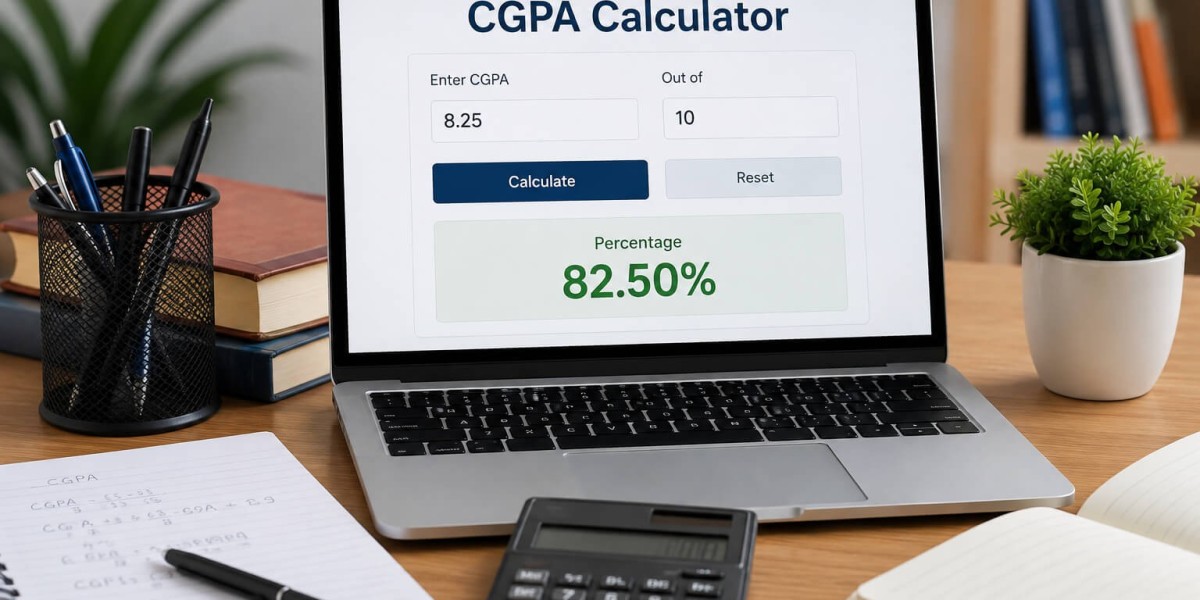


Are you confused about your CGPA and wondering how it translates into percentage marks? You are not alone. Thousands of students face this situation after receiving their semester results or final university marksheets. While educational institutions increasingly use grading systems, many admission forms, recruiters, and scholarship providers continue to ask for percentage scores. This is why knowing the correct method of cgpa to percentage conversion is important.
In this article, we will explain the meaning of CGPA, commonly used conversion formulas, practical examples, and important points students should remember before using their converted scores.
Understanding the CGPA Grading System
CGPA means Cumulative Grade Point Average. It is a grading method used by educational institutions to measure a student's overall academic performance.
Under this system, students receive grade points instead of relying exclusively on traditional percentage marks. These points are calculated according to the institution's grading rules and are generally averaged across multiple subjects or semesters.
For example, imagine a student receives the following semester scores:
- Semester 1: 8.0
- Semester 2: 8.5
- Semester 3: 7.8
- Semester 4: 8.2
The average CGPA can be calculated as:
CGPA = (8.0 + 8.5 + 7.8 + 8.2) / 4
CGPA = 8.125
This gives the student an overall academic score of 8.125, assuming equal weighting across the semesters.
Why Do Students Need Percentage Conversion?
Different institutions and organisations follow different academic evaluation systems. While one university may use CGPA, another may request percentage marks.
The cgpa to percentage process helps students understand their academic performance in a format that is widely recognised.
Here are some common reasons why conversion is necessary:
1. College Admissions
Students applying for postgraduate courses may need to meet minimum percentage requirements. Converting their grades helps them understand whether they meet the stated eligibility criteria.
2. Employment Opportunities
Many companies request academic percentages during recruitment. Fresh graduates may need to convert their final CGPA before completing employment applications.
3. Competitive Examinations
Some government examinations and professional courses require percentage-based academic information.
4. Scholarships
Scholarship programmes frequently use percentage-based eligibility criteria to identify qualifying candidates.
5. International Education
Students applying to foreign universities may need to provide converted academic information according to the receiving institution's evaluation requirements.
How to Calculate CGPA into Percentage
The most important step is identifying the correct conversion formula. One commonly used formula for a 10-point grading system is:
Percentage = CGPA × 9.5
Let's understand this through an example.
Suppose your final CGPA is 8.5.
Percentage = 8.5 × 9.5
Percentage = 80.75%
Therefore, your equivalent percentage is 80.75% when using the 9.5 conversion factor.
However, another formula used by several universities is:
Percentage = (CGPA - 0.75) × 10
If your CGPA is 8.5, the calculation becomes:
Percentage = (8.5 - 0.75) × 10
Percentage = 77.5%
Both calculations produce different results. Therefore, do not select a formula simply because it is commonly available online. Your university's official conversion policy should determine the correct method.
Quick Conversion Table
The following table uses the CGPA multiplied by 9.5 formula.
| CGPA | Percentage |
|---|---|
| 9.5 | 90.25% |
| 9.0 | 85.50% |
| 8.5 | 80.75% |
| 8.0 | 76.00% |
| 7.5 | 71.25% |
| 7.0 | 66.50% |
| 6.5 | 61.75% |
| 6.0 | 57.00% |
| 5.5 | 52.25% |
| 5.0 | 47.50% |
This reference table makes it easier to understand how different CGPA scores translate into percentages using the same conversion factor.
Can You Calculate Your Score Online?
Yes. An online cgpa to percentage calculator can make the process much easier. Instead of manually multiplying numbers or remembering different formulas, students can enter their CGPA and select the appropriate grading scale.
A useful calculator may support 4-point, 5-point, and 10-point grading systems. Some tools also provide semester-wise calculations, allowing students to enter multiple semester scores and obtain an average result.
However, students should remember that an online tool is only as reliable as the formula selected. Always verify that the calculation matches the university's prescribed method.
University-Specific Conversion Rules
Different universities may follow different calculation methods.
For example, CBSE commonly uses the 9.5 factor for its relevant CGPA grading system. VTU uses the formula (CGPA - 0.75) × 10 in its applicable regulations.
GTU uses (CGPA - 0.5) × 10 for the relevant CGPA, SPI, or CPI calculation. Delhi University has also used the 9.5 factor under its applicable guidelines.
Mumbai University has different conversion approaches for different programmes. Its engineering conversion formula is expressed as 7.25 × CGPA + 11.
Students should confirm the current rules for their specific course, academic scheme, and graduating batch.
Common Mistakes to Avoid
While converting academic grades, students should avoid these mistakes:
- Applying the 9.5 formula without checking university guidelines.
- Confusing semester SGPA with cumulative CGPA.
- Entering an incorrect grading scale.
- Rounding off the result too early.
- Using an unofficial conversion method for important applications.
- Assuming every university follows identical rules.
These small errors can create problems during admission or recruitment procedures.
Final Thoughts
Understanding cgpa to percentage conversion does not have to be difficult. Once you know your grading scale and the correct institutional formula, calculating your academic percentage becomes straightforward.
Whether you are applying for higher studies, searching for employment, or preparing scholarship documents, always prioritise accuracy. Keep your official marksheets and conversion guidelines available so that you can provide the correct academic information whenever required.







