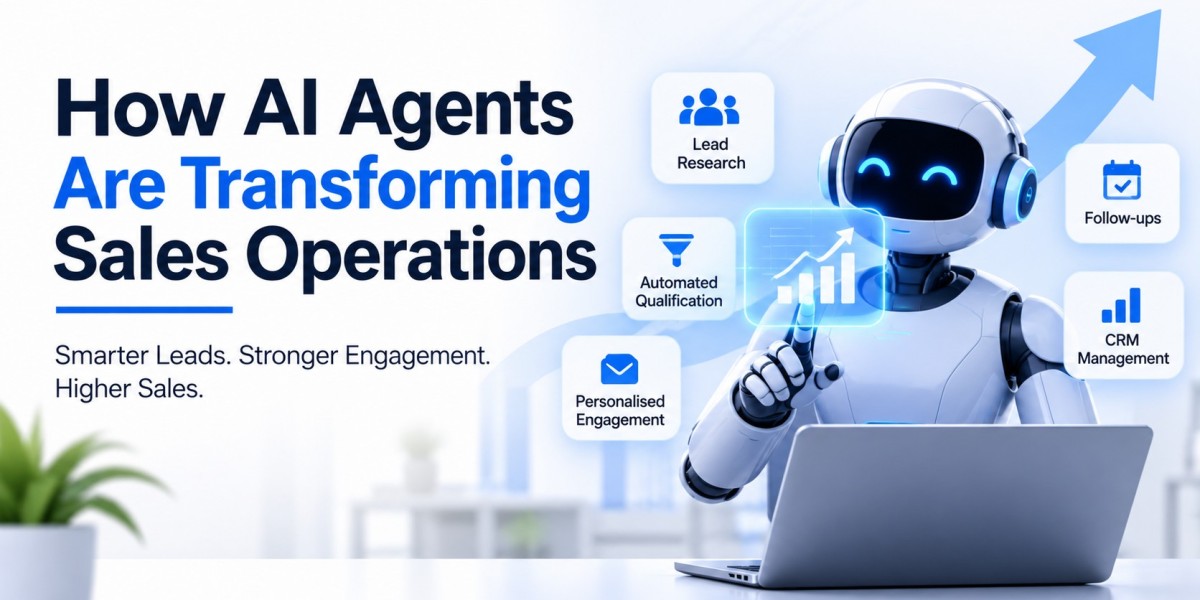


How AI Agents Are Transforming Sales Operations becomes clearer when businesses look beyond task automation and consider how intelligent systems can improve sales decisions. Sales managers need to understand which opportunities are progressing, where deals are getting delayed, and which customers may require additional attention. Traditional reporting tools provide historical information, but AI agents can help interpret that information, identify patterns, and recommend practical next steps. This creates opportunities for sales teams to make better-informed decisions throughout the customer journey.
Turning Sales Data Into Actionable Insights
Sales departments generate information through CRM platforms, website enquiries, email conversations, meetings, and customer interactions. However, having large amounts of data does not automatically make decision-making easier.
AI agents can analyse authorised sales information and organise it into meaningful summaries. They may identify changes in lead activity, highlight opportunities with incomplete information, or point out patterns in customer engagement.
For example, if several prospects from a particular industry repeatedly ask about the same product capability, an AI agent can identify that pattern and share it with the sales team. Managers can use the insight to improve sales presentations or prepare more relevant product information.
The objective is not simply to generate more reports. It is to make existing business information easier to interpret and act upon.
Predicting Sales Opportunities and Customer Behaviour
Sales forecasting often depends on historical performance, pipeline stages, representative estimates, and market conditions. These methods are useful, but manual forecasting can become difficult when businesses manage hundreds or thousands of opportunities.
AI agents can support forecasting by analysing historical sales records, current pipeline activity, conversion patterns, and other relevant business signals.
They may help identify:
Opportunities that show signs of progressing.
Deals with limited recent engagement.
Lead sources producing stronger conversion rates.
Sales periods with changing demand.
Accounts that may need additional attention.
Differences between expected and actual sales performance.
Predictions should be treated as decision support rather than guaranteed outcomes. Forecast accuracy depends on reliable data, appropriate models, and regular evaluation.
Identifying Sales Pipeline Bottlenecks
A healthy sales pipeline requires opportunities to move through different stages without unnecessary delays. When deals remain inactive for long periods, managers need to understand what is preventing progress.
An AI agent can review pipeline activity and identify recurring bottlenecks. It may highlight opportunities waiting for proposals, customers who have not responded to follow-ups, or deals that repeatedly remain in the same stage.
Sales managers can use these findings to investigate process issues and provide targeted support to representatives.
For example, if a team consistently experiences delays between product demonstrations and proposal submissions, managers may need to improve internal coordination or simplify proposal preparation.
This makes pipeline monitoring more proactive instead of relying only on periodic manual reviews.
Supporting Better Sales Decisions With Customer Insights
Different customers have different requirements, purchasing priorities, and communication preferences. Understanding these differences helps sales representatives recommend more relevant solutions.
AI agents can summarise previous interactions, identify frequently discussed requirements, and organise customer information for sales teams.
They can also help representatives prepare for meetings by presenting key account details, unresolved questions, and previous commitments.
When connected to authorised CRM and customer support systems, agents can bring together information that might otherwise remain scattered across separate applications.
Businesses should ensure that customer data is accurate, access is properly controlled, and sensitive information is handled according to applicable privacy requirements.
Combining Specialised Agents for Sales Intelligence
A single AI agent may support a specific reporting or research task. More advanced operations can use multiple specialised agents to coordinate different responsibilities.
For instance, a data analysis agent can examine sales performance, while a forecasting agent estimates potential outcomes. A customer intelligence agent can summarise account activity, and a workflow agent can recommend follow-up actions.
This multi-agent approach can connect insights with operational tasks. However, each agent needs a clearly defined purpose, access permissions, and boundaries for the actions it can perform.
Businesses exploring these capabilities can consider AI application development solutions to design intelligent systems around their sales processes and existing technology.
Measuring the Business Impact of AI-Driven Sales Operations
Implementing AI agents should produce measurable operational improvements. Businesses can evaluate their performance using indicators such as:
Average lead response time.
Lead-to-opportunity conversion rate.
Sales cycle duration.
Forecast accuracy.
Follow-up completion rate.
CRM data quality.
Revenue generated by different lead sources.
These measurements help managers understand whether automation is improving sales performance or simply adding another technology layer.
Organisations interested in developing intelligent business solutions can explore Nextwebi for its software development capabilities.
Frequently Asked Questions
1. How do AI agents help with sales forecasting?
They analyse historical sales information, pipeline activity, and conversion patterns to identify trends and support more informed forecasting decisions.
2. Can AI agents identify sales pipeline bottlenecks?
Yes. They can examine opportunity activity, identify delayed stages, and highlight deals that may require additional attention from sales managers.
3. Are AI-generated sales predictions always accurate?
No. Predictions depend on data quality, model performance, and changing market conditions. Sales teams should review forecasts before making important business decisions.
4. Can AI agents analyse customer behaviour?
Yes. With appropriate data access, they can summarise customer interactions, identify engagement patterns, and provide useful context for sales representatives.
5. Which metrics should businesses track after implementing AI agents?
Businesses can monitor lead response time, conversion rates, sales cycle duration, forecast accuracy, follow-up completion, and CRM data quality to evaluate results.







