

Metabolomics Data Normalization: How Dual MSTUS Improves LC-MS Accuracy and Sample Comparability
Metabolomics has become an essential tool for understanding biological systems, identifying biomarkers, and investigating metabolic changes associated with disease, environmental conditions, and experimental treatments. However, obtaining reliable results from liquid chromatography-mass spectrometry (LC-MS) requires more than accurate metabolite detection.
One of the biggest challenges researchers face is ensuring that measurements from different samples can be compared meaningfully. Variations in sample preparation, extraction efficiency, instrument performance, and ionization response can introduce unwanted differences into experimental datasets.
This is where metabolomics data normalization plays a critical role.
Advanced normalization approaches, including Dual MSTUS, help researchers reduce technical variability while preserving meaningful biological differences.
What Is Metabolomics Data Normalization?
Metabolomics data normalization is the process of adjusting measured metabolite signals to minimize unwanted technical variation between samples.
During LC-MS analysis, metabolite intensities may fluctuate because of factors unrelated to actual biological conditions.
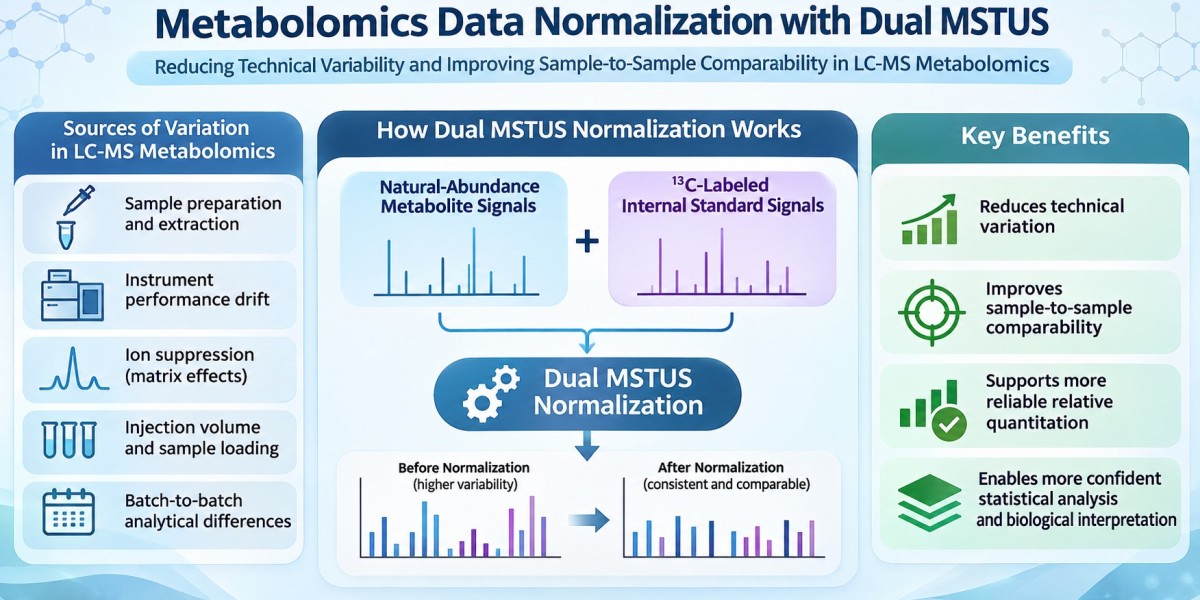
Common sources of variation include:
Differences in sample extraction and preparation
Variations in sample concentration and injection volume
Instrument sensitivity changes over time
Ion suppression and matrix effects
Batch-to-batch analytical differences
Inconsistent sample loading
Without appropriate normalization, these factors may influence statistical results and lead to incorrect conclusions about metabolic activity.
For example, a metabolite may appear more abundant in one biological sample simply because the instrument produced a stronger signal during that measurement.
Normalization helps distinguish such analytical differences from genuine biological changes.
Why Traditional LC-MS Normalization Methods Have Limitations
Several normalization techniques are commonly used in metabolomics research, including total signal normalization, median normalization, probabilistic quotient normalization, and internal standard-based approaches.
Each method offers advantages, but its effectiveness depends on the experimental design and underlying assumptions.
Total signal normalization, for instance, assumes that the overall measured metabolite signal remains sufficiently comparable across samples. This assumption may not hold when biological treatments cause widespread changes in metabolite abundance.
Similarly, normalization using a single internal standard may not adequately represent variations affecting chemically diverse metabolites.
Researchers therefore need normalization strategies that account for analytical variability without unintentionally removing biologically meaningful signals.
One approach designed to address these challenges is Dual MSTUS normalization.
Understanding Dual MSTUS Normalization in Metabolomics
MSTUS stands for Mass Spectrometry Total Useful Signal. This approach uses a collection of suitable metabolite signals to estimate normalization factors across experimental samples.
Rather than depending on one metabolite, MSTUS considers broader signal information to help reduce the influence of individual measurement fluctuations.
Dual MSTUS expands this concept by incorporating two complementary sources of information:
Natural-abundance metabolite signals from experimental samples.
Uniformly carbon-13-labeled internal standard signals that provide an analytical reference.
By evaluating both signal populations, researchers can obtain additional information about technical variation and biological differences.
For a more detailed explanation of the methodology, explore this guide to metabolomics data normalization using Dual MSTUS.
This approach is particularly relevant for studies where consistent quantitative measurements are essential for interpreting metabolic changes.
The Role of Isotope-Labeled Internal Standards
Internal standards are important tools for improving measurement reliability in quantitative metabolomics.
Stable isotope-labeled metabolites are chemically similar to their naturally occurring counterparts but can be distinguished by mass spectrometry because of their different isotopic compositions.
When appropriately incorporated into an analytical workflow, these standards provide reference signals that can help researchers evaluate variation introduced during sample processing and measurement.
For example, if an isotope-labeled reference produces different signal intensities across samples despite being added consistently, this may indicate changes in extraction recovery, ionization efficiency, or instrument response.
These observations can support more informed correction and normalization decisions.
Using a broad mixture of isotope-labeled metabolites also provides information across multiple chemical classes, potentially offering greater analytical coverage than a single reference compound.
How Dual MSTUS Improves Sample-to-Sample Comparability
Sample-to-sample comparability is fundamental to meaningful metabolomics research.
When comparing control and treatment groups, researchers need confidence that observed differences reflect biological conditions rather than technical inconsistencies.
Dual MSTUS provides a normalization framework that uses both experimental metabolite information and isotope-labeled reference signals.
1. Reducing Unwanted Technical Variation
Analytical measurements may change because of sample loading differences, instrument drift, or inconsistent signal response.
Dual MSTUS can help estimate and adjust for broader variations in analytical signal intensity.
2. Supporting More Reliable Relative Quantitation
Reliable comparisons require measurements that have been processed consistently.
Normalization can improve the suitability of metabolite intensity data for relative abundance comparisons, particularly when supported by appropriate internal standards and quality controls.
3. Improving Cross-Sample Interpretation
Researchers frequently analyze dozens or hundreds of samples collected across multiple experimental conditions.
A consistent normalization strategy can make comparisons more interpretable and reduce the likelihood that technical differences dominate downstream analyses.
4. Supporting Statistical Analysis
Normalized datasets provide a more appropriate foundation for analytical methods such as principal component analysis, clustering, fold-change estimation, and differential metabolite analysis.
However, normalization does not automatically eliminate every source of experimental error. Quality-control assessment remains essential.
Why Ion Suppression Correction Matters Before Normalization
Ion suppression is another major challenge in LC-MS-based metabolomics.
It occurs when compounds within a sample matrix interfere with the ionization of target analytes, reducing their measured signal intensity.
Importantly, ion suppression and global analytical variability are not identical problems.
A normalization method that adjusts overall signal intensity may not fully correct compound-specific ion suppression.
For this reason, workflows that incorporate both suppression correction and normalization can provide a more comprehensive approach to improving measurement consistency.
Researchers interested in these analytical challenges can review IROA Technologies' discussion of Dual MSTUS and sample-to-sample comparability, which explains how isotope-labeled reference information contributes to the normalization process.
Applications of Reliable Metabolomics Normalization
Accurate normalization supports research across a wide range of scientific fields.
Biomarker Discovery
In clinical and biomedical studies, researchers investigate metabolite patterns associated with disease progression, treatment response, and physiological changes.
Reliable normalization helps reduce technical interference when identifying potentially meaningful biomarkers.
Pharmaceutical Research
Metabolomics is used to investigate drug metabolism, toxicity, and treatment-related biochemical changes.
Consistent analytical measurements are important when comparing treated and untreated samples.
Nutritional Metabolomics
Dietary interventions can influence numerous metabolic pathways.
Normalization helps researchers assess changes in metabolite profiles while accounting for unwanted analytical variability.
Environmental and Agricultural Research
Metabolomics can reveal how organisms respond to environmental stress, nutrient availability, and changing growth conditions.
Improved sample comparability strengthens the interpretation of these experimental datasets.
Best Practices for Reliable LC-MS Metabolomics Data
Although advanced normalization methods can improve analytical consistency, successful metabolomics research requires a well-designed workflow.
Researchers should consider the following practices:
Standardize sample collection, storage, and extraction procedures.
Use suitable internal standards wherever possible.
Include pooled quality-control samples and analytical blanks.
Monitor instrument performance throughout sample acquisition.
Evaluate ion suppression and matrix effects.
Select normalization methods appropriate to the experimental design.
Compare data distributions before and after normalization.
Validate biological findings using appropriate statistical methods.
Importantly, researchers should assess whether normalization improves technical reproducibility without eliminating expected biological differences.
Advancing Reproducible Metabolomics Research
As metabolomics datasets become larger and more complex, the need for standardized analytical workflows continues to grow.
Reliable metabolite identification, suppression correction, normalization, and quality-control assessment all contribute to reproducible research.
Organizations such as IROA Technologies develop isotope-labeled standards, metabolite libraries, and analytical workflows designed to support more consistent quantitative metabolomics.
Combining appropriate reference materials with carefully selected data-processing strategies can help laboratories improve the quality and interpretability of LC-MS measurements.
Conclusion
Metabolomics data normalization is essential for generating meaningful comparisons across biological samples.
While traditional normalization approaches remain useful in many applications, methods such as Dual MSTUS offer an additional framework for incorporating isotope-labeled reference information into analytical correction.
By addressing technical variability, supporting sample-to-sample comparability, and complementing ion suppression correction, these approaches can strengthen quantitative metabolomics workflows.
Ultimately, reliable metabolomics depends on more than detecting metabolites. It requires carefully controlled experimental procedures, appropriate reference standards, validated data-processing methods, and ongoing quality assessment.
With these elements in place, researchers can produce more interpretable datasets and make better-supported biological discoveries.







