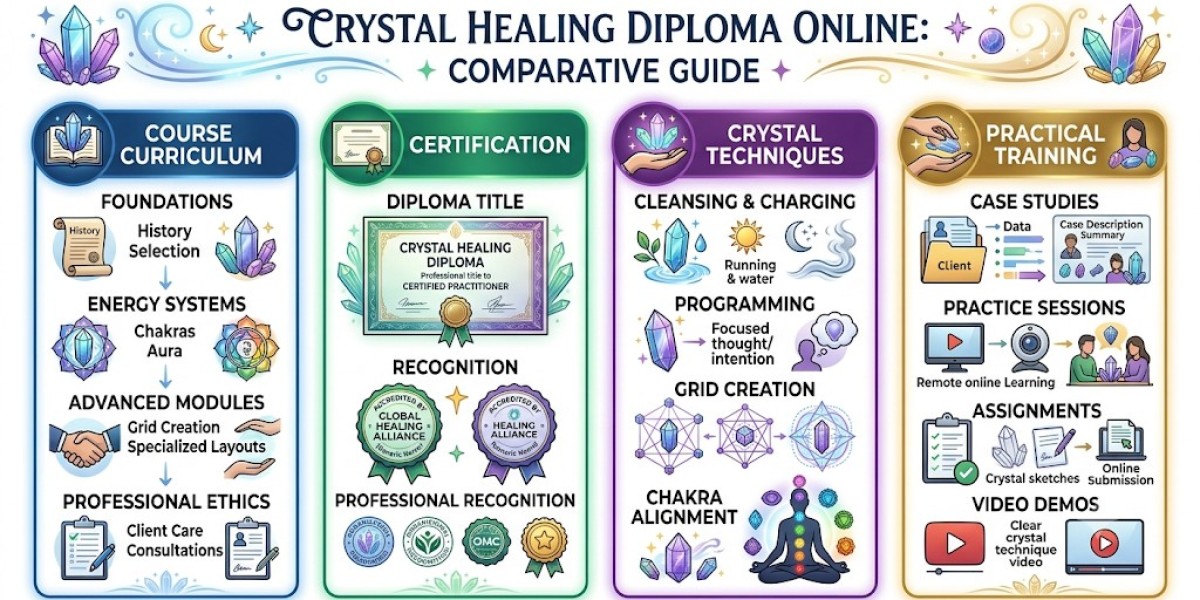


Crystal Healing Diploma Online: Compare Course Curriculum, Certification, Crystal Techniques and Practical Training
Crystal healing has become an area of interest for people exploring traditional wellness practices, spiritual learning and holistic approaches to personal development. From understanding different crystal types to learning about their traditional associations, beginners often want structured guidance before choosing a professional training programme. A well-organised course can help learners understand crystal properties, traditional techniques, responsible practices and the importance of practical learning.
Choosing a crystal healing course involves more than comparing course names or certificates. Learners should understand what the curriculum covers, whether the programme includes demonstrations, how practical exercises are organised, what type of certification is offered and whether the learning format matches their goals. These factors become particularly important when considering a crystal healing diploma or a structured online training programme.
Online education has also made it easier to explore specialised subjects from different locations. However, not every programme offers the same depth of learning or level of guidance. Comparing the curriculum, teaching approach and practical components can help learners make a more informed decision.
The Indian Institute of Vedic Science (IIVS) provides a learning platform for people interested in Vedic sciences and related holistic subjects. If you are exploring crystal healing education, understanding the following factors can help you evaluate available learning options before enrolling.
What Is Crystal Healing and What Does a Course Teach?
Crystal healing is a traditional complementary and spiritual practice that involves the use of crystals and gemstones within different wellness and meditation-related routines. Different crystals are traditionally associated with particular symbolic meanings, intentions and energy concepts.
For example, some traditions associate rose quartz with love and compassion, amethyst with calmness and spiritual awareness, and clear quartz with clarity or intention. These associations belong to traditional and spiritual belief systems. They should not be confused with scientifically established medical effects.
A structured crystal healing course introduces learners to the terminology, traditional concepts and methods associated with this subject. Instead of relying only on information available online, students can follow a learning sequence and understand how different concepts connect.
Depending on the programme, learners may study:
Introduction to crystal healing and its traditional background.
Common crystals and their traditional associations.
Crystal identification and basic handling.
Cleansing and charging concepts in different traditions.
Crystal placement and arrangement techniques.
Meditation and intention-setting practices.
Ethical considerations and responsible communication.
Guided exercises and practical demonstrations.
The actual curriculum varies between institutions. Therefore, learners should request a detailed syllabus before enrolling.
Why Consider a Crystal Healing Diploma Online?
An online programme can be a convenient option for people who want to study alongside their existing work, education or personal responsibilities. It removes the need to travel to a physical classroom and may allow learners to access lessons from different locations.
A structured crystal healing diploma may be suitable for beginners who want to explore the subject systematically rather than learning isolated techniques from different sources.
Here are some reasons learners consider online training.
1. Flexible Learning Environment
Online learning can help students manage their study schedules more conveniently. Depending on the teaching format, a programme may offer live sessions, recorded lessons, study materials or instructor-guided discussions.
Before joining, check whether classes are conducted live, whether recordings are available and how students can clarify their doubts.
2. Structured Understanding of Crystal Concepts
Learning about crystals involves more than memorising their names. Students may need to understand traditional associations, different crystal categories, handling practices and the context in which specific techniques are used.
A structured curriculum helps organise these concepts into progressive learning stages.
3. Guided Demonstrations
Practical demonstrations can help learners understand how crystals are selected, arranged and used in traditional exercises. A good learning programme should explain the purpose and limitations of each activity rather than presenting techniques without context.
4. Learning From Different Locations
Students from different cities can explore crystal healing courses online without relocating. This can be useful for working professionals, homemakers, students and individuals interested in holistic learning.
5. Opportunity for Further Study
Some learners begin with introductory concepts and later explore related subjects such as meditation, energy traditions, spiritual studies and other holistic disciplines.
However, learners should choose additional subjects based on their interests and the relevance of each curriculum rather than assuming that every discipline is interchangeable.
What Should a Crystal Healing Course Curriculum Include?
The curriculum is one of the most important factors to evaluate before selecting a programme. A course should provide a clear learning structure, explain its subject-specific concepts and offer appropriate opportunities to understand practical techniques.
When comparing courses on crystal healing, review the following curriculum areas.
1. Introduction to Crystals and Their Traditional Background
A beginner-friendly programme should introduce the history and traditional use of crystals across different cultural and spiritual practices.
Students may learn about:
The meaning of crystal healing in traditional wellness systems.
Common crystal and gemstone terminology.
Different types of crystals.
Traditional beliefs associated with selected stones.
The distinction between spiritual practices and scientific evidence.
This foundation helps learners understand the subject without making unsupported assumptions about the effects of crystals.
2. Types of Crystals and Their Traditional Associations
Different crystals are associated with different meanings in various spiritual traditions. A curriculum may introduce commonly discussed stones and explain their traditional significance.
Examples include:
Rose quartz: traditionally associated with love, compassion and emotional symbolism.
Amethyst: commonly associated with calmness and spiritual awareness.
Clear quartz: traditionally linked with clarity and intention.
Citrine: often associated with positivity and abundance symbolism.
Black tourmaline: traditionally connected with protection symbolism.
Lapis lazuli: associated in some traditions with wisdom and communication.
Learners should understand that these are traditional associations, not verified medical or therapeutic outcomes.
3. Crystal Cleansing and Charging Concepts
Cleansing and charging are commonly discussed concepts in crystal-related spiritual practices. Different traditions describe different methods, and a programme may explain their meaning and application.
Topics may include:
Traditional cleansing practices.
The use of water, where appropriate for the particular stone.
Sound-based cleansing traditions.
Moonlight and sunlight practices.
Intention-based rituals.
Storage and handling considerations.
An important part of this topic is learning that not all crystals are suitable for every cleansing method. Some stones may be damaged by water, direct sunlight or other environmental conditions. Students should be taught to check the physical properties and care requirements of individual stones.
4. Crystal Placement and Arrangement Techniques
Some traditional practices involve arranging crystals in particular patterns or placing them in specific spaces. A course may introduce crystal grids, symbolic arrangements and placement concepts.
Students should understand the purpose of each arrangement within the relevant tradition and learn how to approach these activities responsibly.
5. Meditation and Intention-Setting
Crystal-related meditation exercises may involve focusing attention, setting personal intentions or using a crystal as a symbolic object during a reflective practice.
A structured curriculum can explain:
Basic meditation preparation.
Intention-setting exercises.
Focus and observation.
Guided relaxation practices.
Reflective journaling.
Responsible use of symbolic objects.
These activities should be presented as personal or spiritual practices, not as substitutes for professional medical or mental health care.
6. Practical Exercises and Demonstrations
Practical learning is an important consideration when comparing programmes. Students should have opportunities to observe techniques, understand the sequence of activities and ask questions.
A course may include demonstrations of crystal identification, handling, arrangement, storage and guided exercises.
Before enrolling, ask whether the practical component is instructor-led, self-directed or supported by feedback.
How to Compare Crystal Healing Certification Options
Certification is another important consideration for learners evaluating professional training. However, a certificate's value depends on the course provider, curriculum, assessment process and the actual learning completed.
A crystal healing certification course should clearly explain what students are expected to study and whether any assessment is required.
Consider these factors before selecting a programme.
1. Course Content and Learning Outcomes
Check whether the institution provides a detailed syllabus. It should explain the topics covered and the knowledge or skills students are expected to develop.
Avoid selecting a programme based only on an attractive course title.
2. Certification Requirements
Ask whether the certificate is provided after completing the lessons, attending a required number of sessions or passing an assessment.
You should also understand the exact title of the certificate and what it represents.
3. Practical Learning Opportunities
A certification programme becomes more meaningful as a learning experience when students understand the techniques through demonstrations and guided exercises.
Check whether the programme includes practical activities, assignments or instructor feedback.
4. Instructor Guidance
A good learning environment should allow students to clarify questions and understand difficult concepts.
Before enrolling, ask about the teaching format, doubt-resolution process and availability of learning support.
5. Transparency About Recognition
Do not assume that every certificate is equivalent to a government-recognised academic qualification, professional licence or healthcare credential.
Ask the institution to explain the nature and scope of its certification. Students should understand what the certificate confirms and what it does not authorise them to do.
What Is the Difference Between Online Certification and Diploma Programmes?
Learners often compare a short certification programme with a more extensive diploma-style course. The right choice depends on the depth of learning, curriculum structure and personal objectives.
A crystal healing certification online programme may focus on introducing essential concepts and selected techniques. A diploma-style programme may offer a broader learning structure, depending on the institution.
Certification Programme
A certification programme may be appropriate for learners who want an organised introduction to crystal healing.
It may focus on:
Basic crystal terminology.
Traditional crystal associations.
Introductory cleansing concepts.
Fundamental handling practices.
Selected practical demonstrations.
Basic assessment or completion requirements.
The actual scope depends on the provider.
Diploma Programme
A diploma-style programme may be designed to cover a wider range of topics and provide a more detailed learning experience.
It may include:
Foundational crystal concepts.
Different crystal categories.
Traditional techniques and applications.
Crystal placement and arrangements.
Meditation-related exercises.
Practical demonstrations.
Ethical considerations.
More extensive assessments or assignments.
A longer programme is not automatically better. Learners should compare the actual syllabus, teaching quality and practical components before deciding.
How Important Is Practical Training in Crystal Healing?
Practical training helps learners connect theoretical concepts with demonstrations and guided exercises. It can also help students understand the limitations and appropriate context of different traditional techniques.
When evaluating crystal healing classes, look for a programme that explains the steps involved in each activity instead of simply listing techniques.
Useful practical learning areas may include:
Crystal Identification
Students can learn to recognise commonly discussed crystals through their appearance, names and basic characteristics. They should also understand that similar-looking stones may have different mineral compositions.
Crystal Handling and Storage
A programme may introduce appropriate handling, cleaning and storage practices. Students should understand that different stones have different physical properties and care requirements.
Crystal Arrangement
Guided demonstrations can help students understand traditional arrangements and crystal grid concepts.
Meditation Exercises
Students may practise simple meditation or intention-setting exercises using crystals as symbolic objects.
Practice Reflection
Reflection activities can help learners document what they have studied, identify questions and understand how different traditions describe particular techniques.
Practical learning should be educational and responsible. Crystal practices should not be promoted as proven treatments for medical conditions or as replacements for qualified healthcare services.
How to Choose the Best Crystal Healing Course
Searching for the best crystal healing course can produce many options, but the most suitable programme is the one that matches your learning goals and provides transparent information.
Use these considerations to compare available institutions.
1. Review the Complete Syllabus
A course page should provide enough information to understand what is included. If the syllabus is unclear, ask for a detailed module list before making a decision.
2. Check the Teaching Format
Understand whether the course includes live online classes, recorded sessions, demonstrations or independent study.
Choose a format that suits your schedule and preferred learning style.
3. Understand the Course Duration
Course duration should be considered alongside the number of topics, teaching hours and practical activities. A short programme may provide an introduction, while a longer programme may allow more time for detailed study.
Do not judge the quality of a programme by duration alone.
4. Ask About Practical Support
Find out whether students receive guided demonstrations, assignments, practice activities or feedback.
5. Verify Certification Details
Understand the certificate's issuing institution, completion requirements and scope. Avoid relying on broad claims of recognition without supporting information.
6. Compare Fees With Course Value
Compare the course fee with the curriculum, teaching format, instructor support and learning resources.
The lowest-priced programme may not provide the learning experience you need, while a higher fee does not automatically indicate better quality.
7. Evaluate the Institution
Review the institution's website, course information, communication process and available student support.
For learners exploring holistic and Vedic-science education, IIVS provides a platform to learn about its available courses and educational approach.
Who Can Consider Learning Crystal Healing?
A crystal healing course may interest different types of learners, depending on their personal and educational goals.
Beginners Interested in Spiritual Learning
People who are new to crystals may want to understand their traditional meanings, categories and common practices through a structured learning environment.
Holistic Wellness Enthusiasts
Individuals interested in meditation, reflective practices and traditional wellness concepts may explore crystal healing as an area of personal learning.
Students Exploring Complementary Subjects
Learners studying spiritual or traditional subjects may wish to understand how crystal-related practices are discussed in different belief systems.
Working Professionals
People with professional responsibilities may prefer online classes because they can study without travelling to a physical location.
Individuals Interested in Further Education
Some learners may want to explore additional subjects after completing introductory training. They should choose further education based on the relevance of the curriculum and their own objectives.
It is important to remember that completing a course does not automatically qualify someone to provide medical treatment, diagnose conditions or make health-related claims.
Exploring Related Learning: Astrology and Online Courses
People interested in crystal healing sometimes explore other traditional and spiritual subjects as part of a broader learning journey. Astrology is a separate discipline with its own concepts, terminology and methods of study.
If you are also interested in astrology, it is useful to evaluate it independently rather than assuming that crystal healing and astrology follow the same curriculum.
Learners searching for online astrology courses may want to understand topics such as planetary concepts, zodiac signs, houses, birth charts and traditional interpretative methods.
When comparing online astrology courses in india, consider the course syllabus, teaching format, practical horoscope analysis and instructor guidance.
A structured astrology course online may be useful for people who prefer learning from home. Before selecting an option, check whether the programme covers foundational concepts and provides opportunities to practise chart interpretation.
Students exploring astrology classes online should also understand how sessions are organised. Some programmes may provide live teaching, while others may use recorded lessons or a combination of learning formats.
If you are looking for online classes for astrology, compare the curriculum and practical learning opportunities rather than relying only on course titles.
Beginners who want to learn astrology online should look for a step-by-step approach that introduces basic terminology before moving to advanced interpretative concepts.
It is also important to review the details of astrology certification courses. Ask what the certificate represents, how completion is assessed and whether practical assignments are included.
A learner considering an astrology certificate course online should verify the course structure and issuing institution before enrolling.
For students seeking more extensive study, an astrology diploma course online may be worth comparing with shorter introductory programmes. The decision should depend on curriculum depth and learning objectives.
An online astrology course with certificate may appeal to learners who want documented evidence of course completion. However, the value and recognition of a certificate should always be checked with the provider.
People searching for the best astrology courses should compare course content, teaching quality, practical exercises and student support.
Similarly, when evaluating the best astrology courses online, focus on whether the programme provides a clear learning progression and opportunities to clarify doubts.
Common Mistakes to Avoid When Selecting a Crystal Healing Course
Before enrolling in a programme, avoid these common mistakes.
1. Choosing Only on the Basis of Price
Course fees matter, but they should not be the only deciding factor. Review the curriculum, learning resources and instructor support.
2. Ignoring the Practical Component
A programme that discusses techniques without explaining how they are demonstrated may not meet the expectations of learners seeking practical understanding.
3. Assuming Every Certificate Has the Same Recognition
Certificates can differ in their purpose and scope. Always verify the issuing institution and completion requirements.
4. Believing Unsupported Health Claims
Be cautious of programmes or advertisements that promise to cure illnesses, guarantee results or replace professional medical treatment through crystal practices.
5. Not Checking the Online Class Format
Before enrolling, understand whether sessions are live, recorded or self-paced. Check how questions are answered and whether learning materials remain accessible.
6. Enrolling Without Reviewing the Syllabus
A clear syllabus helps students understand the actual topics covered. Request the course outline if it is not available on the website.
Why Explore Crystal Healing Learning at IIVS?
Choosing an educational institution is an important step when beginning a new subject. Learners should look for clear course information, a structured learning approach and an opportunity to understand whether a programme matches their expectations.
The Indian Institute of Vedic Science (IIVS) focuses on educational programmes across Vedic sciences and related learning areas. Students interested in holistic and traditional subjects can explore the institute's available courses and request information about the programme relevant to their interests.
Before making an enrolment decision, ask about:
The complete crystal healing curriculum.
Online class format and session structure.
Course duration and learning schedule.
Practical demonstrations and guided exercises.
Certification and completion requirements.
Course fees and available learning support.
For course information, visit https://iivs.com/ or explore the IIVS courses page.
Conclusion: Choose a Crystal Healing Programme With Structured Learning
Selecting the right programme requires careful evaluation of the curriculum, certification, practical training and teaching format. Whether you are exploring introductory crystal healing classes, comparing crystal healing courses online or considering a crystal healing diploma, focus on the quality and transparency of the educational experience.
A well-structured learning programme should explain traditional crystal concepts, introduce appropriate techniques, provide opportunities to understand demonstrations and communicate the scope of its certification clearly.
Avoid choosing a course only because of promotional claims or promises of guaranteed results. Instead, compare the syllabus, ask questions and select a programme that supports your learning goals.
The Indian Institute of Vedic Science (IIVS) can be a starting point for exploring educational opportunities in Vedic sciences and related subjects. Visit https://iivs.com/ to learn more about the institute and its courses.
Ready to explore your learning options? Book your free counselling. Connect with the IIVS team, discuss your interests and understand the available course details before making your decision.
Frequently Asked Questions
1. What is a crystal healing course?
A crystal healing course is an educational programme that introduces learners to crystals, their traditional associations, handling practices and techniques used in different spiritual or wellness traditions. The curriculum may include crystal identification, cleansing concepts, placement, meditation and practical demonstrations.
2. Can beginners enrol in crystal healing classes?
Yes, many introductory crystal healing classes are designed for beginners. However, learners should check the eligibility requirements and syllabus before enrolling. A beginner-friendly programme should explain basic terminology and concepts before introducing more advanced techniques.
3. Are crystal healing courses online suitable for working professionals?
Yes. Crystal healing courses online can be convenient for working professionals because they allow students to study without travelling to a physical classroom. The suitability depends on the session schedule, availability of recordings and level of instructor support.
4. What is included in a crystal healing certification course?
A crystal healing certification course may cover crystal types, traditional associations, cleansing concepts, handling practices, placement techniques and guided exercises. The exact curriculum and certification requirements vary by institution, so students should review the syllabus before enrolling.
5. Can I pursue crystal healing certification online?
Yes, some institutions offer crystal healing certification online through live classes, recorded lessons or structured online learning. Before joining, check the teaching format, practical components, assessment requirements and certificate details.
6. What is a crystal healing diploma?
A crystal healing diploma is generally a diploma-style educational programme that may provide broader coverage of crystal-related concepts and traditional techniques. Its actual depth depends on the institution's syllabus, duration and learning requirements.
7. How do I find the best crystal healing course?
To find the best crystal healing course, compare the curriculum, practical demonstrations, instructor guidance, online learning format, duration, fees and certification details. Select a programme based on its educational value and your learning objectives rather than promotional claims alone.
8. Are all courses on crystal healing the same?
No. Different courses on crystal healing may vary in their curriculum, teaching approach, practical exercises, course duration and certificate requirements. Reviewing the complete syllabus is the best way to understand what a particular programme offers.
9. How long does it take to complete a crystal healing course?
The duration depends on the institution and course structure. Some programmes provide introductory training, while others may cover a wider range of concepts over a longer period. Ask the provider for the exact schedule and number of learning sessions.
10. Does crystal healing certification qualify someone to provide medical treatment?
No. Completing a crystal healing programme does not establish medical qualifications or authorise someone to diagnose or treat medical conditions. Crystal healing is associated with traditional and spiritual practices and should not replace qualified healthcare.
11. What practical techniques are taught in crystal healing training?
Depending on the curriculum, students may study crystal identification, handling, storage, traditional cleansing concepts, crystal arrangements, meditation exercises and intention-setting practices. The exact practical content should be confirmed with the institution.
12. What should I check before choosing a crystal healing certification online programme?
Review the syllabus, teaching format, practical demonstrations, instructor support, course duration, assessment requirements and certificate details. Also ask the institution to clarify the scope and recognition of its certification.
13. Can I study astrology along with crystal healing?
Yes, learners can explore both subjects as separate areas of study. However, astrology and crystal healing have different concepts and learning requirements. Students should select independent programmes with clear curricula for each subject.
14. How can I compare online astrology courses before enrolling?
When comparing online astrology courses, review the syllabus, class format, practical horoscope analysis, instructor guidance, course duration and certification details. Choose a programme that matches your current knowledge and learning objectives.







