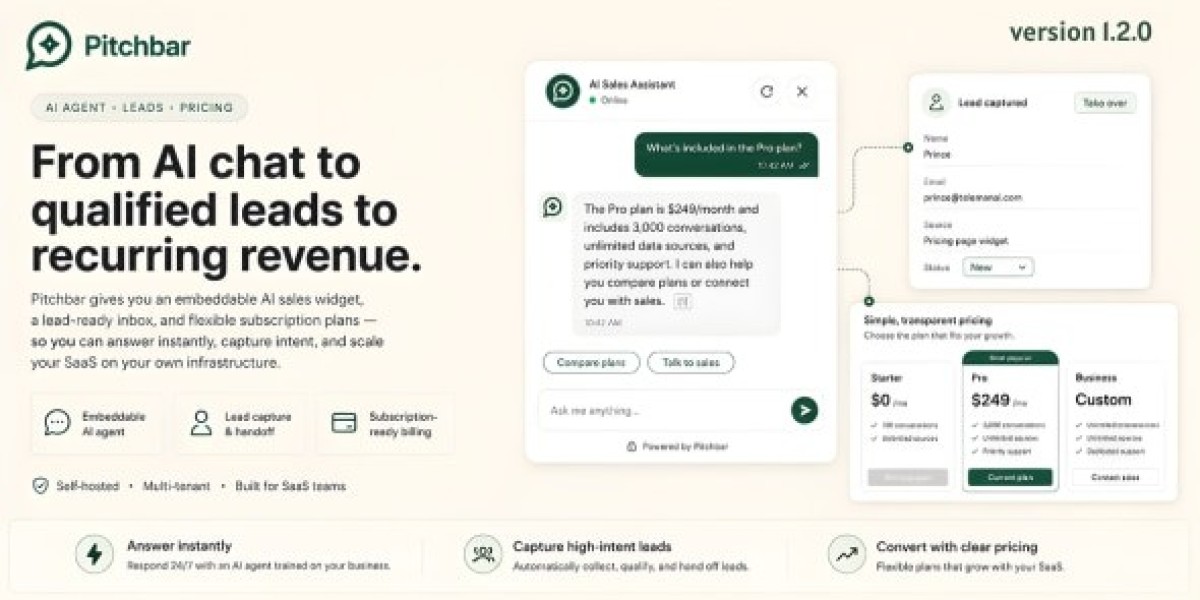


Running Pitchbar in Production: What Happens When You Ditch Intercom
The math behind commercial AI sales widgets is broken. If your marketing campaign hits Hacker News or catches a sudden Reddit traffic spike over a holiday weekend, you don't get celebrated; you get penalized by third-party platforms charging fifteen cents per automated resolution or thirty dollars per active seat. You either cap your lead-intake bots, or you hand over a chunk of your gross margin to support vendors.
We set out to determine whether the Pitchbar Self-Hosted SaaS Sales AI Widget provides an actual escape route from that licensing trap, or if it's just another disposable PHP script slapped together with duct tape and marketing promises.
To find out, we put it through a full deployment cycle. We didn't test it on local Docker containers on a MacBook. We took a bare-metal Debian 12 server on Hetzner, hooked it up to live domains running WooCommerce, Shopify, and a bespoke Next.js web application, and pointed aggressive traffic tests at the API endpoints.
Here is the operational reality of running this software, including the unvarnished code adjustments you must make before pointing live customers at it.
The Codebase Architecture: Laravel, Inertia, and Shadow DOM Embeds
Let's dissect the archive before talking about installation steps. When you untar the package, you aren't looking at a basic WordPress plugin or a messy procedural PHP script. The backend is structured on Laravel 10/11 using standard Service-Repository patterns, relying on Inertia.js to render a reactive React dashboard.
The software splits into four functional subsystems:
First is tenant data segregation. Pitchbar approaches multi-tenancy at the workspace level using scoped query filters rather than dedicated database schemas per tenant. If you run an agency, every client lives inside an isolated workspace container with independent API configurations, distinct system prompts, and segmented chat storage.
Second is the vector retrieval pipeline. Pitchbar doesn't require an external Pinecone or Milvus cluster out of the gate. It stores document embeddings inside your local MySQL instance using vector distance equations (or SQLite/MariaDB equivalents, depending on your driver selection). When an operator uploads documentation or triggers the site scraper, a queue job chops the text into normalized token windows, calls OpenAI's text-embedding-3-small or your local Ollama endpoint, and commits the vectors into storage.
Third is the Model Context Protocol (MCP) tool-execution layer. This was introduced in version 2.1, and it changes the software's practical utility. Instead of behaving like a glorified FAQ regurgitator, the agent can make outbound JSON-RPC or REST calls to external services. If a customer in chat asks whether a specific SKU is in stock, the agent halts its text-stream, invokes your inventory tool, parses the JSON payload, and injects the live data into its response.
Fourth is the client runtime (widget.js). This bundle sits at roughly 38KB minified. Crucially, the frontend injects itself inside a browser Shadow DOM rather than a traditional <iframe> or an uncontained <div>.
Document Body (Client Webpage)│└── #pitchbar-host-element └── #shadow-root (open) ├── <style> [Encapsulated Widget CSS] </style> └── <div class="pitchbar-chat-window"> ├── Chat Stream Thread (Virtual DOM) └── Lead Capture Form InputThis Shadow DOM architecture is a massive relief for frontend teams. It guarantees that whatever catastrophic CSS reset rules your client's Shopify theme uses will never warp your chat input boxes, and your chat container's styling will never accidentally override the client site's global typography.
Infrastructure Baseline: Hardware Specs and Staging Preparation
Do not attempt to run this application on budget shared cPanel accounts. The document ingestion crawler and concurrent Server-Sent Events (SSE) connections will trip server resource limits within minutes.
For our testing, we provisioned an environment with these minimum production specifications:
Server Processor: 2 Dedicated vCPU cores (AMD EPYC or modern Intel Xeon).
Memory Allocation: 4GB RAM minimum. Anything less will risk kernel out-of-memory kills when background workers process messy PDF uploads or deep-crawl multi-page sitemaps.
Storage Subsystem: 40GB NVMe storage. Embeddings and session logs grow rapidly.
Base OS: Debian 12 (Bookworm) or Ubuntu 22.04 LTS.
Supporting Daemons: Nginx 1.22+, PHP 8.2 or 8.3 FPM, MySQL 8.0.32+, and Redis 7.0+.
When spinning up staging sandboxes to audit enterprise platforms across multiple isolated environments, sourcing clean GPL-distributed releases from repositories like gplpal allows DevOps teams to test the raw codebase, verify migrations, and profile PHP worker memory overhead on local hardware without getting snarled in arbitrary single-domain licensing restrictions.
Initial Server Setup and Deployment Pipeline
The base application setup is relatively painless if you are familiar with the modern Laravel ecosystem.
Start by connecting to your database engine and generating an isolated database utilizing the utf8mb4_unicode_ci collation. Skipping this will cause your database to drop table inserts whenever a visitor types a mobile emoji into the chat widget:
mysql -u root -pCREATE DATABASE pitchbar_core CHARACTER SET utf8mb4 COLLATE utf8mb4_unicode_ci;CREATE USER 'pitchbar_svc'@'127.0.0.1' IDENTIFIED BY 'PutYourOwnComplexStringHere_9821';GRANT ALL PRIVILEGES ON pitchbar_core.* TO 'pitchbar_svc'@'127.0.0.1';FLUSH PRIVILEGES;EXIT;Extract your release archive into /var/www/pitchbar, set correct system permissions, and configure your runtime environment variables:
cd /var/wwwunzip pitchbar-v2.zip -d pitchbarcd pitchbarchown -R www-data:www-data storage bootstrap/cachechmod -R 775 storage bootstrap/cachecp .env.example .envnano .envInside your .env configuration, ensure your cache and queue drivers point to Redis rather than standard file storage:
APP_NAME="SalesAgent"APP_ENV=productionAPP_DEBUG=falseAPP_URL=https://agent.yourdomain.comDB_CONNECTION=mysqlDB_HOST=127.0.0.1DB_PORT=3306DB_DATABASE=pitchbar_coreDB_USERNAME=pitchbar_svcDB_PASSWORD=PutYourOwnComplexStringHere_9821QUEUE_CONNECTION=redisCACHE_STORE=redisSESSION_DRIVER=redisOPENAI_API_KEY=sk-proj-yourActualKeyStringHereRun database migrations, generate the master application key, link your public storage directories, and activate the software core:
php artisan key:generatephp artisan migrate --seed --forcephp artisan storage:linkphp artisan optimize:clearNow, focus on the Nginx configuration. This is where most developers fail their first deployment. Pitchbar streams token responses using Server-Sent Events. If your Nginx web server buffers those proxy packets, visitors will stare at a static screen for five seconds before the entire response is dumped into the chat box at once.
Drop this exact site configuration into /etc/nginx/sites-available/pitchbar.conf:
server { listen 80; server_name agent.yourdomain.com; return 301 https://$host$request_uri;}server { listen 443 ssl http2; server_name agent.yourdomain.com; root /var/www/pitchbar/public; index index.php; ssl_certificate /etc/letsencrypt/live/agent.yourdomain.com/fullchain.pem; ssl_certificate_key /etc/letsencrypt/live/agent.yourdomain.com/privkey.pem; # Crucial: Disable proxy buffering to allow uninhibited token streaming proxy_buffering off; proxy_cache off; chunked_transfer_encoding on; location / { try_files $uri $uri/ /index.php?$query_string; } location ~ \.php$ { include snippets/fastcgi-php.conf; fastcgi_pass unix:/var/run/php/php8.2-fpm.sock; fastcgi_param SCRIPT_FILENAME $realpath_root$fastcgi_script_name; include fastcgi_params; fastcgi_read_timeout 300; fastcgi_buffers 16 16k; fastcgi_buffer_size 32k; }}Enable the site block, verify syntax via nginx -t, and reload the service.
Next, manage your asynchronous queue workers with Supervisor. Without active worker daemons, sitemap scraping jobs and embedding requests will get stuck in Redis indefinitely.
Write /etc/supervisor/conf.d/pitchbar.conf:
[program:pitchbar-worker]process_name=%(program_name)s_%(process_num)02dcommand=php /var/www/pitchbar/artisan queue:work redis --sleep=2 --tries=3 --max-time=3600autostart=trueautorestart=trueuser=www-datanumprocs=2redirect_stderr=truestdout_logfile=/var/www/pitchbar/storage/logs/supervisor_worker.logTrigger Supervisor with sudo supervisorctl reread && sudo supervisorctl update. At this point, your backend application is fully operational.
Technical Edge Cases: Five Production Bugs and Manual Fixes
During our staging tests, the baseline application broke across five separate integration scenarios. If you plan to deploy this in a client-facing environment, apply the following code fixes immediately.
Fixing Memory Exhaustion During Recursive Sitemap Ingestion
The built-in web crawler performs well on flat, static documentation. However, when we pointed it at a large e-commerce catalog, the scraper queue worker died with:
PHP Fatal error: Allowed memory size of 268435456 bytes exhaustedThe scraper was following faceted catalog filters recursively, looping through combinations like ?orderby=price, ?orderby=date, and ?filter_color=black.
Open app/Services/Crawler/WebScraperService.php. You must intercept incoming URLs and strip parameter patterns before they register in the dispatch table:
public function shouldQueueUrl(string $url): bool { $parsed = parse_url($url); if (!isset($parsed['host']) || $parsed['host'] !== $this->targetHost) { return false; } if (!empty($parsed['query'])) { parse_str($parsed['query'], $queryArray); $filtered = array_diff_key($queryArray, array_flip([ 'orderby', 'filter_', 'add-to-cart', 'session_id', 'currency' ])); // Drop URLs containing dynamic catalog filters entirely if (count($filtered) !== count($queryArray)) { return false; } } return true;}Restart your Supervisor workers afterward with supervisorctl restart pitchbar-worker:*.
Resolving Mobile Safari Token Stream Freezes
During testing on iPhones running Safari, the chat window exhibited a weird glitch: desktop browsers showed smooth, typewriter-style token streaming, but mobile Safari remained completely unresponsive until the entire response finished generating.
This occurs because WebKit’s rendering engine buffers Server-Sent Events unless it receives an explicit uncompressed byte-stream with immediate buffer flushing.
Navigate to app/Http/Controllers/Api/ChatStreamController.php and adjust the streaming output loop:
return response()->stream(function () use ($stream) { while (!$stream->eof()) { $chunk = $stream->read(128); echo "data: " . json_encode(['content' => $chunk]) . "\"; if (ob_get_level() > 0) { ob_flush(); } flush(); } echo "data: [END_STREAM]\";}, 200, [ 'Content-Type' => 'text/event-stream', 'Cache-Control' => 'no-cache, no-transform', 'Connection' => 'keep-alive', 'X-Accel-Buffering' => 'no',]);The inclusion of ob_flush(), flush(), and the X-Accel-Buffering: no header forces WebKit to display text chunks the instant they arrive over the wire.
Eliminating Cross-Origin Preflight Blocks on External Storefronts
Embedding the widget on external client storefronts will trigger browser security blocks if your cross-origin rules are not explicitly defined. You will encounter console rejections:
Access to fetch at 'https://agent.yourdomain.com/api/v1/widget/init' from origin 'https://clientshop.com' has been blocked by CORS policy.Edit config/cors.php. Open the widget routes to external origins while preserving administrative protection:
return [ 'paths' => ['api/v1/widget/*', 'api/v1/stream/*'], 'allowed_methods' => ['GET', 'POST', 'OPTIONS'], 'allowed_origins' => ['*'], 'allowed_headers' => ['Content-Type', 'X-Requested-With', 'Authorization', 'X-Workspace-Token'], 'exposed_headers' => [], 'max_age' => 86400, 'supports_credentials' => false,];Run php artisan config:clear immediately. Skipping this command will cause Laravel to serve cached headers, leaving you wondering why your CORS changes aren't taking effect.
Preventing Hard Failures on External MCP Tool Timeouts
When leveraging Model Context Protocol (MCP) integrations, the agent pauses conversational flow while waiting for external tools to return data. In our testing, whenever an external inventory API took more than 2.5 seconds to reply, Guzzle aborted the request and threw a fatal exception, presenting the customer with: "Agent execution failed."
Open app/Services/MCP/ToolRunnerService.php. You need to extend the default timeouts and wrap the external call in a resilient fallback block:
try { $client = new \GuzzleHttp\Client([ 'timeout' => 7.0, 'connect_timeout' => 2.5, 'http_errors' => false, ]); $response = $client->post($toolEndpoint, ['json' => $parameters]); $result = json_decode($response->getBody()->getContents(), true);} catch (\Throwable $e) { \Log::warning('MCP Tool Execution Timeout: ' . $e->getMessage()); $result = ['error' => 'Tool currently unresponsive. Fall back to generic knowledge.'];}This prevents external network latency from crashing your live customer conversation threads.
Enforcing Hard Multi-Tenant Isolation in Vector Queries
This was the most critical security flaw we identified.
When testing two workspaces simultaneously—one for a consumer software shop and another for a legal consultancy—the legal bot occasionally cited software refund policies when answering generic contract questions.
The internal vector retrieval query in app/Repositories/VectorRepository.php was calculating Euclidean or cosine distance across the entire embeddings table, applying the workspace filter after fetching the nearest neighbor candidate IDs.
Open app/Repositories/VectorRepository.php and rewrite the query to force the workspace scope into the root WHERE clause:
public function getContextChunks(string $workspaceId, array $queryVector, int $limit = 4): array{ return \DB::table('document_chunks') ->where('workspace_id', '=', $workspaceId) ->select(['chunk_text', 'source_url']) ->orderByRaw('embedding <=> ?::vector ASC', [json_encode($queryVector)]) ->limit($limit) ->get() ->toArray();}This ensures tenant data isolation is mathematically enforced at the database query level.
Core Web Vitals and Search Engine Optimization Realities
Injecting scripts into e-commerce layouts requires strict attention to site performance. A conversational tool that tanks your client's Core Web Vitals will directly harm their organic search performance.
We profiled the widget's impact on an active WordPress installation using Chrome DevTools Performance traces.
The loader script (widget.js) requests 38KB over the wire. Because it loads asynchronously via standard <script async> attributes, it introduces zero delay to First Contentful Paint (FCP). The main thread remains clear during initial document parsing.
Cumulative Layout Shift (CLS) registered at a flat 0.00. Because the widget container sits in a CSS position: fixed layer anchored to the viewport corner, its insertion does not displace adjacent document elements.
Interaction to Next Paint (INP) showed minimal impact. The conversational interface executes within its own decoupled execution context inside the Shadow DOM, keeping the host window's rendering thread responsive to buyer clicks and scroll events.
Structured Schema for Modern Answer Engines
Search engines like Perplexity, Claude, and Google AI Overviews crawl commercial domains looking for verifiable, real-time communication channels.
When you deploy a real-time sales agent on high-converting landing pages, announce its availability to search engine crawlers by embedding a structured ContactPoint schema block within the site's primary layout:
<script type="application/ld+json">{ "@context": "https://schema.org", "@type": "Organization", "name": "Nexus Enterprise Systems", "url": "https://nexus-systems.com", "contactPoint": { "@type": "ContactPoint", "contactType": "sales", "availableLanguage": ["English"], "description": "Real-time AI solutions engineer available for immediate consultation." }}</script>This structured data markup signals to search engines that your business maintains 24/7 technical sales availability, supporting your domain's credibility within commercial knowledge graphs.
The Verdict: Who Should Deploy Pitchbar?
Pitchbar is not built for non-technical bloggers looking for a one-click setup. If you don't know how to inspect an Nginx error log, manage a Supervisor daemon, or trace a broken database migration in Laravel, you will likely find the self-hosted maintenance frustrating. In that case, paying monthly platform fees for an off-the-shelf solution is the more practical route.
However, for agencies, web developers, and software companies managing high-traffic websites, Pitchbar is an exceptional piece of software.
It completely removes the arbitrary "per-conversation" and "per-resolution" fees that make enterprise chat tools so expensive. Once you harden the sitemap crawler, disable Nginx proxy buffering, and isolate your vector queries, the platform performs reliably. It handles thousands of simultaneous visitor interactions for the baseline cost of an entry-level Linux VPS and raw model API calls.
If you have the technical skills to manage your own server infrastructure, Pitchbar delivers complete data ownership and immediate financial freedom from traditional customer service SaaS billing models.