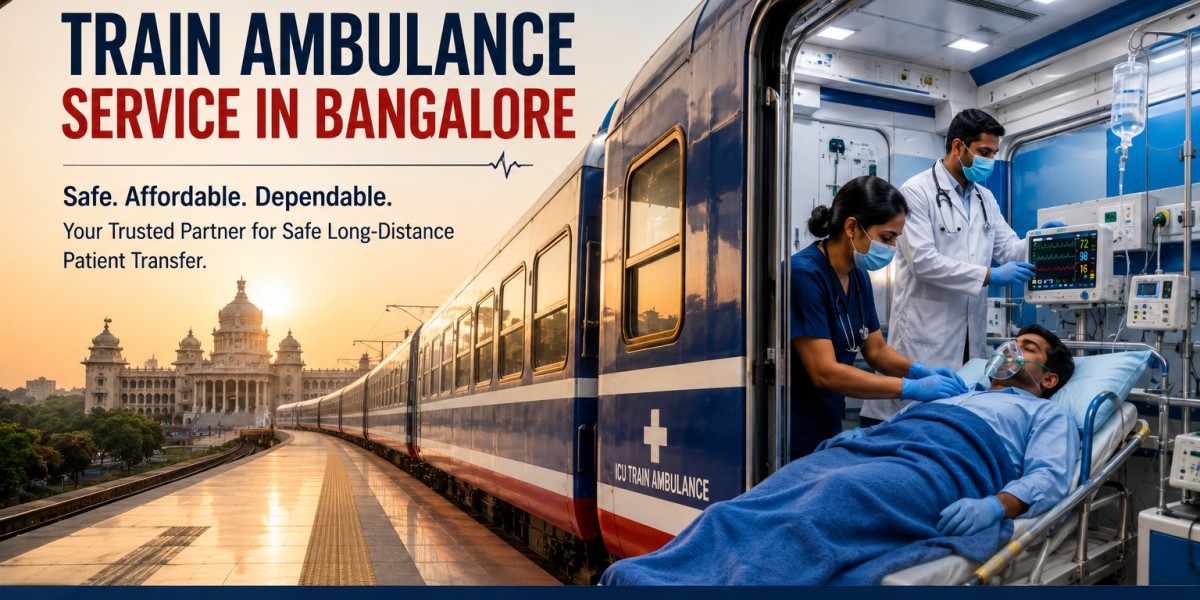


When doctors recommend shifting a patient to another city, families are often overwhelmed. Questions like "How will we transport a critically ill patient?", "Will the patient remain stable during the journey?", and "Can we afford an air ambulance?" quickly become major concerns.
For many families, a Train Ambulance Service in Bangalore provides the right balance of medical safety, affordability, and comfort. Unlike a regular train journey, this service transforms a reserved coach into a mobile intensive care unit (ICU), allowing patients to travel long distances under the supervision of trained medical professionals.
This guide answers the most common questions families have and explains how train ambulance services work, who needs them, and how to choose the right provider.
Why Do Families Need a Train Ambulance?
Not every medical emergency requires an air ambulance, and not every patient can safely travel by road for 15–30 hours.
Many patients need:
- Advanced treatment in another city
- Transfer from one hospital to another
- Transportation after major surgery
- Long-distance travel while receiving oxygen or ICU care
- Safe return home after hospitalization
In these situations, a train ambulance offers a medically supervised environment without the extremely high cost of air transportation.
Why Bangalore is One of India's Biggest Medical Destinations
Every year, thousands of patients arrive in Bangalore because the city is home to some of India's most advanced hospitals specializing in:
- Cardiology
- Neurology
- Oncology
- Organ transplantation
- Trauma care
- Spine surgery
- Pediatric critical care
Patients often travel from Bihar, Jharkhand, Odisha, West Bengal, Assam, Uttar Pradesh, Rajasthan, and other states to receive specialized treatment.
Once treatment is complete—or if another hospital is better equipped—a medically managed transfer becomes essential.
What Exactly Happens Inside a Train Ambulance?
Many people imagine that a patient simply travels on a reserved train berth. In reality, professional train ambulance providers create a temporary ICU inside the train.
The setup generally includes:
- ICU ventilator
- Oxygen support
- Cardiac monitor
- Defibrillator
- Infusion pumps
- Syringe pumps
- Suction machine
- Emergency medicines
- Portable ECG
- Pulse oximeter
- BP monitoring equipment
A doctor, ICU nurse, and paramedic remain with the patient throughout the journey.
Which Patients Actually Need a Train Ambulance?
One of the biggest misconceptions is that every patient requires a train ambulance.
Doctors usually recommend this service for patients who are medically stable enough for rail travel but still require continuous monitoring.
Examples include:
Cardiac Patients
Patients recovering from bypass surgery, angioplasty, or heart failure often need monitoring during long-distance travel.
Stroke Patients
Stroke survivors frequently require oxygen support, medication, and neurological observation.
Cancer Patients
Patients traveling between cities for chemotherapy, radiation therapy, or surgery often benefit from medically supervised transport.
Accident Victims
Individuals recovering from fractures, spinal injuries, or multiple trauma need careful handling to avoid complications.
Organ Transplant Patients
Post-transplant patients require infection control and constant monitoring during travel.
Elderly Patients
Senior citizens with multiple health conditions often find long road journeys physically exhausting.
Problems Families Face Without Professional Medical Transport
Many families initially try to arrange transportation on their own.
Unfortunately, this can create serious risks.
Lack of Medical Equipment
Regular trains do not have oxygen, ventilators, or emergency monitoring devices.
Delayed Emergency Response
If a patient's condition suddenly worsens, family members may not know how to respond.
Physical Stress
Improper positioning during long journeys can increase pain and discomfort.
Medication Errors
Critical medicines often need to be administered at precise intervals.
Professional train ambulance teams prevent these issues by providing hospital-level care throughout the journey.
Step-by-Step Process of a Train Ambulance Transfer
Step 1: Medical Evaluation
Doctors review reports, current condition, and treatment history.
Step 2: Travel Planning
The team selects the best train based on availability and medical requirements.
Step 3: Reservation
Necessary berths are booked and converted into a patient-care area.
Step 4: Ground Ambulance
The patient is safely transported from the hospital to the railway station.
Step 5: Medical Journey
Doctors continuously monitor:
- Heart rate
- Blood pressure
- Oxygen saturation
- Respiratory status
- Medication schedule
Step 6: Final Hospital Transfer
Upon arrival, another ambulance shifts the patient directly to the receiving hospital.
This complete coordination is known as bed-to-bed patient transfer.
Why Train Ambulances Are More Affordable Than Air Ambulances
Many families assume that advanced medical transport is always expensive.
However, train ambulance cost significantly less because:
- Railway travel is more economical.
- No aircraft charter is required.
- Medical equipment is installed inside reserved coaches.
- Long-distance transportation becomes more cost-effective.
This makes train ambulances an ideal choice for patients who require medical supervision but are not facing an immediate life-threatening emergency.
How to Choose the Right Train Ambulance Provider
Before booking, ask these important questions:
✔ Is an ICU doctor available throughout the journey?
✔ Will oxygen and ventilator support be provided if needed?
✔ Is bed-to-bed transfer included?
✔ Are experienced paramedics accompanying the patient?
✔ Is the pricing transparent?
✔ Does the provider have experience in long-distance patient transfers?
A reliable provider will answer these questions clearly before confirming the booking.
Common Mistakes Families Should Avoid
Many people unknowingly make decisions that increase medical risks.
Avoid these mistakes:
- Booking regular train tickets without medical advice
- Delaying transportation after doctors recommend transfer
- Choosing the cheapest service without checking medical facilities
- Ignoring the patient's oxygen requirements
- Not carrying updated medical reports
Planning ahead can make the entire transfer safer and smoother.
Why Families Trust Train Ambulance Services
Families choose train ambulances because they offer:
- Affordable long-distance transportation
- ICU-equipped medical support
- Continuous monitoring by professionals
- Comfortable travel experience
- Reduced stress for caregivers
- Better coordination with hospitals
These benefits allow patients to travel safely while receiving uninterrupted care.
Conclusion
Choosing a Train Ambulance Service in Bangalore is about more than transportation—it's about protecting a patient's health during one of the most vulnerable stages of treatment. With ICU-equipped coaches, trained doctors, experienced paramedics, and complete bed-to-bed coordination, train ambulance services provide a dependable solution for long-distance patient transfers.
If your loved one requires specialized treatment in another city or needs to return home after hospitalization, planning the transfer with a professional medical team can make the journey safer, more comfortable, and less stressful for everyone involved.
Frequently Asked Questions
1. Is a train ambulance safe for ICU patients?
Yes. Patients who are medically stable for rail transport can travel safely under continuous supervision with ICU equipment and trained medical staff.
2. How long does it take to arrange a train ambulance?
Depending on train availability and medical requirements, arrangements can often be made within a few hours.
3. Can family members travel with the patient?
Yes. Most train ambulance providers allow one or two attendants to accompany the patient, subject to berth availability.
4. Is oxygen available throughout the journey?
Yes. Professional train ambulances carry oxygen cylinders and backup supplies to ensure uninterrupted respiratory support.
5. Is a doctor's referral required?
A treating doctor's recommendation and recent medical reports help determine whether train ambulance transportation is appropriate for the patient's condition.
6. What is included in bed-to-bed transfer?
It includes hospital pickup, road ambulance to the railway station, medical care during train travel, and road ambulance from the destination station to the receiving hospital.
7. When should I choose a train ambulance instead of an air ambulance?
A train ambulance is ideal when the patient needs continuous medical care during long-distance travel but is stable enough that immediate air evacuation is not necessary.








