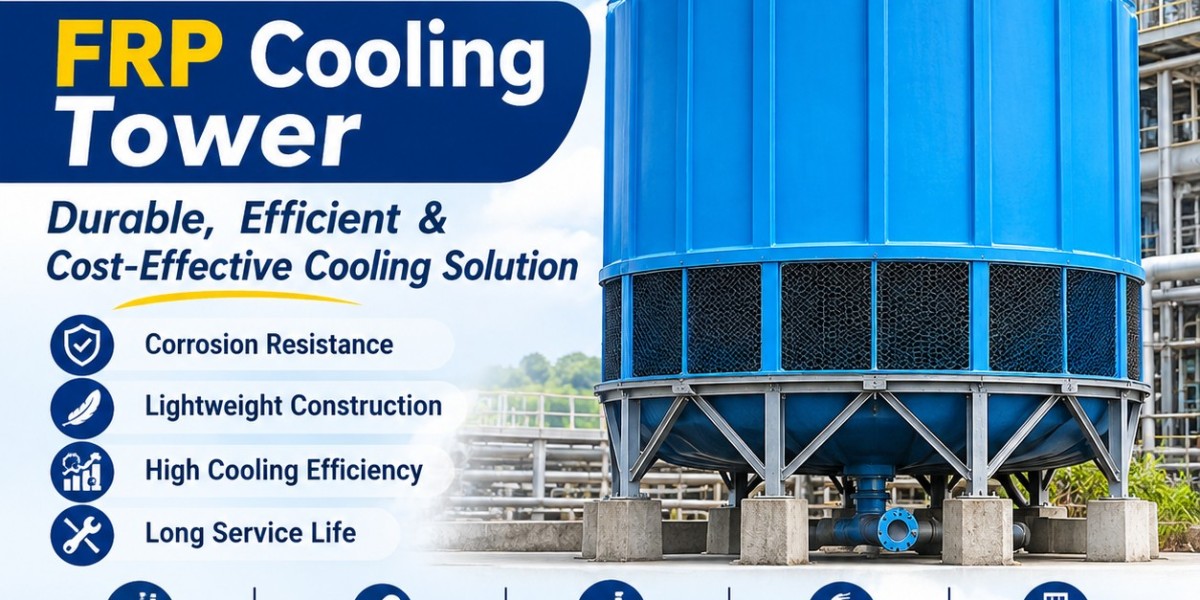


Purchasing an industrial cooling tower is a significant decision because the selected equipment directly affects process temperature control, operational reliability, and maintenance requirements. Businesses should carefully evaluate their cooling needs before investing in equipment. A suitable FRP Cooling Tower can provide a durable and practical solution for industrial facilities that require continuous water cooling.
FRP stands for Fibre Reinforced Plastic. It is a composite material that combines reinforcing fibres with resin to create a strong and relatively lightweight structure. Its corrosion-resistant properties make it useful in many cooling tower environments.
1. Identify Your Actual Cooling Requirements
The first step is understanding how much heat your industrial process needs to reject.
Important technical details include:
Circulating water flow rate.
Hot water inlet temperature.
Required cold water outlet temperature.
Total heat load.
Ambient wet-bulb temperature.
Operating hours and seasonal conditions.
These parameters help determine the cooling tower capacity required for the application.
A tower that is too small may not achieve the required cooling performance, while an unnecessarily oversized system may increase initial investment and operating costs.
2. Evaluate the Material and Construction Quality
FRP construction is one of the main reasons industries consider this type of cooling tower.
The material offers resistance to many corrosion conditions and can be manufactured in different structural configurations. Its relatively low weight can also simplify handling and installation.
However, buyers should not assume that all FRP products offer identical performance. The resin system, fibre reinforcement, manufacturing quality, structural design, and compatibility with the operating environment should be evaluated.
3. Check the Cooling Tower Components
A cooling tower consists of several components that work together to achieve heat rejection.
Fill media: Provides the surface area needed for water and air contact.
Fan and motor: Support airflow through the cooling tower.
Drift eliminators: Help reduce the quantity of water droplets carried away with exhaust air.
Water distribution system: Distributes hot water over the fill media.
Basin: Collects cooled water before it returns to the process.
Buyers should understand the specifications and maintenance requirements of these components before purchasing equipment.
4. Select Experienced Manufacturers in India
Choosing experienced FRP Cooling Tower Manufacturers in India can make the purchasing process easier.
A technically capable manufacturer should understand the relationship between cooling capacity, water flow, air movement, ambient conditions, and tower configuration.
Businesses should ask for relevant product specifications and clarify what is included in the proposed supply. Installation requirements, electrical connections, water piping, and commissioning responsibilities should also be discussed.
Comparing multiple manufacturers on technical suitability is generally more useful than selecting a product solely on the basis of price.
5. Compare Suppliers and Exporters Carefully
Professional FRP Cooling Tower Suppliers help industrial customers identify equipment suitable for their requirements. When evaluating FRP Cooling Tower Suppliers in India, buyers should consider product availability, communication, delivery schedules, technical assistance, and replacement component support.
For international projects, FRP Cooling Tower Exporters can help source equipment from manufacturers serving overseas markets. Businesses evaluating FRP Cooling Tower Exporters in India should also examine product documentation, packaging standards, transportation arrangements, and applicable export requirements.
A reliable supply partner should communicate product specifications clearly and help customers understand the scope of supply.
6. Consider Operating and Maintenance Costs
The purchase price is only one part of the total cost of ownership.
Electricity consumption, water losses, water treatment, cleaning, inspection, and component replacement can influence the long-term cost of operating a cooling tower.
For example, poor water distribution or blocked fill media can affect cooling efficiency. Fan and motor problems may also increase operating expenses.
Businesses should evaluate expected maintenance requirements and ask about recommended inspection intervals.
7. Plan Regular Cooling Tower Maintenance
Even high-quality cooling equipment needs proper maintenance.
Regular maintenance activities include basin cleaning, fill inspection, fan checks, motor inspection, nozzle cleaning, and water quality monitoring.
Professional FRP Cooling Tower Services can help identify wear, blockages, vibration, and other developing issues. Preventive maintenance also helps reduce unexpected interruptions in industrial production.
A maintenance programme should be developed according to operating hours, environmental conditions, and manufacturer recommendations.
Why SP Cooling Tower Is Worth Exploring
Choosing the right cooling tower involves balancing product quality, application requirements, operating conditions, and long-term support.
SP Cooling Tower offers industrial cooling tower solutions for different business requirements. Its FRP cooling tower product page provides a starting point for customers researching corrosion-resistant industrial cooling equipment.
When comparing FRP Cooling Tower Manufacturers, businesses should evaluate technical specifications, construction quality, and service capabilities to make an informed decision.
Explore the available product information and connect with FRP Cooling Tower Manufacturers at SP Cooling Tower for your industrial cooling requirements.







