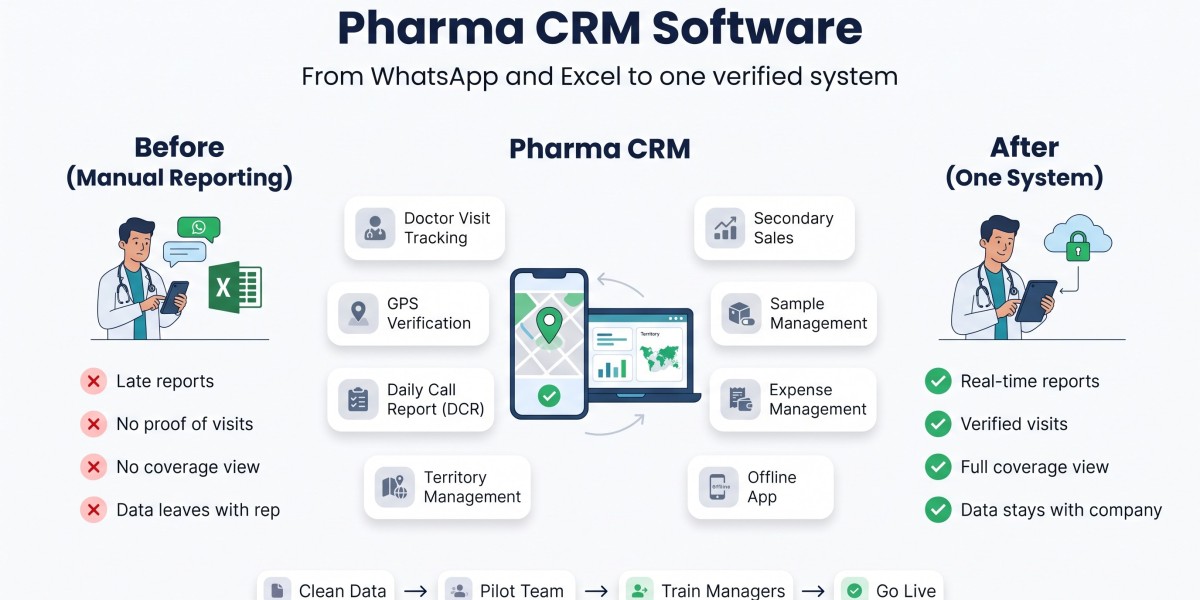


Pharma CRM software is a system that records every doctor visit, chemist call, sample and order your field team handles, and turns that data into reports managers can trust. If your medical reps still report through WhatsApp messages and Excel sheets, you already know the problem: reports arrive late, visits cannot be verified, and nobody can say with confidence which doctors are being covered. Teams in Pakistan can see how this works locally on our pharma field force system in Pakistan page.
This guide explains what pharma CRM software does, which features matter, which type suits your company, and how to avoid the mistakes that make teams abandon a new system within months.
What is pharma CRM software?
Pharma CRM (customer relationship management) software helps pharmaceutical companies manage relationships with doctors, chemists, stockists and hospitals. Each medical representative uses a mobile app to plan visits and log calls. Managers use a dashboard built from those logs to see coverage, performance and gaps in real time.
You will also see it called pharmaceutical CRM, CRM for pharma companies, MR reporting software or pharma sales force automation (SFA). The names overlap, but the goal is the same: one reliable record of what happened in the field.
What separates a pharma CRM from a general sales CRM is the way pharma teams work. Reps follow tour plans, visit doctors by class and specialty, give samples under strict limits, submit daily call reports and claim travel expenses. A general CRM built around leads and deals does not handle any of that out of the box.
Why spreadsheets and WhatsApp stop working
Most teams start with Excel and WhatsApp because they are free and familiar. The cracks show as the team grows:
Late and inconsistent reports. Every rep uses a different format, and managers spend hours collecting and cleaning data.
No proof of visits. A typed report cannot show whether the rep was actually at the clinic.
No coverage view. You cannot easily see which A-class doctors were missed this month.
Samples and expenses are hard to audit. Records live in separate files that rarely match.
Data leaves with the rep. When someone resigns, their doctor list and visit history go with them.
A pharma CRM replaces these scattered files with one system that every rep and manager works in.
Key features of pharma CRM software
Doctor visit tracking: logs each visit with time, notes and next action, giving managers a real record of field activity.
GPS visit verification: captures location at check-in, so you can confirm a visit happened without chasing reps.
Digital daily call reporting (DCR): builds the daily report from logged visits, which removes double entry and late reports.
Territory management: assigns doctors and areas to reps, balancing workload and preventing overlap.
Secondary sales tracking: tracks sales from stockists to chemists, showing whether visits turn into market sales.
Sample management: records samples by doctor, product and quantity, keeping records ready for audits.
Expense management: handles travel and daily allowance claims, speeding up approvals and reducing disputes.
Offline mobile app: works without signal and syncs later, which matters because clinics and rural areas often have weak coverage.
For a deeper look, read our guide to what DCR means in pharma.
Two types of pharma CRM software
Most confusion when choosing comes from treating two different kinds of product as one category.
1. Enterprise HCP engagement platforms. These are built for large, research-led brand companies that need compliant detailing, approved content, consent management and healthcare professional engagement across several countries. Veeva and Salesforce Life Sciences Cloud are well-known examples. They are powerful, and they come with enterprise pricing and long implementations.
2. Field force and sales CRMs. These are built for pharma companies that need reps to plan tours, log visits, submit reports, track samples and claim expenses, and need managers to see coverage and secondary sales. They are quicker to set up and far cheaper per user.
A simple way to decide: if your main challenge is running and verifying a field team, you need the second type. If your main challenge is multi-country regulated HCP engagement, start with the first. Smaller teams usually do better with a simple field-force tool than an enterprise platform.
How to choose pharma CRM software: 8 questions to ask
How many reps do you have today, and how many in a year? Check the minimum number of users and how pricing scales.
Does the app work offline? Ask the vendor to show a visit logged with no signal, then synced.
Can it verify visits? Look for location capture at check-in, not just a typed report.
Does the daily call report build itself? If reps must type the same information twice, they will stop using it.
Can managers see coverage by doctor class and territory? This is the report that justifies the system.
Does it cover your trade side? If reps book chemist or stockist orders, check secondary sales support.
Is pricing clear? Per-user monthly pricing is easier to plan than custom quotes with hidden setup fees.
How are data migration and training handled? The best software fails if your doctor list is messy and your team is untrained.
Ask every vendor to show these live, not on slides. If a feature cannot be demonstrated, treat it as a promise, not a feature.
How much does pharma CRM software cost?
Pricing usually follows one of three models:
Per user per month. You pay for each rep or manager. This is the easiest model to budget.
Tiered plans. Features are bundled into plans, so you pay more for advanced modules.
Custom enterprise quotes. Common with large platforms, often with implementation and licensing fees on top.
When comparing prices, calculate the cost for your full team, including managers, for at least twelve months, and ask what is included in support and training. For reference, RxRep plans start from $7 per user per month, with a free trial so you can test the app with your own team before paying.
How to roll out a pharma CRM without losing your team
Software rarely fails because of its features. It fails because reps do not adopt it.
Clean your doctor and chemist lists first. Remove duplicates and add specialty, class and area.
Start with a small pilot. Run one team or region for two weeks and fix friction early.
Train managers before reps. Reps follow what managers check.
Stop the old reporting on a fixed date. If Excel and WhatsApp reports continue, the CRM becomes extra work.
Common mistakes when buying pharma CRM software
Buying an enterprise tool you will not fully use. Paying for features you never switch on wastes budget.
Ignoring the rep experience. If logging a visit is slower than writing it down, adoption drops.
Skipping visit verification. Without it, the data is only as honest as the reporting.
Having no data owner. Doctor lists decay quickly unless one person is responsible for them.
Judging by the demo alone. Run a trial with real reps and real doctors before you commit.
Where RxRep fits
RxRep is a pharma CRM built for pharma field teams. Reps plan tours, log visits with GPS verification and submit daily call reports from a mobile app that works offline. Managers see coverage, territory performance, secondary sales and expenses in one dashboard. It is designed for pharma companies of different sizes, including teams in Pakistan that currently run on paper, Excel and WhatsApp.
If you are a large global brand that needs multi-country HCP engagement and approved-content detailing, an enterprise platform will likely suit you better. If you want to digitize your field force quickly and see what your reps are really doing, you can start with a free trial.
Frequently asked questions
What is pharma CRM software?
Pharma CRM software is a system that records and manages a drug company’s interactions with doctors, chemists, stockists and hospitals. It helps field teams plan visits, log calls and samples, and gives managers real-time reports on coverage and performance.
What is the difference between pharma CRM and pharma SFA?
Pharma SFA (sales force automation) focuses on the rep’s daily work: tour plans, daily call reports, orders and expenses. Pharma CRM is a broader term that includes SFA and also covers customer relationships, data and analytics. In practice, many products combine both.
Do small pharma companies need a CRM?
If you have more than a handful of reps and managers cannot verify what is happening in the field, a CRM usually pays for itself through better coverage and less time spent compiling reports. Small teams do best with simple, per-user priced tools rather than enterprise platforms.
Can pharma CRM software work offline?
Good ones can. Reps log visits without signal, and the data syncs when the phone reconnects. This matters in clinics, hospitals and rural areas with weak coverage.
How long does it take to implement?
A field-focused pharma CRM can be running with a pilot team in days and rolled out across the whole team in a few weeks, provided your doctor list is clean and managers lead the adoption.
Conclusion
Pharma CRM software is worth buying when it matches how your company actually sells. Know which type you need, score vendors on the questions above, test with real reps, and clean your data before you go live.
Ready to see what your field team is really doing? Start a free RxRep trial and test it with your own reps.