

The global Protein Supplements Market is experiencing substantial growth as increasing fitness participation, preventive healthcare awareness, and demand for convenient nutrition reshape consumer purchasing behavior. Growing interest in muscle recovery, weight management, healthy aging, and functional foods is creating opportunities for manufacturers, ingredient suppliers, and nutrition brands.
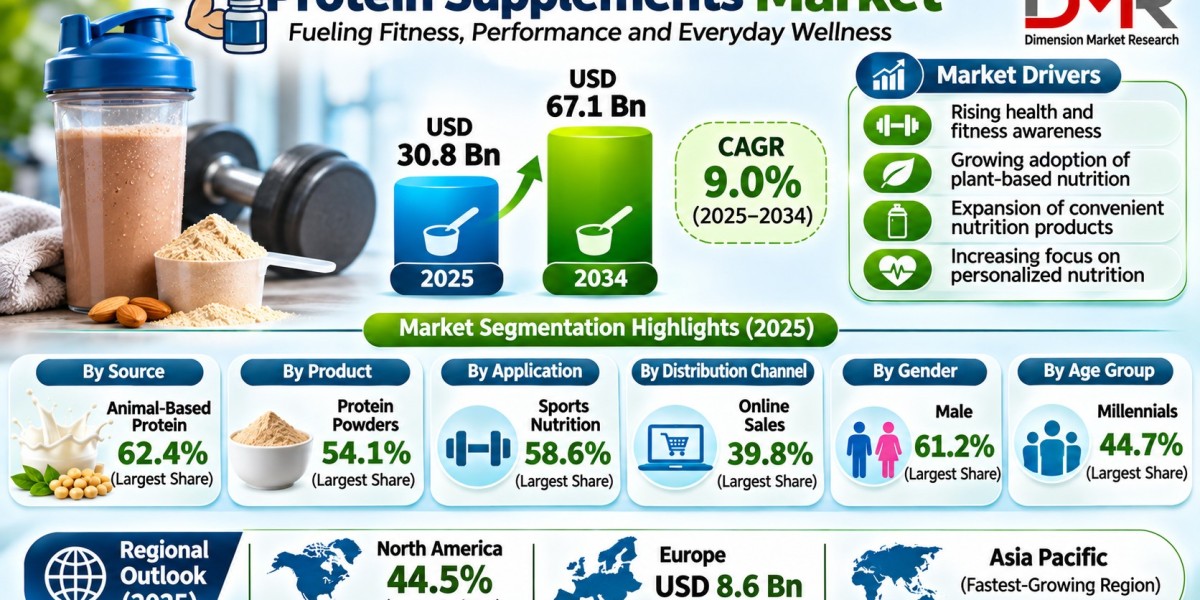
According to Dimension Market Research, the global Protein Supplements Market is projected to reach USD 30.8 billion in 2025 and expand to USD 67.1 billion by 2034, registering a CAGR of 9.0% during 2025 to 2034.
Advancements in plant-based proteins, clean-label formulations, ready-to-drink beverages, and personalized nutrition are expanding protein supplementation beyond traditional athletes to everyday consumers and older adults.
What Is the Protein Supplements Market?
Protein supplements are concentrated nutritional products derived from animal-based and plant-based sources. They are designed to supplement dietary protein intake and support muscle maintenance, post-exercise recovery, and nutritional requirements.
The industry includes protein powders, protein bars, ready-to-drink beverages, and other protein-enriched products.
Popular ingredients include whey, casein, soy, pea, rice, and blended proteins. These ingredients are used across sports nutrition, functional foods, and general wellness applications.
Increasing demand for convenient protein intake, sustainable ingredients, and formulations suited to different dietary preferences is encouraging manufacturers to diversify their portfolios.
Why Is the Protein Supplements Market Growing?
Increasing Health and Fitness Awareness
Rising participation in gym activities, resistance training, recreational sports, and home fitness programs is strengthening demand for protein supplementation.
Consumers increasingly recognize the role of adequate dietary protein in supporting muscle function, recovery, and healthy aging.
Growing Adoption of Plant-Based Nutrition
Plant-based protein formulations are gaining attention among vegan, vegetarian, and flexitarian consumers. Improvements in extraction technologies, flavor development, and amino acid balancing are making plant proteins more commercially competitive.
Expansion of Convenient Nutrition Products
Busy lifestyles are supporting demand for ready-to-drink protein beverages, bars, and portable nutritional products.
These formats enable consumers to incorporate protein supplementation into everyday dietary routines without extensive preparation.
Growing Interest in Personalized Nutrition
Digital health applications, nutritional tracking platforms, and individualized dietary recommendations are encouraging demand for supplements aligned with age, physical activity, and wellness objectives.
Get a Free Sample of the Protein Supplements Market Report
Evaluating opportunities in sports nutrition, plant-based protein, functional foods, or dietary supplements? Request a free sample to review the report's market segmentation, competitive landscape, regional outlook, and growth opportunities.
https://dimensionmarketresearch.com/request-sample/protein-supplements-market/
Protein Supplements Market Segmentation: Which Categories Lead?
The industry is segmented by source, product, application, distribution channel, gender, and age group.
By Source: Animal-Based Protein Leads
Animal-based protein supplements accounted for 62.4% of the global market in 2025.
Whey and casein proteins are widely used because of their essential amino acid profiles, established applications in sports nutrition, and suitability for muscle recovery formulations.
Plant-based proteins represent the fastest-growing source category, supported by sustainability concerns, dietary preferences, and improvements in ingredient processing.
By Product: Protein Powders Dominate
Protein Powders held approximately 54.1% market share in 2025.
Their versatility, flexible serving sizes, storage convenience, and availability across different protein sources support widespread consumption.
Ready-to-drink protein supplements represent a rapidly expanding category as consumers prioritize portability, convenience, and ready-to-consume nutrition.
By Application: Sports Nutrition Holds the Largest Share
Sports Nutrition accounted for 58.6% of global market revenue in 2025.
Demand is supported by athletes, fitness enthusiasts, and recreational exercisers seeking convenient protein sources for muscle recovery and performance-oriented diets.
Functional Foods are also growing as manufacturers introduce protein-enriched snacks, beverages, and meal replacements for everyday consumption.
By Distribution Channel: Online Sales Lead
Online channels captured approximately 39.8% market share in 2025.
E-commerce platforms provide product variety, pricing transparency, customer reviews, subscription services, and convenient delivery.
Supermarkets & Hypermarkets remain important for reaching mainstream consumers and expanding the visibility of protein supplement products.
By Gender and Age Group
Male consumers accounted for 61.2% of the market in 2025, reflecting established demand for muscle-building and performance-focused products.
Female consumers represent a growing opportunity as protein supplementation becomes more closely associated with general wellness and active lifestyles.
Millennials held 44.7% of market share in 2025, while Generation Z is identified as the fastest-growing age group.
How Is Artificial Intelligence Transforming Protein Supplement Innovation?
Artificial intelligence is supporting innovation in product development, personalized nutrition, and manufacturing operations.
AI-based formulation tools can analyze ingredient combinations, nutritional characteristics, and consumer preferences to support new product development.
Machine learning also enables manufacturers to study purchasing patterns, forecast demand, and improve inventory planning.
Digital nutrition platforms can support individualized protein recommendations based on lifestyle, age, activity levels, and dietary objectives.
For supplement manufacturers, these capabilities create opportunities to differentiate products and improve customer engagement.
Regional Outlook: North America Leads While Asia-Pacific Expands
North America accounted for 44.5% of global market revenue in 2025, making it the leading regional market.
The region benefits from established fitness culture, high consumer awareness, extensive retail infrastructure, and demand for premium nutritional products.
The United States Protein Supplements Market was projected at USD 12.0 billion in 2025, with an anticipated CAGR of 8.5%.
Europe was projected to reach USD 8.6 billion in 2025, supported by clean-label preferences, sustainability initiatives, and demand for plant-based nutrition.
Asia-Pacific represents the fastest-growing regional market.
Increasing disposable incomes, urbanization, gym participation, e-commerce penetration, and health awareness are supporting adoption across China, India, Japan, and Southeast Asia.
Japan's Protein Supplements Market was projected at USD 1.5 billion in 2025, with an anticipated CAGR of 9.4%.
Competitive Landscape and Recent Developments
The Protein Supplements Market is highly competitive, with companies emphasizing ingredient quality, product differentiation, sustainable sourcing, flavor innovation, and digital distribution.
Prominent participants include Abbott, Glanbia plc, Nestlé, Herbalife Nutrition, Amway, GNC Holdings, Iovate Health Sciences, Quest Nutrition, The Hut Group (Myprotein), Post Holdings, NOW Foods, BellRing Brands, Dymatize Enterprises, and Universal Nutrition.
In January 2026, Bloom Nutrition introduced Bloom Clear Protein, combining clear whey protein isolate and grass-fed collagen peptides in a fruit-forward beverage format. The product provides 20 grams of protein per serving.
In December 2025, Abbott announced two additions to its Ensure Max Protein portfolio: Ensure Max Protein 42g and Ensure Max Protein 2 in 1 Muscle Support, expanding its offerings for muscle health and nutritional support.
These developments highlight growing interest in convenient formats, functional formulations, and differentiated nutritional products.
Challenges and Emerging Opportunities
Despite favorable growth projections, regulatory compliance, ingredient quality, premium product pricing, and intense competition remain challenges.
Manufacturers must address labeling accuracy, ingredient safety, product authenticity, and varying international regulations.
However, plant-based formulations, healthy aging nutrition, functional beverages, and personalized supplementation offer opportunities for continued innovation.
Emerging economies also provide expansion potential as consumer purchasing power, fitness participation, and online retail accessibility increase.
View the Protein Supplements Market Report and Purchase Options
Understanding product demand, regional growth, competitive positioning, and evolving consumer preferences can support investment, product development, and market entry decisions.
Explore the complete Protein Supplements Market report, including available licensing and purchase options.
https://dimensionmarketresearch.com/checkout/protein-supplements-market/
Frequently Asked Questions
1. What is the size of the Protein Supplements Market?
The global Protein Supplements Market was projected at USD 30.8 billion in 2025 and is forecast to reach USD 67.1 billion by 2034.
2. What is the projected CAGR of the Protein Supplements Market?
The market is expected to expand at a CAGR of 9.0% during 2025 to 2034.
3. Which product segment dominates the Protein Supplements Market?
Protein Powders held the largest product share at 54.1% in 2025.
4. Which region leads the global Protein Supplements Market?
North America accounted for the largest regional share at approximately 44.5% in 2025.
5. Which application dominates the Protein Supplements Market?
Sports Nutrition held the largest application share at 58.6% in 2025, supported by demand for muscle recovery and performance-oriented nutrition.
Conclusion
The global Protein Supplements Market is evolving as fitness participation, preventive healthcare, and personalized nutrition influence purchasing decisions.
Animal-based proteins and protein powders continue to hold substantial market shares, while plant-based formulations, functional foods, and ready-to-drink products are expanding consumer choice.
Growing opportunities in healthy aging, sustainable nutrition, and emerging markets are expected to support industry development through 2034.
Related Dietary Supplements and Nutrition Market Insights
The Probiotic Dietary Supplements Market Size is estimated at USD 14.98 billion in 2026 and projected to reach USD 44.33 billion by 2035, registering a CAGR of 12.81%. Gastrointestinal Health leads the application segment with a 61.73% revenue share, while Asia Pacific dominates regionally with 44.48% in 2026. Increasing interest in digestive wellness, microbiome health, and targeted nutrition is supporting market expansion.
The Veterinary Dietary Supplements Market Share analysis highlights opportunities in animal nutrition and preventive veterinary healthcare. The global market was estimated at USD 3,291.9 million in 2025 and is projected to reach USD 7,418.6 million by 2034, expanding at a CAGR of 9.4%. Increasing demand for joint health, digestive wellness, immune support, and species-specific nutritional formulations is encouraging innovation across companion and livestock animal supplement categories.
The Vitamin D Supplement Market Growth outlook reflects increasing demand for nutritional products supporting bone health and general wellness. The global market is estimated at USD 1.7 billion in 2026 and forecast to reach USD 3.3 billion by 2035, registering a CAGR of 7.6%. Vitamin D3 dominates the type segment with an 86.3% share, while North America leads regionally with 35.1% in 2026.







