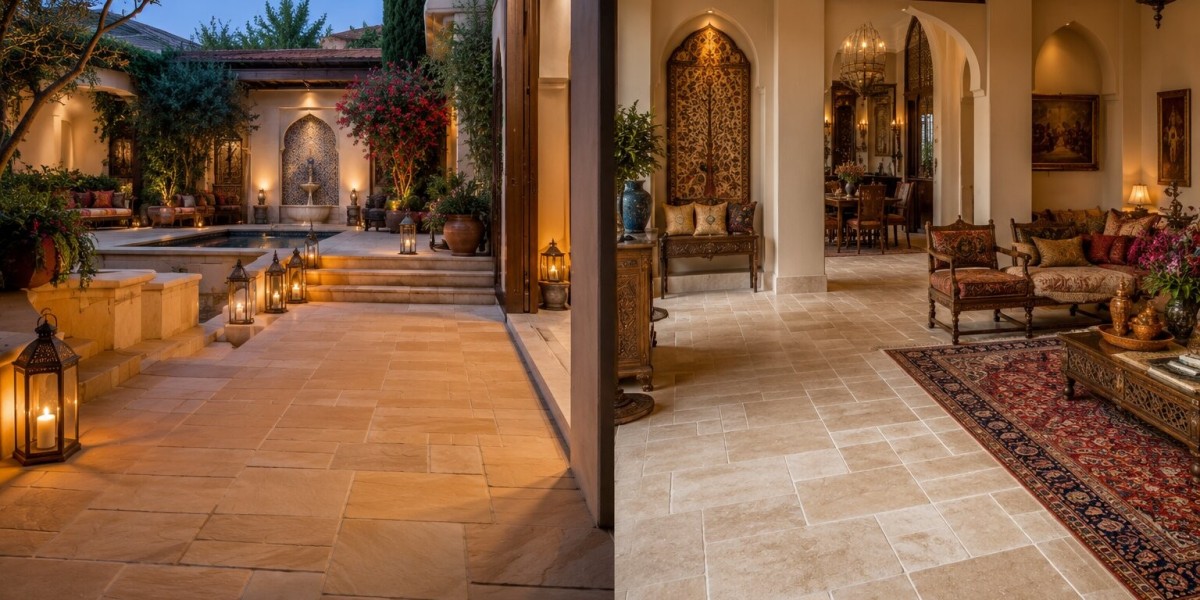


Persians have been masters of stone and craft for thousands of years. Persian artisans historically prized the natural durability and aesthetic beauty of Iran's vast reserves of limestone, onyx and white marble. They didn't just build with stone. They celebrated it.
In Persian culture, stone isn't just a material. It's a symbol. It represents permanence, strength, and quiet elegance. A home built on good stone was seen as a home built to last generations.
That philosophy still holds up today. Especially here in Australia, where our climate demands materials that are tough, natural and low-fuss.
Start Outside, Where the Warmth Lives
Outdoor zones are the easiest place to start. Sandstone tiles outdoor areas bring a soft, honey-toned glow that instantly lifts a backyard or alfresco space. The soft warm touch of sandstone add a sense of warmth and inviting feel.
A few reasons Aussies keep choosing it:
- Stays cool underfoot, even in peak summer
- Naturally slip-resistant, great around pools
- Ages beautifully, picking up character over time
Pair it with timber decking or greenery, and you've basically got yourself a Persian courtyard, minus the plane ticket.
Bring In Some Contrast
Once you've got warmth sorted outside, it's time for a bit of drama indoors.
Natural stone with a slightly porous, layered texture has been used across the Middle East and Mediterranean for thousands of years, and it still looks effortlessly upscale today. One layout worth knowing is the Travertine French pattern, a classic technique using four different tile sizes arranged in a staggered, repeating layout. No harsh grid lines. Just an organic, handcrafted flow.
Warm honey tones outside. Cooler, patterned stone inside. That contrast is where the luxury really shows up.
Do You Still Need a Persian Carpet?
Well, the big question and the crucial one, do you still need a persian carpet? Not necessarily. But you can steal its spirit.
Traditional Persian carpets are stunning, but not always practical for busy homes with kids, pets, or coastal humidity. A smarter move is to combine the two. You get the richness of Persian textiles, without constant upkeep.
- Lay a strong natural stone floor as your base
- Layer a smaller Persian-style rug over the living zone or dining area
- Let the rug bring the colour and pattern, while the stone brings the durability
Weaving Persian Motifs into an Open Living Plan
Australians love an open floor plan. Kitchen flowing into dining, flowing into living. It's basically become common, and Persian design fits right in.
A few easy ways to bring it in:
- Arched doorways or mirrored arch mouldings, echoing Persian architecture
- A geometric tile layout as a feature in one zone
- Jewel-toned cushions or a rug, something like deep blues, terracottas and golds
- Neutral walls, so the natural stone and patterns do the talking
The Real Beauty of Persian Design
What makes this style timeless is that it never chases trends. It leans on natural materials, honest craftsmanship and genuine respect for stone.
Limestone, onyx, marble and the warmer tones we lean on today. These were never just building materials in Persian culture. They were symbols of a home meant to stand strong and look beautiful doing it.
That's exactly why more Australian homeowners are getting inclined towards this style. It suits our climate, our lifestyle and it looks incredible in natural light.
Wrapping It Up
You don't need a full renovation to bring Persian elegance home. Start small, outside by the pool. Add a patterned stone feature indoors and layer in a Persian-inspired rug. Keep the rest simple. Before long, your home will carry that quiet, timeless luxury Persian design has been perfecting for thousands of years.
Disclaimer: The information provided in this blog is to the best of our knowledge and intended as a general guide. We recommend confirming all details based on your specific project requirements before execution.








