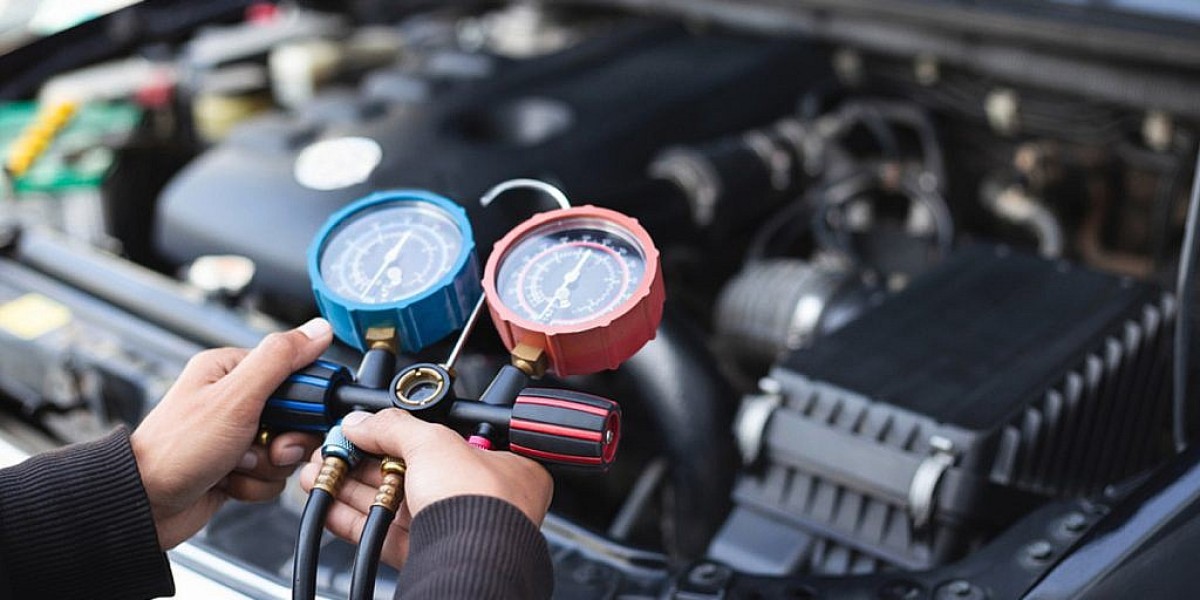


A car air conditioner rarely dies overnight. It fades — vents that once frosted your fingertips now blow merely cool. Booking car AC repair in Dubai at that fading stage usually means a leak repair and a re-gas, not a compressor bill.
In a climate where cabin temperatures reach 70°C in a parked car, air conditioning is a safety system rather than a comfort feature. Understanding the early symptoms is what keeps a routine repair from becoming a July emergency.
Why a Cheap Re-Gas Is a False Economy
A sealed air conditioning system does not consume refrigerant. If yours is low, it has leaked — through a perished O-ring, a corroded condenser, a tired compressor shaft seal or a cracked hose. Topping it up without finding the leak means paying twice: once now, and again in a few weeks when the gas has escaped through the same hole.
A proper service therefore starts with recovery and a vacuum test, holding the system under vacuum to confirm it is sealed before new refrigerant goes in. Where a leak is suspected but not visible, UV dye or an electronic sniffer locates it. That leak test is the step budget operators skip, and the reason their re-gas stops cooling by the following month.
Reading Your Symptoms
What you notice | Most likely cause |
Cool air, never cold | Low refrigerant from a slow leak |
Cold when moving, warm at idle | Failing condenser fan or blocked condenser |
Airflow weak on all settings | Clogged cabin filter or failing blower motor |
Musty smell when AC starts | Mould on a damp evaporator core |
Rattle or squeal when AC engages | Worn compressor clutch or bearing |
Water pooling inside the cabin | Blocked evaporator drain hose |
Cooling on one side only | Blend door actuator fault in dual-zone systems |
The Components That Actually Fail
· Compressor — the pump that pressurises refrigerant. It fails from age, from running with low gas, or from contamination, and is the most expensive component in the loop.
· Condenser — mounted at the front of the car, it sheds heat and takes the full force of road debris and desert dust. Blocked fins are one of the most common causes of poor cooling in the UAE.
· Evaporator — sits inside the dashboard and gets cold. Because it stays damp, it is where mould grows and where that unmistakable musty smell begins.
· Blower motor — pushes air through the vents. When it fails, cooling capacity may be fine but almost nothing reaches you.
· Cabin filter — cheap, quick to change, and the first thing to check when airflow drops. In Dubai's dust it clogs far faster than the service schedule assumes.
Keeping the System Healthy
Run the air conditioning for at least ten minutes every week, even in the cooler months. The refrigerant carries lubricant around the loop, and a system left idle dries out its seals until they crack. Switch to fresh air for the last minute before parking to dry the evaporator and discourage mould. Rinse the condenser when you wash the car, and change the cabin filter roughly every 15,000 km rather than waiting for the manual's interval.
One more habit pays off in summer: open the windows for the first thirty seconds of a drive to vent the superheated air, rather than asking the compressor to fight 70°C from a standing start.
What Repairs Cost in Dubai
At iTyreCare in Al Quoz, the AC inspection is free and repairs start from AED 150, with the final figure set by which component has actually failed. Gas refilling covering both R-134a and the newer R-1234yf refrigerant starts from AED 150 including a pressure test afterwards; compressor and condenser replacement are quoted individually after diagnosis, always in writing before work begins.
Most AC faults are same-day jobs. The workshop is at 1 D65 Al Manara Road East, Al Quoz, Dubai — minutes from Business Bay, Al Barsha and Jumeirah, just off Sheikh Zayed Road — open daily 9 AM to 9 PM on +971 4 227 9700, with a 4.7 out of 5 rating from over 1,180 Google reviews. If your system is simply low on refrigerant, the detail on car AC gas refilling explains exactly what the process involves.








