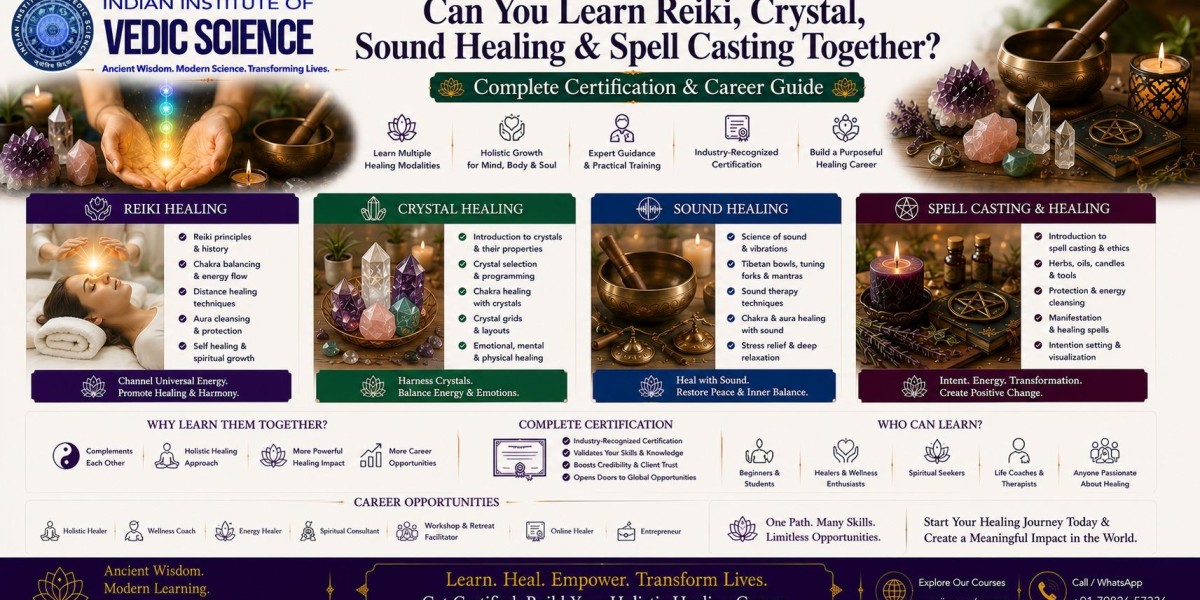


Can you learn Reiki, crystal healing, sound healing and spell casting together? Yes, you can study these disciplines as part of a broader holistic and spiritual learning journey—but it is usually better to develop a strong foundation in one practice before combining several.
Each discipline has its own background, concepts and practical methods. Reiki traditionally follows an energy-based framework, crystal healing explores crystals through symbolic and spiritual traditions, sound healing uses sound and instruments in meditation or relaxation-oriented practices, while spell casting belongs to diverse ritual and occult traditions.
For beginners, studying everything simultaneously can become confusing. A better approach is to understand each discipline separately, practise responsibly and then explore how complementary practices may fit together.
This guide explains how combined learning can work, what certification means, how to choose training, and what career opportunities may be available after developing practical skills.
Can You Learn All Four Together?
Yes, but sequence matters more than quantity.
A practical learning pathway can be:
Start with one primary discipline.
Learn its foundational theory.
Complete practical exercises.
Develop confidence and responsible communication.
Obtain relevant certification where appropriate.
Add a second complementary discipline.
Gradually develop knowledge of the remaining practices.
Build a professional niche based on genuine competence.
For example, someone might begin with Reiki, later study sound healing, then explore crystal practices and finally investigate ritual traditions.
The objective should not be collecting four certificates as quickly as possible. The objective should be developing meaningful knowledge and practical understanding.
What Is the Difference Between Reiki, Crystal, Sound Healing & Spell Casting?
Although these subjects are sometimes grouped together, they are not the same system.
Reiki
A reiki healing course generally introduces Reiki as a Japanese-origin practice traditionally associated with energy and structured sessions.
A curriculum may cover:
Reiki principles
Historical background
Energy-related concepts
Hand positions
Self-practice
Session preparation
Practitioner-client communication
Practical demonstrations
Reiki may appeal to learners who prefer a defined learning structure and a traditional energy-based practice.
Crystal Healing
A crystal healing course generally explores crystals within traditional, symbolic, spiritual or meditative frameworks.
Students may learn about:
Crystal identification
Traditional associations
Cleansing and care
Meditation
Intention-setting
Crystal placement
Session preparation
Responsible communication
Beginners should understand that traditional beliefs about crystals should not be presented as scientifically established medical effects.
Sound Healing
A sound healing course typically explores sound, tone, rhythm, resonance and instruments in relaxation, meditation or contemplative settings.
Training can include:
Singing bowls
Sound meditation
Rhythm and tone
Instrument handling
Session planning
Guided exercises
Practical demonstrations
This can be particularly suitable for learners interested in combining sound, meditation and structured sessions.
Spell Casting
A spell casting course belongs to a different category. Spell casting can refer to diverse occult, magical, folk and ritual traditions.
Training may explore:
Ritual structure
Symbolism
Intention
Traditional correspondences
Meditation
Ritual preparation
Historical context
Ethical considerations
Because traditions vary significantly, students should understand the particular framework taught by their course instead of assuming that all spell-casting systems follow the same rules.
Is It Better to Learn One Discipline First?
For most beginners, yes. Learning one subject first provides a foundation for understanding terminology, methodology and practical boundaries.
For example, a learner beginning with Reiki can focus on understanding its principles and session structure rather than simultaneously trying to memorise crystal associations, sound techniques and ritual frameworks.
Once the learner is comfortable with the first discipline, adding another can become more manageable.
A Useful Learning Sequence
Stage 1 — Foundation: Choose one primary subject.
Stage 2 — Practice: Complete guided exercises and build consistency.
Stage 3 — Certification: Complete relevant assessment or certification requirements.
Stage 4 — Expansion: Introduce a second discipline that complements your interests.
Stage 5 — Integration: Explore how different practices can be presented together without confusing their individual traditions.
This approach creates deeper subject knowledge and supports stronger professional credibility.
How Can These Four Disciplines Complement Each Other?
Combined learning can make sense when each practice has a clearly defined role.
For example, a practitioner interested in meditation may study sound-based practices alongside Reiki. Someone interested in symbolic spiritual practices may explore crystals after developing a foundation in another discipline.
However, combining practices does not mean claiming that they scientifically produce the same effects.
A responsible practitioner can explain the following:
What each practice traditionally represents
Which technique is being used
What the session involves
What clients can reasonably expect
What the practitioner cannot diagnose or guarantee
This clarity is essential for trust.
What Practical Training Should You Look For?
If you plan to study several disciplines, practical training becomes even more important.
Reiki Practice
Look for opportunities to learn session preparation, traditional hand positions, self-practice and communication.
A reiki healing certification program should clearly explain its learning requirements and what the certificate represents.
Crystal Practice
Practical learning may involve identifying crystals, studying traditional associations, creating meditation routines and maintaining a practice journal.
If you are considering a crystal healing certification course, check whether practical exercises and instructor guidance are included rather than choosing solely on the basis of the certificate.
Sound Practice
For sound-based learning, practical exposure is particularly useful.
Students can practise:
Instrument handling
Sound sequencing
Rhythm
Tone
Guided sound meditation
Session preparation
A sound healing certification can document completion of a particular educational program, but continued practice is still necessary to develop confidence.
Spell-Casting Practice
Practical learning may focus on understanding ritual structure, symbolism, intention-setting and the historical or cultural context of a particular tradition.
If you explore spell casting online, evaluate whether the program teaches a clearly defined tradition and responsible practice instead of promising guaranteed outcomes.
Can You Get Separate Certifications?
Yes. Since these are distinct disciplines, students may pursue separate certificates for different areas.
For example:
Reiki certification after Reiki training
Crystal-focused certification after crystal studies
Sound healing certification after sound-based training
Spell-casting course completion after studying a specific ritual framework
However, more certificates do not automatically mean more expertise.
A student with one well-understood discipline and substantial practical experience may have a stronger foundation than someone who completes several short programs without meaningful practice.
Before enrolling, check:
Curriculum
Course duration
Practical training
Instructor guidance
Assessment
Certification requirements
Student support
Learning format
Can You Build a Career After Learning These Disciplines?
Potentially, yes—but certification alone does not guarantee a career, income or clients.
Depending on their training and experience, practitioners may explore:
Individual Sessions
Some practitioners provide complementary or spiritual sessions online or in person.
Workshops
Learners with sufficient experience may eventually conduct introductory workshops related to meditation, sound, crystals or other traditional practices.
Online Education
A practitioner can develop educational blogs, videos, social media content, webinars and beginner-focused resources.
Spiritual Practice
Some individuals combine several disciplines into a personal or complementary spiritual practice while keeping the methodology of each system clearly defined.
Further Learning
Students may eventually explore related areas such as numerology, Vedic astrology, meditation or other traditional disciplines.
A sustainable career requires more than a certificate. Subject expertise, practical ability, communication, ethical standards, digital visibility and continued learning all contribute to professional development.
What Should You Avoid When Combining Practices?
Combining disciplines can become problematic when practitioners make exaggerated claims.
Avoid:
Claiming guaranteed healing
Presenting spiritual practices as medical treatment
Diagnosing physical or mental-health conditions
Advising clients to discontinue professional treatment
Promising guaranteed financial, relationship or career outcomes
Using fear to sell sessions
Presenting personal beliefs as universal facts
Mixing different traditions without explaining the difference
For example, Reiki can be presented as a traditional spiritual or energy-based practice, while sound practices can be described in terms of meditation or relaxation. Crystal and ritual traditions should similarly be explained within their appropriate cultural or spiritual frameworks.
How to Choose the Right Institute
When searching for a training provider, do not rely only on phrases such as “best course” or “top institute.”
Instead, investigate:
Curriculum Quality
Does the program explain the subject in enough depth for a beginner to understand the methodology?
Practical Training
Are there demonstrations, exercises, assignments or guided sessions?
Instructor Support
Can learners ask questions and receive feedback?
Certification Transparency
Does the institute clearly explain what the certificate represents?
Student Support
Are students supported during the learning process?
Learning Format
Does the online or live format suit your schedule and preferred learning style?
These factors provide a more reliable basis for selecting a course than promotional claims alone.
Why Choose IIVS?
The Indian Institute of Vedic Science (IIVS) can be considered by learners interested in structured education across Vedic, holistic and related traditional disciplines.
For beginners who want to explore multiple subjects, an organised learning environment can provide a clearer path than relying only on scattered social-media videos, short tutorials and disconnected resources.
Prospective students should review the current IIVS course information, including curriculum, practical components, learning format, instructor guidance, certification details and student support, before enrolling.
IIVS also provides learning opportunities across related traditional disciplines. This can allow learners to gradually broaden their education after establishing a foundation in their primary area of interest.
The right choice should ultimately be based on course relevance, educational depth and practical value rather than simply the number of certificates available.
A Practical Career Roadmap
If your long-term goal is to develop professional expertise, consider this progression:
Beginner: Choose one discipline and learn the foundations.
Developing learner: Practise regularly and maintain a learning journal.
Trained practitioner: Complete structured coursework and relevant assessment.
Expanding practitioner: Add a complementary discipline after developing confidence in the first.
Professional development: Build communication skills, educational content and a responsible online presence.
Advanced learning: Continue education and refine your niche.
This approach is more sustainable than trying to become an expert in four disciplines immediately.
Start Your Learning Journey With IIVS
If you want to explore Reiki, crystal, sound healing and spell-casting traditions together, begin by identifying the discipline you are most interested in.
Then compare its curriculum, practical training, instructor guidance and certification requirements. After developing a solid foundation, you can decide whether adding another discipline makes sense.
IIVS provides learning opportunities across relevant Vedic and holistic areas. Explore the relevant course options and select a program according to your educational objectives, preferred learning format and desired level of practical training.
Yes, you can learn Reiki, crystal healing, sound healing and spell casting together, but learning them sequentially is usually more effective than attempting to master everything at once.
Each discipline has its own history, terminology and practical framework. Start with one subject, develop genuine understanding, practise consistently and then expand into complementary areas.
Certification can document structured education, but it should not be confused with guaranteed expertise or career success. Long-term credibility comes from practical experience, responsible communication, continued learning and trust.
For anyone planning a professional path, the strongest strategy is simple: learn deeply → practise consistently → certify appropriately → expand gradually → communicate responsibly → build trust.
Apply Now for Free Counseling
Website: https://iivs.com/
Phone: +91 79826 57336
FAQs
1. Can I learn Reiki, crystal healing, sound healing and spell casting together?
Yes. You can study all four, but beginners generally benefit from learning one discipline at a time before combining them. This makes it easier to understand each practice independently.
2. Should I get separate certifications for each discipline?
If you want structured education in multiple disciplines, separate certifications or course-completion credentials may be appropriate. However, the quality and practical depth of training matter more than the number of certificates.
3. Can I learn these practices online?
Yes. Online learning can provide theory, demonstrations, guided exercises and instructor support. For practical subjects, always check how hands-on learning and feedback are delivered.
4. Can these disciplines become a career?
They can form part of a professional or educational pathway for some practitioners. Potential activities include complementary sessions, workshops and educational content, but certification does not guarantee income, employment or clients.
5. Are these practices substitutes for medical treatment?
No. Spiritual and complementary practices should not be presented as replacements for qualified medical or mental-health care. Practitioners should avoid diagnosing conditions and making unsupported claims about guaranteed cures.