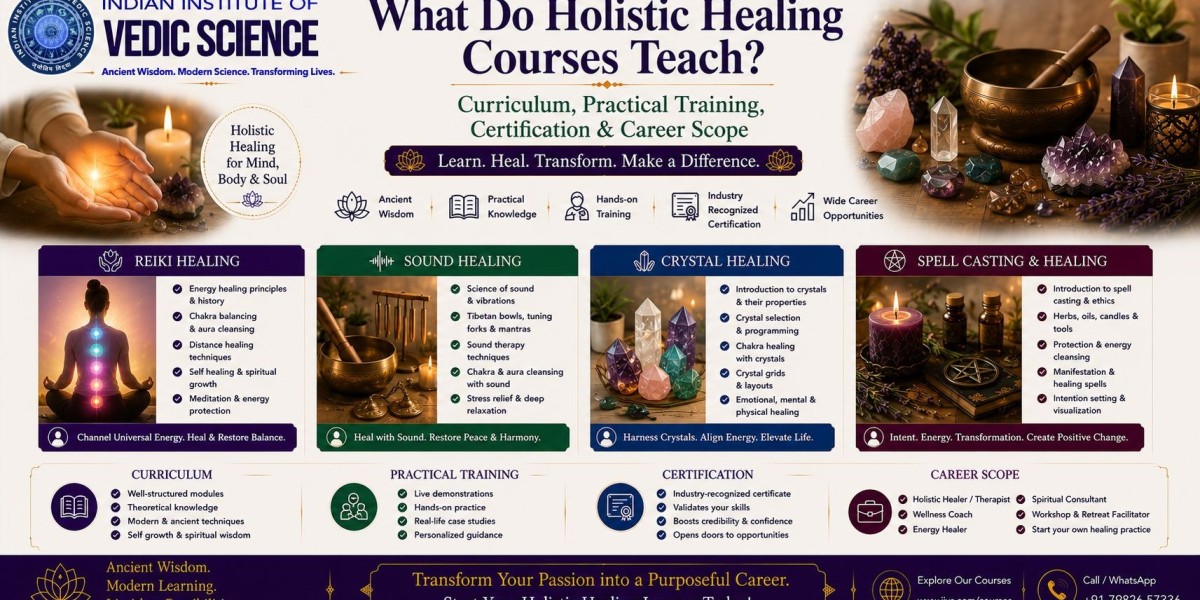


Holistic healing courses are increasingly attracting beginners who want to explore traditional wellness practices, spiritual learning and complementary approaches to personal wellbeing. But “holistic healing” is a broad category. Reiki, crystal healing, sound healing and spell casting each have different origins, concepts, practical methods and learning pathways.
A good course should therefore offer more than a collection of definitions. Students should understand the background of the practice, learn its core techniques, complete practical exercises and develop responsible communication skills.
For anyone considering holistic education, the important questions are straightforward: What does a holistic healing course teach? How much practical training is involved? Is certification useful? And what career opportunities can follow structured learning?
This guide explains what beginners can expect from a well-organized program and how to evaluate training before enrolling.
What Do Holistic Healing Courses Teach?
A beginner-level holistic program may cover:
Foundations and history of the selected discipline
Core terminology and principles
Meditation, grounding and intention-setting
Practical techniques and session structure
Demonstrations and guided exercises
Client communication and professional boundaries
Ethical considerations
Assignments or case-based practice
Assessment and certification, where applicable
Possible professional and educational applications
The exact curriculum depends on whether you choose Reiki, crystal healing, sound healing, spell casting or another complementary discipline.
What Are Holistic Healing Courses?
Holistic healing courses or best online astrology courses generally introduce practices that approach well-being through broader physical, emotional, mental, spiritual or reflective perspectives.
However, it is important to distinguish traditional or spiritual practices from evidence-based healthcare. A course may teach a traditional framework without establishing that its claims are medically proven.
For this reason, responsible training should encourage students to avoid diagnosing illnesses, promising guaranteed results or advising people to replace qualified medical or mental-health care with spiritual practices.
This distinction is also an important part of building trust as a future practitioner.
What Does the Curriculum Usually Include?
Although every institute has its own structure, a comprehensive beginner curriculum can be divided into several stages.
1. Foundations and Background
The first stage introduces the history, terminology and philosophy of the chosen practice.
Students may explore:
Origins and traditional context
Core concepts
Common terminology
Different schools or approaches
Appropriate uses and limitations
Ethical considerations
This foundation prevents learners from treating social-media claims or isolated techniques as the complete discipline.
2. Core Techniques
The next stage introduces the practical framework.
For example, a reiki healing course may cover Reiki principles, traditional energy concepts, hand positions, self-practice and session preparation.
A crystal healing course may focus on crystal identification, traditional associations, cleansing methods, meditation, intention-setting and symbolic use.
A sound healing course can introduce sound, rhythm, tone, resonance and instruments used in relaxation or contemplative sessions.
Meanwhile, a spell casting course may explore ritual structure, symbolism, intention, traditional correspondences and the historical context of different magical practices.
The key point is that these disciplines should not be treated as identical. Each has its own methodology and cultural background.
What Practical Training Do Students Receive?
Practical training is one of the most important differences between simply reading about holistic practices and actually learning how they are traditionally performed.
Reiki Practical Training
Students may practise:
Hand positions
Self-practice
Session preparation
Structured session sequences
Grounding exercises
Communication before and after a session
The objective is to understand how a session is organized and how to interact respectfully with participants.
Crystal-Based Practical Training
Students can learn to:
Identify commonly used crystals
Understand traditional symbolic associations
Create meditation routines
Practise intention-setting
Maintain and store crystals appropriately
Develop structured personal practices
The emphasis should remain on traditional and spiritual frameworks rather than unsupported medical claims.
Sound-Based Practical Training
Sound-related education becomes more meaningful when learners actually work with the tools involved.
Training may include:
Singing bowls
Tone and rhythm exercises
Sound meditation
Instrument handling
Session sequencing
Creating a calm practice environment
Students should learn both technique and appropriate communication rather than simply memorizing instrument names.
Spell Casting Practice
Ritual-based learning can involve:
Understanding ritual structure
Working with symbolism
Intention-setting
Preparing a ritual space
Studying traditional correspondences
Reflective or meditative practices
Spell casting varies substantially across cultures and traditions, so students should understand which framework their program follows.
Why Is Practical Training Important?
Theory tells you what a practice is; practical learning helps you understand how it is approached.
For beginners, practical work can improve the following:
Observation
Consistency
Confidence
Session planning
Communication
Self-awareness
Understanding of limitations
A useful method is to maintain a learning journal. Record the exercise performed, what you observed, what questions arose and what you would change next time.
This creates a record of development and makes learning more active.
What Does Certification Mean?
Certification can document that a student has completed a particular educational program. However, a certificate should not automatically be interpreted as proof of expertise, medical qualification or guaranteed professional success.
For example, students researching reiki healing certification should examine what the program actually teaches, whether practical work is included and how completion is assessed.
Similarly, someone comparing a crystal healing certification course should look beyond the certificate title and examine the curriculum, instructor support and practical components.
For sound-based learning, sound healing certification can document completion of a structured course, but the learner should still develop practical competence through continued study.
Before enrolling, ask:
Is there an assessment?
Are practical exercises included?
Is instructor guidance available?
What does the certificate specifically represent?
Is the curriculum clearly explained?
Is there student support?
The educational experience behind the credential matters more than the credential alone.
Can You Learn Holistic Healing Online?
Yes. Online education can be useful for beginners because it provides flexibility and allows students to revisit learning materials.
A good online program may include:
Live classes
Recorded lessons
Demonstrations
Digital study resources
Assignments
Guided practice
Instructor interaction
Assessment
However, online learning should not be judged simply by whether it is convenient. For practical subjects, students should investigate how demonstrations and guided exercises are delivered.
For example, spell casting online education may work well for theoretical, historical and ritual-structure components, while disciplines involving physical techniques or instruments require meaningful practical demonstrations.
How Should Beginners Choose the Right Course?
There is no single best holistic course for everyone.
Start by identifying your interest.
Reiki may suit someone interested in a structured traditional energy-based practice.
Crystal practices may appeal to someone interested in crystals, symbolism, meditation and intention-setting.
Sound healing may suit learners drawn to instruments, sound and relaxation-oriented practices.
Spell casting may be more relevant to students interested in occult, ritual and magical traditions.
After identifying your preferred discipline, evaluate the program itself.
Look for:
Detailed curriculum
Practical training
Instructor guidance
Transparent certification
Clear learning outcomes
Ethical boundaries
Student support
Suitable online or live format
Do not choose a course only because its marketing calls it “the best.” Evaluate what you will actually learn and practise.
What Career Scope Does Holistic Healing Have?
Holistic education can support different professional and educational directions, depending on the learner's skills and experience.
Potential pathways include:
Individual Sessions
Practitioners may offer complementary or spiritual sessions online or in person, depending on their training and local requirements.
Workshops
Experienced learners may eventually conduct introductory workshops covering meditation, sound, crystals or traditional spiritual practices.
Online Education
A practitioner can develop educational content through blogs, videos, social media posts, webinars and beginner-focused learning resources.
Spiritual or Complementary Practice
Some individuals combine their primary discipline with other traditional or spiritual approaches after gaining sufficient foundational knowledge.
Further Education
Students can continue into related subjects such as Vedic astrology, numerology, meditation or other traditional learning areas.
However, career success, income and client acquisition are not guaranteed by certification. Long-term professional development depends on knowledge, practical competence, communication, ethical conduct, audience building and continued education.
Common Mistakes Beginners Should Avoid
New learners often make predictable mistakes:
Studying several disciplines simultaneously
Memorising information without practicing
Choosing a course solely because it offers certification
Believing every online claim about spiritual practices
Making guaranteed healing promises
Presenting traditional beliefs as established medical facts
Ignoring cultural and historical context
Using fear-based communication
Offering professional services before developing adequate skills
Responsible communication is particularly important in holistic education because clients may interpret practitioner statements very seriously.
Why Choose IIVS?
The Indian Institute of Vedic Science (IIVS) can be considered by learners interested in structured education across Vedic, holistic and related traditional disciplines.
For beginners, a structured institute can provide a clearer learning path than relying exclusively on random videos, social media posts and disconnected online resources.
When evaluating an IIVS program, prospective students should review the current curriculum, practical training, learning format, instructor guidance, certification requirements and student support.
IIVS also provides learning opportunities across related traditional disciplines, allowing students to broaden their education after establishing a foundation in their primary area of interest.
The right program should ultimately be selected based on educational relevance, practical value and alignment with the learner's goals.
How to Start Learning Holistic Healing
If you are completely new to holistic practices, start with one discipline rather than trying to learn everything at once.
First understand the history and principles. Then learn the core techniques, complete guided practice and maintain a learning journal. Once you have developed a foundation, you can consider certification and explore related disciplines.
If your goal is professional development, also work on communication, ethical boundaries and responsible presentation of services.
Students interested in Reiki, sound healing, crystal-based learning or spell casting can explore relevant IIVS programs and compare their current curriculum, practical training and certification structure before choosing.
Holistic healing education is broader than learning a few techniques or collecting certificates. A useful program should explain the background of the discipline, teach its core concepts, provide practical training and help students understand ethical boundaries.
Reiki, crystal healing, sound healing and spell casting each have different traditions and methodologies. Choosing one area first allows beginners to develop deeper knowledge before expanding into related subjects.
Certification can document structured learning, but professional credibility comes from continued study, practical experience, responsible communication and trust.
For anyone considering a holistic career, the most sensible approach is to choose a discipline, learn systematically, practise consistently, understand limitations and build professional skills gradually.
Apply Now for Free Counseling
Website: https://iivs.com/
Phone: +91 79826 57336
FAQs
1. What do holistic healing courses teach?
They can teach the history, concepts, terminology, practical methods, session structures and ethical considerations associated with a particular holistic or spiritual discipline. Curriculum varies by course.
2. Can beginners join holistic healing courses?
Yes. Many introductory programs are designed for beginners without previous experience. Students should check the specific eligibility requirements before enrolling.
3. Is practical training necessary in holistic education?
Practical training is valuable because it helps learners move beyond theory and understand how techniques, sessions and communication are applied in practice.
4. Does certification guarantee a career in holistic healing?
No. Certification can document course completion, but it does not guarantee clients, income or professional success. Practical competence, communication, ethical practice and continued learning are also important.
5. Can holistic healing be used instead of medical treatment?
Holistic and spiritual practices should not be presented as substitutes for qualified medical or mental-health care. Practitioners should avoid diagnosing conditions or making unsupported claims about curing illnesses.








