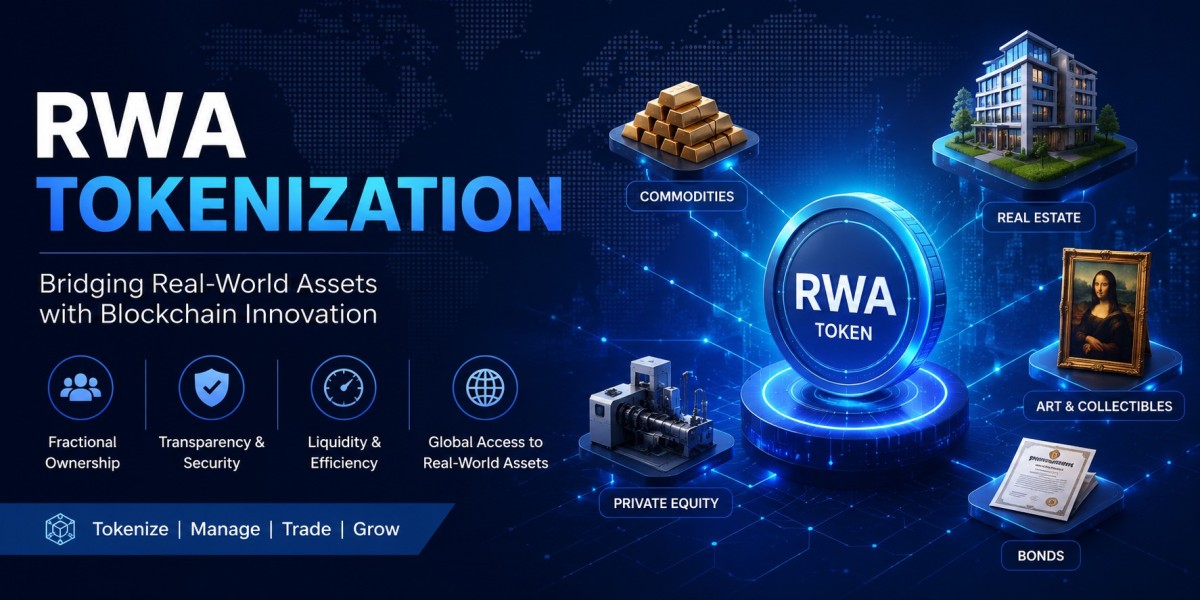


Real-world asset (RWA) tokenization is emerging as one of the most important applications of blockchain technology. Instead of limiting blockchain to cryptocurrencies and digital-native assets, tokenization brings tangible and traditional financial assets such as real estate, government bonds, commodities, private credit, artwork, and company securities onto blockchain networks.
The concept is relatively straightforward: an asset or a legal claim connected to an asset is represented digitally through blockchain-based tokens. However, building a reliable tokenized asset ecosystem involves far more than creating a token. Legal ownership, asset custody, investor rights, compliance, valuation, smart contracts, identity verification, and secondary-market infrastructure all need to work together.
The growing institutional interest demonstrates that RWA tokenization is moving beyond experimentation. The U.S. Securities and Exchange Commission has noted that tokenized securities remain securities and therefore continue to be subject to applicable securities laws. This makes the combination of blockchain infrastructure and traditional financial regulation a central consideration for every serious RWA project.
What Is RWA Tokenization?
RWA tokenization is the process of representing ownership, economic rights, or claims associated with a real-world asset through blockchain-based tokens. Depending on the structure, one token might represent fractional ownership of a property, a claim on an investment fund, an interest in private credit, or exposure to a commodity.
The important distinction is that the blockchain token itself does not magically transform the underlying asset. The legal and economic relationship between the token holder and the asset must be clearly established. For example, if a property is worth $10 million and a compliant structure divides the economic interest into 1 million tokens, each token could represent a proportional interest. But whether that token constitutes direct ownership, a beneficial interest, a security, or another legal claim depends on the jurisdiction and the project's legal architecture.
This is why successful tokenization projects generally combine on-chain technology with off-chain legal entities, custodians, contracts, valuation processes, and compliance systems. Recent academic research similarly finds that many RWA systems use hybrid architectures in which blockchain handles representation, transfers, compliance controls, and settlement while important legal guarantees remain anchored in off-chain structures.
Why Is RWA Tokenization Important?
Traditional assets frequently suffer from high transaction costs, limited accessibility, lengthy settlement processes, and restricted liquidity. Real estate is a particularly strong example. Buying a property normally requires substantial capital, legal documentation, intermediaries, due diligence, and lengthy settlement procedures.
Tokenization can potentially divide exposure to an asset into smaller units and enable ownership records or transfers to be managed through blockchain infrastructure. This does not automatically make an asset liquid, but it can reduce some of the administrative friction surrounding issuance and ownership.
The Bank for International Settlements has specifically examined real estate tokenization because property markets are traditionally characterized by illiquidity and complex transaction processes. Its research highlights the potential of tokenization to address some of these gaps while also emphasizing the interaction between blockchain platforms, traditional property markets, and regulatory structures.
Tokenization can also improve transparency. Instead of maintaining fragmented records across multiple intermediaries, blockchain infrastructure can provide a shared record of token ownership and transactions. Smart contracts can further automate functions such as transfer restrictions, distributions, settlement, and compliance checks.
Which Assets Can Be Tokenized?
RWA tokenization can be applied to a broad range of assets and financial instruments. The most prominent categories include:
- Real estate: Residential properties, commercial buildings, rental portfolios, and real estate funds.
- Government securities: Treasury bills, bonds, and other government-backed instruments.
- Private credit: Loans, credit funds, and debt instruments.
- Commodities: Gold and other physical commodities.
- Private equity: Shares or economic interests in privately held companies and investment funds.
- Art and collectibles: High-value assets that can be divided into fractional economic interests.
- Infrastructure: Renewable energy projects, infrastructure funds, and other long-term assets.
Among these categories, tokenized government securities have attracted considerable attention because they combine the relatively familiar risk characteristics of traditional fixed-income instruments with blockchain-based settlement and distribution infrastructure.
How Does RWA Tokenization Work?
A professional tokenization project normally begins with asset selection and legal structuring rather than smart contract development.
First, the asset is evaluated to determine ownership, valuation, documentation, and suitability for tokenization. Legal professionals then determine what exactly the token represents and which entity holds the underlying asset.
Next comes the token design. The project defines the token's supply, ownership rights, transfer rules, redemption mechanisms, investor eligibility, and distribution model. Smart contracts are then developed to enforce these rules on the selected blockchain.
Compliance is another essential layer. Depending on the asset and jurisdiction, the platform may require Know Your Customer (KYC), Anti-Money Laundering (AML) procedures, accredited-investor restrictions, transfer limitations, reporting, and transaction monitoring.
After issuance, tokens may be distributed through an appropriate platform. If regulations and market infrastructure permit secondary trading, investors may be able to transfer or trade their interests under predefined conditions.
Finally, ongoing asset verification becomes essential. Investors need confidence that the off-chain asset exists, remains properly held, and corresponds to the claims represented by the tokens.
The Role of Smart Contracts
Smart contracts are the operational foundation of many RWA tokenization platforms. They can automate rules that traditionally require manual intervention from multiple intermediaries.
For example, a token contract can restrict transfers to verified wallets, enforce maximum ownership limits, distribute income to eligible holders, record redemptions, and trigger specific settlement processes.
However, smart contracts cannot independently verify whether an apartment building actually exists or whether a government bond is genuinely held by a custodian. That information must come from trusted external systems, custodians, auditors, legal entities, or oracles.
Therefore, smart contract security should be treated as one part of a broader risk-management strategy. A technically secure contract cannot compensate for weak asset custody, inaccurate valuation, poor legal documentation, or inadequate investor protection.
Real-World Example: Institutional Tokenization
Institutional adoption provides a useful indication of where the market is heading. BlackRock's BUIDL fund is a prominent example of a tokenized investment product that uses blockchain infrastructure to represent interests in a fund investing in cash, U.S. Treasury bills, and repurchase agreements.
The broader institutional trend is also becoming more significant. In July 2026, the Depository Trust & Clearing Corporation announced work involving nearly 40 financial firms and technology providers to test tokenized versions of securities and Treasury assets. The initiative demonstrates how established market infrastructure providers are exploring blockchain for settlement, collateral movement, and other capital-market functions.
These developments are important because they shift the discussion from whether traditional assets can be tokenized toward how tokenization can be integrated with existing financial infrastructure.
Key Benefits of RWA Tokenization
The strongest argument for RWA tokenization is not simply that assets become digital. Its value comes from improving the infrastructure surrounding ownership and financial transactions.
Fractionalization can lower the capital threshold for accessing certain assets. Instead of requiring an investor to purchase an entire property or investment position, a compliant structure may allow smaller interests to be represented by tokens.
Operational efficiency can improve when issuance, transfer, distribution, and settlement processes are automated.
Transparency can increase because blockchain networks provide verifiable transaction records.
Programmability allows financial rules to be incorporated directly into digital infrastructure.
Global distribution may become more efficient, although cross-border participation remains dependent on applicable securities, tax, AML, and investor-protection regulations.
At the same time, tokenization should not be confused with guaranteed liquidity. Research on RWA markets shows that an asset being represented on-chain does not necessarily mean it has an active secondary market. Liquidity depends on investor demand, market structure, transfer restrictions, pricing, custody, and regulatory accessibility.
Challenges Businesses Must Consider
The biggest challenge is often legal rather than technical. A token may represent a security, fund interest, debt claim, beneficial ownership interest, or another form of financial instrument. The classification determines the regulatory obligations surrounding issuance and trading.
The SEC has emphasized that tokenized securities remain subject to securities laws, even when blockchain technology is used to represent ownership.
Custody is another critical issue. Investors need to know who holds the underlying asset, how it is protected, and what happens if an issuer or intermediary becomes insolvent. Recent regulatory discussions have also highlighted the importance of clear disclosures, regulated custody, asset backing, independent verification, redemption procedures, and investor recovery mechanisms.
Interoperability and liquidity present additional challenges. A tokenized asset may exist on one blockchain while potential investors and applications operate on another. Without reliable infrastructure for movement, settlement, and compliance across networks, the theoretical benefits of a global market can remain limited.
Choosing an RWA Tokenization Development Partner
Businesses entering this market should look beyond companies that simply offer token creation. An experienced RWA tokenization development company should understand blockchain architecture alongside token economics, smart contracts, compliance workflows, investor onboarding, asset custody, and platform security.
A capable RWA tokenization company should also be able to design the complete ecosystem rather than treating token issuance as an isolated technical task. This can include token standards, smart contracts, investor dashboards, KYC/AML integrations, asset management systems, wallets, marketplaces, APIs, oracle integrations, and administrative controls.
The right development partner should also understand that tokenization projects require continuous monitoring after launch. Smart contracts may require upgrades, compliance rules can change, and asset information needs to remain synchronized with the blockchain representation.
The Future of RWA Tokenization
The future of RWA tokenization is likely to be defined by integration rather than replacement. Traditional financial institutions are unlikely to abandon every existing system overnight. Instead, blockchain infrastructure is increasingly being tested as an additional layer for issuance, settlement, collateral management, ownership records, and distribution.
The institutional experiments taking place across securities, Treasury products, private credit, and funds suggest that tokenization could gradually become part of mainstream financial infrastructure. However, sustainable growth will depend on solving the difficult issues surrounding legal enforceability, investor protection, custody, interoperability, pricing, and liquidity.
Ultimately, the strongest RWA projects will not be those with the most sophisticated tokens. They will be the projects that successfully connect real-world assets, legally enforceable rights, compliant financial structures, secure blockchain infrastructure, and genuine investor demand.
Conclusion
RWA tokenization represents a significant evolution in how traditional assets can be issued, owned, transferred, and managed. From real estate and private credit to Treasury securities and investment funds, tokenization has the potential to improve accessibility, transparency, programmability, and operational efficiency when implemented within a sound legal and financial framework. Businesses looking to enter this market should prioritize security, regulatory compliance, asset verification, and long-term liquidity rather than focusing solely on token creation. Blockchain App Factory provides the best RWA tokenization services, helping businesses build secure and scalable blockchain-based solutions designed around their specific asset, compliance, and business requirements.






