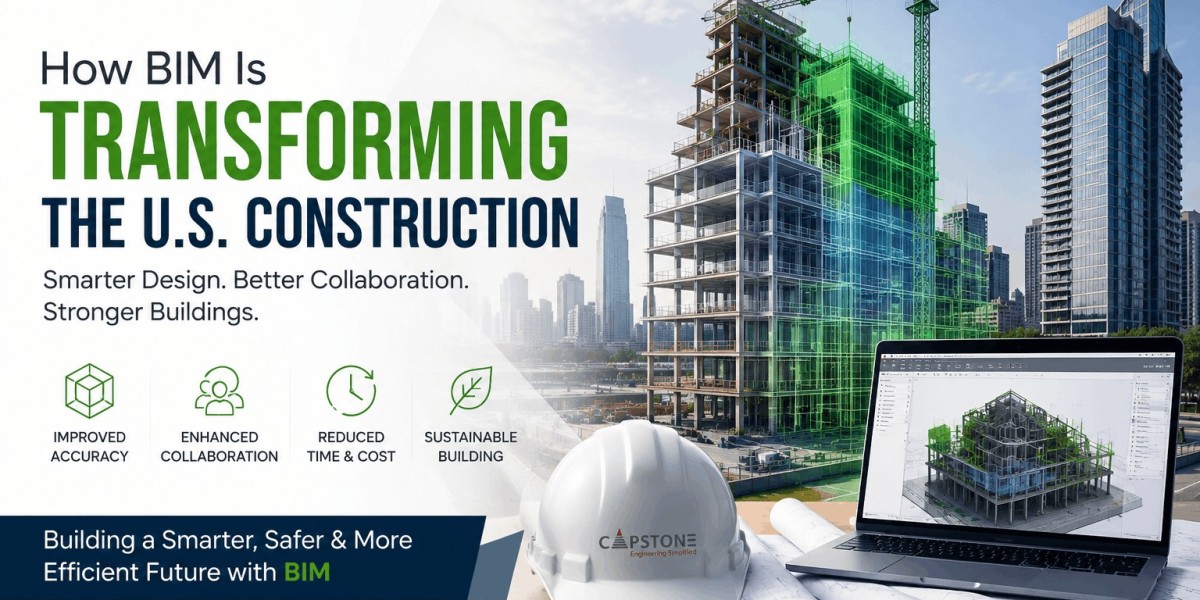


he U.S. construction industry is undergoing a major digital transformation. With increasing project complexity, tighter budgets, labor shortages, and aggressive delivery schedules, project stakeholders are seeking smarter ways to design, coordinate, and construct buildings.
One technology leading this transformation is Building Information Modeling (BIM).
From data centers and healthcare facilities to airports, industrial plants, and commercial buildings, BIM has become the foundation of modern construction project delivery across the United States. It enables architects, engineers, contractors, and facility managers to collaborate in real time, reduce costly errors, and improve project outcomes.
This article explores how BIM is reshaping the U.S. construction landscape, its benefits, current industry trends, and why outsourcing BIM services has become a strategic advantage.
What is Building Information Modeling (BIM)?
Building Information Modeling (BIM) is an intelligent, model-based process that creates and manages digital representations of physical and functional characteristics of a facility throughout its lifecycle.
Unlike traditional 2D CAD drawings, BIM combines geometry, engineering data, schedules, quantities, material specifications, and asset information into a single collaborative environment.
A BIM model serves as a centralized source of truth, allowing every stakeholder—from architects and structural engineers to MEP consultants and contractors—to access accurate, up-to-date project information.
The result is improved coordination, fewer construction conflicts, and better decision-making throughout planning, design, construction, and facility management.
Why BIM Matters More Than Ever in the USA
Construction projects in the United States continue to become larger and more technically demanding.
Several industry trends are driving rapid BIM adoption:
- Mega Data Centers supporting cloud computing and AI infrastructure
- High-performance Healthcare Facilities
- Semiconductor Manufacturing Plants
- Industrial Manufacturing Facilities
- Airports and Transportation Infrastructure
- Commercial Office Developments
- Mixed-Use Residential Projects
- Oil & Gas Facilities
- Renewable Energy Projects
These projects require precise coordination among multiple engineering disciplines.
Without BIM, teams often face:
- Design clashes
- Schedule delays
- Material waste
- Budget overruns
- Communication gaps
- Rework during construction
BIM addresses these challenges before construction begins.
Key Benefits of BIM for U.S. Construction Projects
1. Better Design Coordination
Modern construction involves multiple disciplines working simultaneously.
These include:
- Architecture
- Structural Engineering
- HVAC
- Plumbing
- Electrical
- Fire Protection
- Landscape
- Civil Engineering
BIM enables all disciplines to work within a coordinated digital environment.
This significantly reduces conflicts and improves collaboration.
2. Clash Detection Before Construction
One of BIM's greatest advantages is automated clash detection.
Instead of discovering issues during construction, BIM software identifies conflicts during the design phase.
Examples include:
- HVAC ducts passing through beams
- Electrical conduits intersecting plumbing
- Structural columns conflicting with walls
- Fire sprinkler systems interfering with lighting
Resolving these issues digitally saves thousands of labor hours and avoids expensive field modifications.
3. Reduced Construction Costs
Construction rework is one of the largest contributors to budget overruns.
BIM helps reduce costs by:
- Eliminating design errors
- Improving material estimation
- Reducing RFIs
- Preventing change orders
- Minimizing waste
- Improving procurement planning
Better planning leads to better financial outcomes.
4. Faster Project Delivery
Project schedules continue to shrink.
BIM enables:
- Parallel engineering workflows
- Faster design reviews
- Improved approvals
- Streamlined coordination meetings
- Better construction sequencing
Many U.S. contractors now rely on 4D BIM to simulate construction schedules before work begins.
5. Improved Quantity Take-Offs
Manual quantity estimation can be time-consuming and error-prone.
BIM automatically generates:
- Concrete quantities
- Steel quantities
- Pipe lengths
- Cable quantities
- Equipment schedules
- Material take-offs
This improves estimating accuracy and procurement efficiency.
6. Better Facility Management
The value of BIM continues after construction.
Owners receive accurate digital models containing:
- Equipment data
- Maintenance schedules
- Asset information
- Warranty records
- Space management information
This improves building operations over its entire lifecycle.
BIM Applications Across U.S. Industries
Data Centers
Data centers demand exceptional precision due to their dense MEP systems and mission-critical infrastructure.
BIM helps optimize:
- Cooling systems
- Electrical distribution
- Raised floor coordination
- Cable routing
- Equipment layouts
- Clash-free installations
Healthcare Facilities
Hospitals require extensive coordination between:
- HVAC
- Medical Gas
- Electrical
- Plumbing
- Fire Protection
- Structural Systems
BIM ensures these complex systems integrate efficiently while maintaining compliance with healthcare standards.
Commercial Buildings
Office towers, retail centers, hotels, and mixed-use developments benefit from:
- Faster coordination
- Better visualization
- Accurate quantity estimation
- Improved client approvals
- Reduced construction risk
Industrial Plants
Industrial facilities involve sophisticated piping systems, equipment layouts, and structural steel.
BIM supports:
- Plant modeling
- Equipment coordination
- Pipe routing
- Structural detailing
- Construction planning
Oil & Gas
Oil and gas facilities require accurate engineering due to safety and operational demands.
BIM assists with:
- Process piping
- Structural modeling
- Equipment placement
- Maintenance planning
- Digital asset management
Common BIM Services Required by U.S. Clients
Leading engineering firms typically require:
Architectural BIM Modeling
High-quality architectural models for planning, design development, and construction documentation.
Structural BIM Modeling
Accurate steel, concrete, and foundation models with detailed reinforcement coordination.
MEP BIM Modeling
Integrated HVAC, plumbing, electrical, and fire protection systems.
BIM Coordination
Coordinated multidisciplinary models that reduce construction conflicts.
Clash Detection
Automated clash analysis using industry-leading BIM coordination software.
Shop Drawings
Fabrication-ready drawings for contractors and manufacturers.
Scan to BIM
Laser scan data converted into intelligent Revit models for renovation and retrofit projects.
As-Built BIM Models
Accurate digital records reflecting completed construction.
LOD Development
Support for:
- LOD 100
- LOD 200
- LOD 300
- LOD 350
- LOD 400
- LOD 500
depending on project requirements.
Why U.S. Companies Are Outsourcing BIM Services
Many U.S. engineering firms experience fluctuating project workloads.
Instead of maintaining large in-house BIM teams year-round, they increasingly partner with specialized offshore providers.
Benefits include:
- Lower operational costs
- Faster project turnaround
- Access to experienced BIM professionals
- Flexible resource scaling
- 24/7 project progress across time zones
- High-quality deliverables
- Reduced hiring overhead
This approach allows firms to remain agile while maintaining project quality.
Technologies Driving Modern BIM
Modern BIM workflows leverage advanced software, including:
- Autodesk Revit
- Navisworks
- AutoCAD
- Civil 3D
- BIM 360
- Autodesk Construction Cloud (ACC)
- Dynamo
- Recap Pro
- InfraWorks
- Bluebeam Revu
These tools enable efficient collaboration, design validation, and digital project management.
Emerging BIM Trends in the USA for 2026
The future of BIM is being shaped by several innovations:
AI-Powered Design Automation
Artificial intelligence is helping automate repetitive modeling tasks, improve design validation, and enhance decision-making.
Digital Twins
Owners increasingly use Digital Twins to monitor building performance in real time after construction.
Cloud-Based Collaboration
Platforms like Autodesk Construction Cloud enable distributed teams to collaborate from anywhere.
Reality Capture
Laser scanning and drone photogrammetry provide highly accurate existing-condition models for renovation and retrofit projects.
Sustainable Design
BIM supports energy analysis, daylight studies, carbon reduction strategies, and lifecycle assessments to help meet sustainability goals.
Prefabrication and Modular Construction
BIM enables precise off-site fabrication, reducing construction time, material waste, and installation errors.
Why Choose Capstone Engineering Services?
Capstone Engineering Services delivers comprehensive BIM and digital engineering solutions to clients across the United States, Middle East, and Asia.
Our capabilities include:
- Architectural BIM Modeling
- Structural BIM Modeling
- MEP BIM Services
- BIM Coordination
- Clash Detection
- Scan-to-BIM
- Shop Drawings
- As-Built Documentation
- LOD 100–500 Modeling
- Revit Family Creation
- Quantity Take-Offs
- Construction Documentation
With an experienced team of BIM professionals and expertise in Autodesk technologies, we help clients improve coordination, reduce project risks, and accelerate project delivery.
Whether supporting data centers, healthcare facilities, commercial developments, industrial plants, or infrastructure projects, our focus is on delivering accurate, collaborative, and cost-effective BIM solutions.
Conclusion
Building Information Modeling is no longer just an optional design tool—it has become a strategic necessity for successful construction projects in the United States. As projects grow in scale and complexity, BIM empowers teams to collaborate more effectively, reduce risks, optimize costs, and deliver higher-quality outcomes.
Organizations that adopt advanced BIM workflows today are better positioned to meet evolving industry demands, improve operational efficiency, and create smarter, more sustainable buildings for the future.
For firms seeking to scale resources, improve project coordination, or accelerate delivery, partnering with an experienced BIM service provider can be a significant competitive advantage in the rapidly evolving AEC industry.






