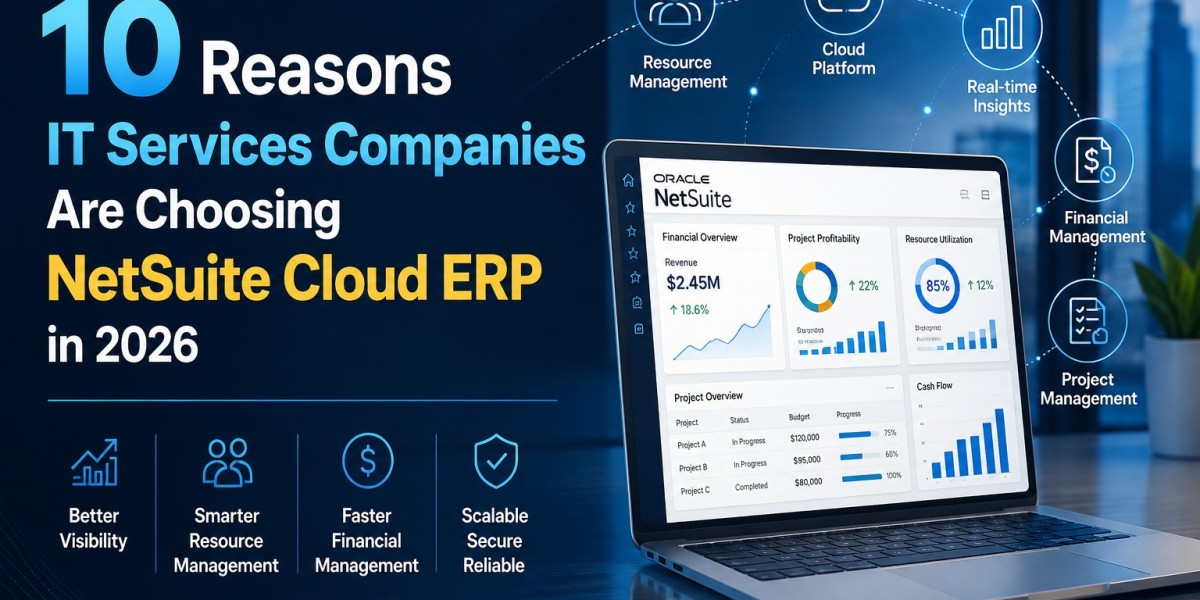


The IT services industry is evolving faster than ever. Businesses are managing remote teams, handling multiple client projects, tracking recurring revenue, and delivering services across different regions. While growth creates new opportunities, it also brings operational challenges that traditional accounting software and disconnected business applications cannot handle efficiently.
Modern IT service providers need a unified platform that connects finance, project management, resource planning, customer data, procurement, and reporting in one place. This is why many organizations are investing in NetSuite Cloud ERP for IT Services to improve efficiency, reduce manual work, and make better business decisions.
Below are ten key reasons why IT services companies are making the move in 2026.
1. A Single Platform for Every Business Process
Many IT companies use separate tools for accounting, CRM, project management, billing, and reporting. While each solution may perform well individually, disconnected systems often create duplicate data, inconsistent reporting, and unnecessary manual work.
A cloud ERP platform brings all essential business functions together. Employees no longer need to switch between multiple applications to complete daily tasks. Financial information, project progress, customer records, invoices, and operational data remain connected in real time.
This unified approach helps leadership gain better visibility into the entire business while improving collaboration across departments.

2. Better Project Visibility
Project success determines profitability for most IT services organizations. Delayed timelines, poor resource planning, and inaccurate budgeting can quickly reduce margins.
Modern ERP solutions provide complete visibility into project performance from planning through delivery. Managers can monitor project budgets, expenses, milestones, utilization, and profitability without waiting for manual reports.
Real-time project tracking enables businesses to identify issues early and make informed decisions before small problems become expensive ones.
3. Smarter Resource Management
People are the most valuable asset in an IT services company. Ensuring that employees are assigned to the right projects at the right time directly impacts customer satisfaction and profitability.
Cloud ERP platforms simplify resource allocation by providing visibility into employee availability, utilization, certifications, workload, and project schedules.
Managers can avoid overbooking experienced consultants while ensuring every team member contributes effectively. Balanced workloads also improve employee satisfaction and reduce burnout.
4. Faster Financial Management
Finance teams often spend significant time consolidating data from different systems, reconciling transactions, and preparing reports.
Cloud ERP automates many financial processes, including accounts payable, accounts receivable, expense management, revenue recognition, budgeting, and financial reporting.
Automation reduces manual errors while allowing finance teams to focus on analysis rather than administrative work.
Faster financial processes also support quicker month-end and year-end closing activities.
5. Improved Revenue Recognition
Revenue recognition has become increasingly complex for IT services businesses offering subscriptions, managed services, implementation projects, maintenance contracts, and milestone-based billing.
Modern ERP platforms automate revenue recognition according to applicable accounting standards.
Instead of relying on spreadsheets, finance teams gain confidence that revenue is recognized accurately and consistently across all projects and service agreements.
This improves compliance while reducing financial risk.
6. Better Client Billing Accuracy
Incorrect invoices create delays, disputes, and cash flow challenges.
Cloud ERP solutions help businesses automate billing based on project milestones, time entries, recurring contracts, subscriptions, or fixed-price agreements.
Since billing information connects directly with project activities and financial data, invoice accuracy improves significantly.
Faster invoicing also leads to quicker payments and healthier cash flow.
7. Real Time Business Intelligence
Business leaders need immediate access to accurate information instead of waiting for weekly or monthly reports.
Cloud ERP platforms provide dashboards that display key business metrics in real time.
Executives can monitor:
- Revenue performance
- Project profitability
- Resource utilization
- Cash flow
- Customer trends
- Operational efficiency
Real-time visibility supports faster strategic decisions while reducing dependence on manually created spreadsheets.
Organizations become more agile because leadership can quickly respond to changing market conditions.
8. Scalability for Business Growth
Growing IT companies eventually outgrow basic accounting software.
Adding more clients, employees, international offices, currencies, or service offerings often requires systems capable of supporting higher operational complexity.
Cloud ERP platforms are designed to scale alongside business growth.
Instead of replacing software every few years, organizations can continue expanding while maintaining the same centralized business platform.
This reduces future implementation costs and minimizes operational disruption.
9. Stronger Security and Compliance
IT services companies manage sensitive customer information, financial records, intellectual property, and confidential project data.
Security therefore becomes a major business priority.
Enterprise cloud ERP platforms include advanced security capabilities such as role-based permissions, audit trails, encryption, automated backups, and compliance controls.
Organizations gain greater confidence that critical business data remains protected while meeting industry compliance requirements.
This becomes increasingly important as cybersecurity regulations continue to evolve.
10. Support for Digital Transformation
Digital transformation is no longer optional.
Clients expect faster delivery, better communication, improved transparency, and higher service quality.
Cloud ERP serves as the operational foundation for digital transformation by connecting people, processes, and data across the organization.
Automation reduces repetitive work while providing employees with more time to focus on innovation, customer relationships, and strategic initiatives.
As artificial intelligence, automation, predictive analytics, and cloud technologies continue advancing, organizations with integrated ERP systems will be better positioned for long-term success.
Why Cloud ERP Matters More Than Ever
Competition within the IT services industry continues to increase.
Businesses must deliver projects faster while maintaining profitability and providing exceptional customer experiences.
Disconnected systems create unnecessary complexity that slows operations and limits decision-making.
A unified cloud platform simplifies finance, project management, billing, reporting, procurement, and resource planning while providing leadership with a complete view of business performance.
Organizations adopting integrated ERP solutions are better equipped to improve operational efficiency, reduce costs, and scale confidently in competitive markets.
Choosing the Right Implementation Partner
Selecting the right ERP software is only part of the journey.
Successful implementation depends on careful planning, business process analysis, data migration, user training, customization, and ongoing optimization.
Working with an experienced implementation partner helps organizations reduce deployment risks while ensuring the solution aligns with long-term business objectives.
SaasWorx Consulting helps organizations implement cloud ERP solutions that improve operational efficiency, financial visibility, and business scalability through industry-focused expertise and proven implementation methodologies.
Conclusion
Technology continues to reshape how IT services companies operate. Businesses require greater visibility, stronger financial control, accurate project management, and better customer experiences to remain competitive.
Modern cloud ERP solutions provide the flexibility, automation, and scalability needed to support these changing business requirements.
Companies investing in integrated ERP platforms today are positioning themselves for stronger growth, higher profitability, improved operational efficiency, and better decision-making in the years ahead. As digital transformation accelerates across every industry, organizations with connected business systems will be better prepared to adapt, innovate, and deliver exceptional value to their clients.








