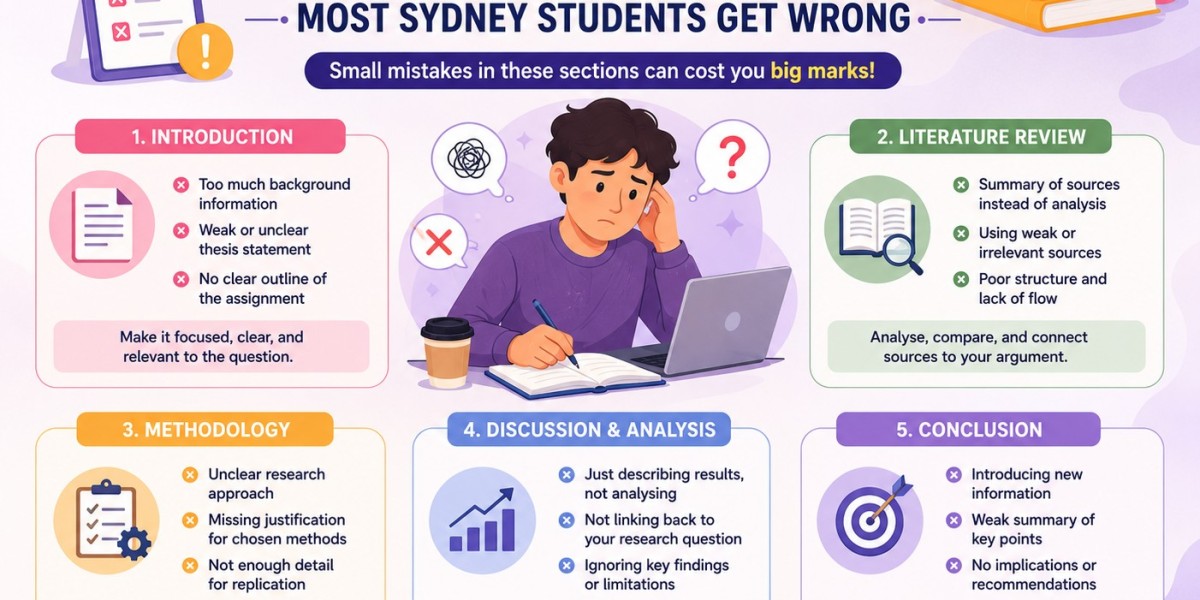


When students ask why their assignments are not performing as well as expected, the conversation almost always ends up in the same place — not with the body of the assignment, where most of the effort went, but with the sections surrounding it. The introduction that does not quite commit to an argument. The conclusion that runs out of steam and restates rather than synthesises. The paragraph transitions that leave gaps a reader has to jump across rather than bridges they can walk over. These are the parts of an assignment that shape a marker's first and last impression, and they are also the parts that most students spend the least time on. If there is one consistent pattern in what Assignment Help Sydney review and feedback services identify in student drafts, it is this — the body is often stronger than the surrounding structure suggests.
Why the Introduction Is So Often Wrong
The introduction is the most frequently rewritten section in any good writer's process, and it is almost always written last by professionals rather than first. Most students do the opposite — they write the introduction first, leave it, and submit it unchanged even when the essay that follows it has developed into something more specific and more argued than the introduction promised.
The result is an introduction that describes the general topic area rather than announcing the specific argument — an introduction that is accurate but vague, informative but directionless. Markers read introductions looking for one thing above everything else: a clear signal of what position the essay will take and how it will be defended. An introduction that does not provide this makes the marker work harder to find the argument, and they start reading with less confidence in what follows.
The specific mistakes that make introductions weaker than they need to be include the following:
- Opening with a broad statement about the general importance of the topic rather than with a sentence that immediately engages the specific question being asked
- Describing what the essay will cover — "this essay will first examine X, then consider Y, before concluding with Z" — rather than stating what the essay will argue about X and Y
- Writing a thesis statement that is so hedged or so general that it does not actually commit to a position that could be disagreed with
- Spending too much of the introduction on background context that belongs in the body rather than in the framing of the argument
- Writing the introduction before the essay is finished, which almost always produces an introduction that does not accurately represent the argument the finished essay actually makes
Why the Conclusion Is Almost Always Rushed
The conclusion is the section most commonly written in the final fifteen minutes before submission. This is also the section where Assignment Help Sydney review services most consistently find the largest gap between what the essay demonstrated and what the student communicated at the end — because a rushed conclusion undersells an often well-argued body. The problem is that a summary conclusion wastes the most structurally important position in the entire assignment.
A conclusion is the last thing a marker reads before they assign a grade. It is the moment when the argument's full weight should land — when everything that has been established across the body paragraphs is pulled together into a statement that is more analytically complete and more confident than any individual section could be on its own. A conclusion that merely restates what was covered squanders that opportunity.
What a strong conclusion should do includes the following:
- Synthesise the argument's key findings into a statement that is richer than any single paragraph produced — showing the cumulative analytical force of what the whole essay has demonstrated
- Reflect on the broader significance of the argument — why this question matters, what the analysis reveals about the topic beyond the immediate answer
- Close with a sentence that gives the reader a clear, confident sense of what the essay has contributed rather than simply signalling that it has ended
- Avoid introducing new evidence or arguments — the conclusion is for synthesis, not continuation
The Transition Problem Nobody Talks About
Between the introduction and conclusion lies the body — and within the body, the thing that most often makes the difference between an argument that flows persuasively and one that reads as a list of points is the quality of transitions between sections. Students who have worked with Assignment Help Sydney on structural review consistently note that transition quality is the feedback they least expected and found most useful.
A transition is not just a word. "Furthermore" and "additionally" placed between two logically unrelated points do not create a transition — they create an illusion of one. A genuine transition briefly reminds the reader of what the previous section established and signals clearly what the next section will add and why it comes next in this particular sequence.
Conclusion
The introduction, conclusion, and transitions are the scaffolding that makes an academic argument legible and persuasive — and they are consistently the most underinvested parts of student submissions. When Assignment Help Sydney review services work through a student's draft, these structural surrounding sections are almost always where the most impactful fixes are found. Fixing them is neither the hardest nor the most time-consuming improvement a student can make — but it is often the one that produces the most immediate improvement in how the work is received.








