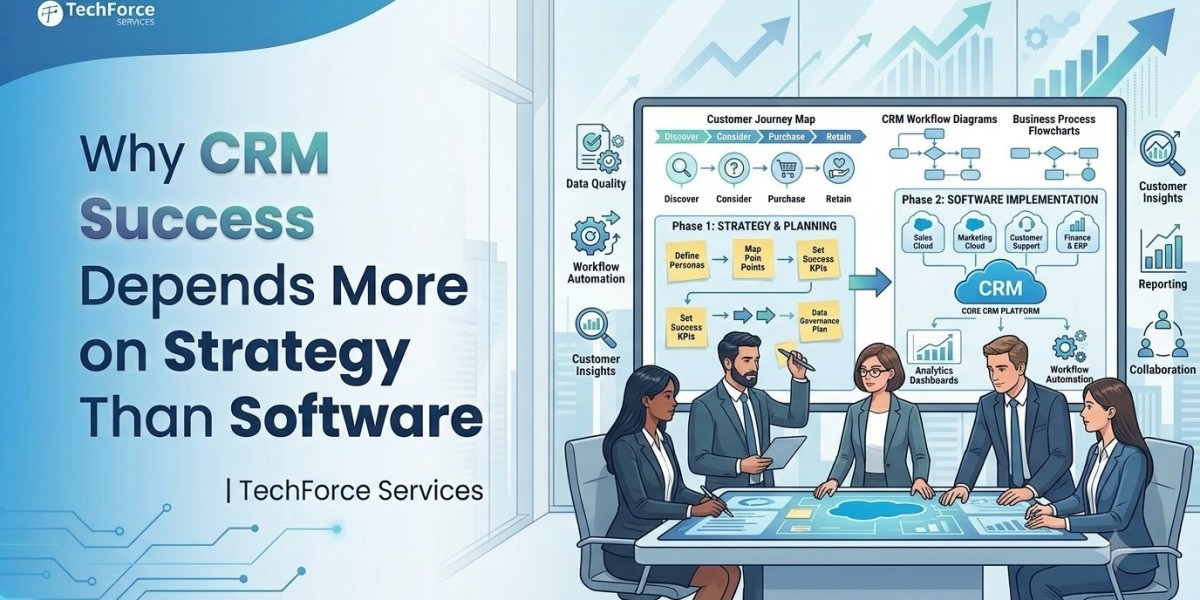


When businesses decide to invest in a customer relationship management (CRM) platform, the conversation usually starts with features. Teams compare dashboards, automation tools, reporting capabilities, and pricing plans before making a decision. While these factors are important, they are rarely what determines whether a CRM project succeeds or fails.
Many organizations discover that implementing new software does not automatically improve customer relationships or business performance. Instead, the biggest improvements happen when technology is supported by a clear business strategy, well-defined processes, and employees who understand how to use the system effectively.
This is why CRM planning deserves as much attention as the software itself.
A CRM Should Reflect How Your Business Works
Every business has its own way of managing customers. A manufacturing company follows a different sales process from a consulting firm. Healthcare providers, financial institutions, and retailers all have unique workflows, reporting requirements, and customer journeys.
Trying to force every organization into the same CRM setup usually creates unnecessary complexity. Employees may begin creating workarounds, maintaining separate spreadsheets, or avoiding the CRM altogether because it does not fit their daily work.
Instead, businesses should first map their customer journey and identify how information moves across departments. Once these processes are understood, the CRM can be configured to support them instead of disrupting them.
The official Salesforce resource library provides useful guidance on CRM planning, implementation, and adoption for organizations beginning this journey.
Clean Data Creates Better Decisions
A CRM is only as valuable as the information stored inside it. If customer records are incomplete, duplicated, or inconsistent, reports become unreliable and decision-making becomes more difficult.
Maintaining high-quality data starts with clear standards for how information is entered and managed. Small improvements such as structured data fields, standardized naming conventions, and guided user input can significantly improve reporting accuracy over time.
Organizations looking for practical examples of improving Salesforce data quality can explore this guide on dependent field configuration, which explains one method of reducing inconsistent data entry.
Connected Systems Reduce Manual Work
Many businesses rely on multiple software platforms every day. Finance teams may use accounting software, marketing departments work with automation tools, customer support teams have their own service platforms, and operations teams often maintain separate business systems.
When these applications operate independently, employees spend valuable time copying information between systems. Besides reducing productivity, manual data entry also increases the likelihood of mistakes.
Integrating business applications allows information to move automatically between systems, creating a more complete view of customers while reducing repetitive administrative work.
Businesses interested in understanding common CRM integration approaches can read more about connecting Salesforce with other business applications.
Salesforce Developers also provide extensive documentation covering APIs, integrations, and connected applications for organizations exploring technical implementation options.
User Adoption Matters More Than Features
One of the most common reasons CRM projects underperform is that employees simply do not use the system consistently.
Even the most advanced platform cannot improve business performance if teams continue relying on spreadsheets or personal notes instead of updating customer records. Successful organizations invest time in employee training, gather regular feedback, and make improvements based on how teams actually work.
When users understand how the CRM supports their daily responsibilities, adoption improves naturally. This also leads to more accurate reporting because everyone contributes to maintaining current customer information.
Continuous Improvement Delivers Long-Term Value
Business requirements change over time. New products are introduced, customer expectations evolve, regulations change, and organizations expand into new markets. A CRM should continue evolving alongside these changes instead of remaining unchanged after implementation.
Regularly reviewing workflows, reports, automation, and data quality helps ensure the platform continues supporting business objectives. Small improvements made consistently often deliver greater long-term value than large redesign projects every few years.
Organizations that treat CRM as an ongoing business improvement initiative rather than a one-time technology project are generally better positioned to adapt as their business grows.
Conclusion
Technology plays an important role in customer relationship management, but software alone does not create successful outcomes. Strong CRM performance comes from understanding business processes, maintaining accurate data, connecting important systems, and helping employees adopt the platform effectively.
Businesses that focus on these fundamentals build CRM environments that support better collaboration, stronger customer relationships, and more informed decision-making. Over time, this strategic approach delivers far greater value than simply choosing the platform with the longest feature list.






