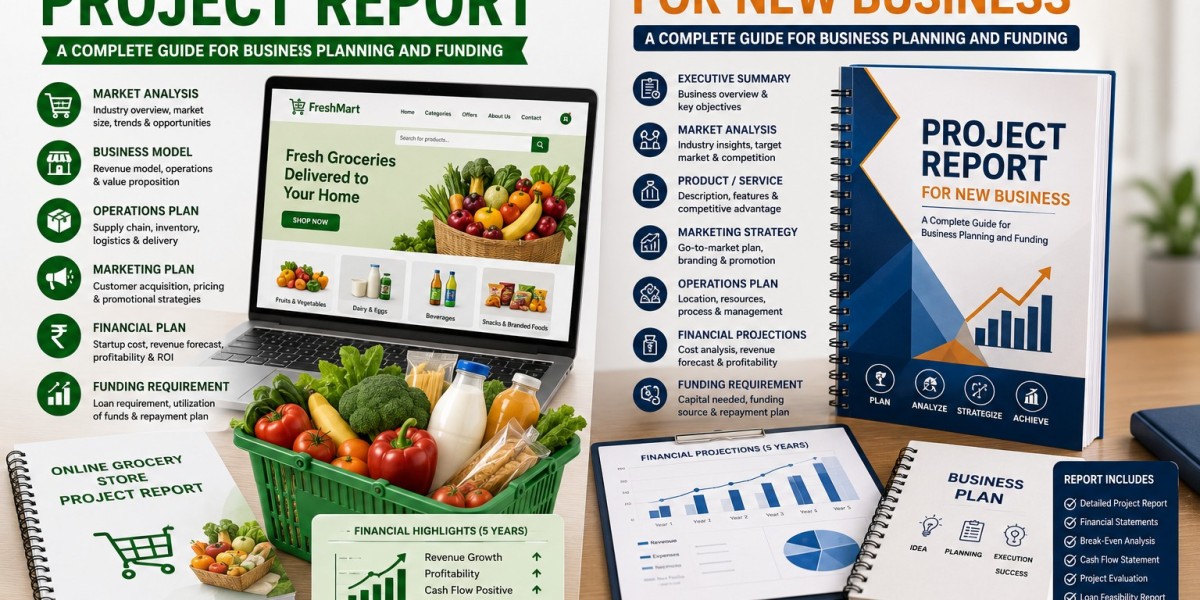


The online grocery store project report is one of the most important documents for entrepreneurs planning to establish a grocery delivery business through an online platform. It presents a complete overview of the proposed business, including investment requirements, operational planning, financial projections, and market potential. A professionally prepared project report for new business also helps banks, investors, and financial institutions evaluate the commercial viability of the venture before approving funding. A comprehensive project report supports informed decision-making, improves financial planning, and provides a structured approach for managing business operations from the initial setup stage through future expansion.
What Is an Online Grocery Store Project Report?
An online grocery store project report is a Detailed Project Report (DPR) that explains how an online grocery business will operate and generate profits. It includes information about the business model, products offered, target customers, supplier network, warehouse requirements, technology platform, delivery system, staffing, marketing strategy, and financial estimates. The report serves as a roadmap that guides entrepreneurs through every stage of business implementation.
Banks and investors review the report to understand the project's investment requirements, expected revenue, profitability, and repayment capacity. Entrepreneurs also benefit from identifying operational challenges before launching the business. A professionally prepared report reduces planning errors and provides measurable financial goals that support sustainable growth. Project Report Online assists entrepreneurs by providing structured DPRs that meet common lending and business planning standards.
Why Is a Project Report Required for an Online Grocery Business?
A project report is required because an online grocery business involves significant investment in inventory, technology, warehousing, logistics, customer service, and marketing. Financial institutions require evidence that the proposed business is capable of generating sufficient revenue to repay borrowed funds while maintaining healthy cash flow.
A comprehensive project report generally includes:
Business objectives and promoter profile
Industry overview and market research
Customer analysis and competitor evaluation
Infrastructure and technology requirements
Capital investment estimation
Working capital calculation
Sales projections and expense estimates
Cash flow statement
Break-even analysis
Loan repayment schedule
Business risks and contingency planning
Each section contributes to a complete assessment of business feasibility while helping entrepreneurs establish realistic financial expectations before investing.
How Do I Prepare a Project Report for an Online Grocery Store?
Preparing an online grocery store project report begins with selecting an appropriate business model based on available investment and market demand. Entrepreneurs should conduct detailed market research to identify customer preferences, pricing strategies, local competition, product availability, and delivery expectations. This information helps create realistic business assumptions.
Financial planning should estimate costs related to website development, mobile applications, warehouse setup, storage equipment, inventory procurement, packaging materials, delivery vehicles, employee salaries, utilities, software subscriptions, and advertising. Revenue forecasts should be based on achievable customer acquisition rates and expected order frequency. The report should also include inventory management systems, supplier agreements, digital payment solutions, delivery operations, and customer support procedures. Accurate financial projections supported by market research improve credibility during loan evaluation.
Why Is a Project Report Important for a New Business?
A project report for new business provides entrepreneurs with a structured financial and operational framework before investing capital. Many startup businesses fail because they underestimate costs, overestimate revenue, or fail to plan working capital requirements adequately. A detailed project report minimizes these risks by presenting realistic projections supported by research.
Banks rely on project reports to evaluate lending risk, while investors use them to assess profitability and business growth potential. Government funding schemes and MSME loan programs also commonly require project reports during the application process. The document enables entrepreneurs to compare multiple funding options, evaluate financial performance, and make strategic business decisions based on measurable information rather than assumptions.
How Do I Prepare a Project Report for a New Business?
Preparing a project report for new business requires systematic collection of technical, operational, and financial information. Every section should be prepared using reliable data obtained from market surveys, supplier quotations, industry benchmarks, and realistic financial assumptions.
An effective project report generally includes:
Executive summary
Promoter details
Business description
Market analysis
Product and service information
Marketing strategy
Operational plan
Infrastructure requirements
Capital investment
Working capital assessment
Projected income statement
Cash flow projections
Balance sheet estimates
Break-even analysis
Profitability assessment
Risk management strategy
For an online grocery store project report, additional emphasis should be placed on inventory turnover, order fulfillment efficiency, warehouse management, customer retention strategies, delivery optimization, and technology maintenance because these factors directly influence operational efficiency and long-term profitability.
Financial Feasibility Analysis and Documentation Requirements
Financial feasibility analysis determines whether the proposed business can generate sustainable profits under realistic market conditions. Entrepreneurs should estimate fixed expenses such as warehouse rent, employee salaries, insurance, software maintenance, and equipment depreciation separately from variable costs, including inventory replenishment, packaging, transportation, advertising, and payment gateway charges. This classification provides greater clarity when forecasting future profitability.
Supporting documentation strengthens the project report for new business during bank loan evaluation. Common documents include business registration certificates, GST registration, promoter identity proof, address proof, supplier quotations, lease agreements, projected financial statements, machinery quotations where applicable, and bank account information. Financial indicators such as gross profit margin, net profit margin, current ratio, debt service coverage ratio, and return on investment provide lenders with measurable evidence of financial viability and repayment capability.
Conclusion
A professionally prepared online grocery store project report enables entrepreneurs to evaluate investment requirements, estimate future profitability, and establish a practical operational strategy before launching their business. An effective project report for new business combines market research, financial forecasting, business planning, and documentation into a comprehensive report that supports funding applications and long-term business management. Accurate financial analysis, realistic assumptions, complete documentation, and careful planning significantly improve business credibility while increasing the likelihood of securing finance, managing operational risks, and achieving sustainable business growth in the competitive online grocery sector.






