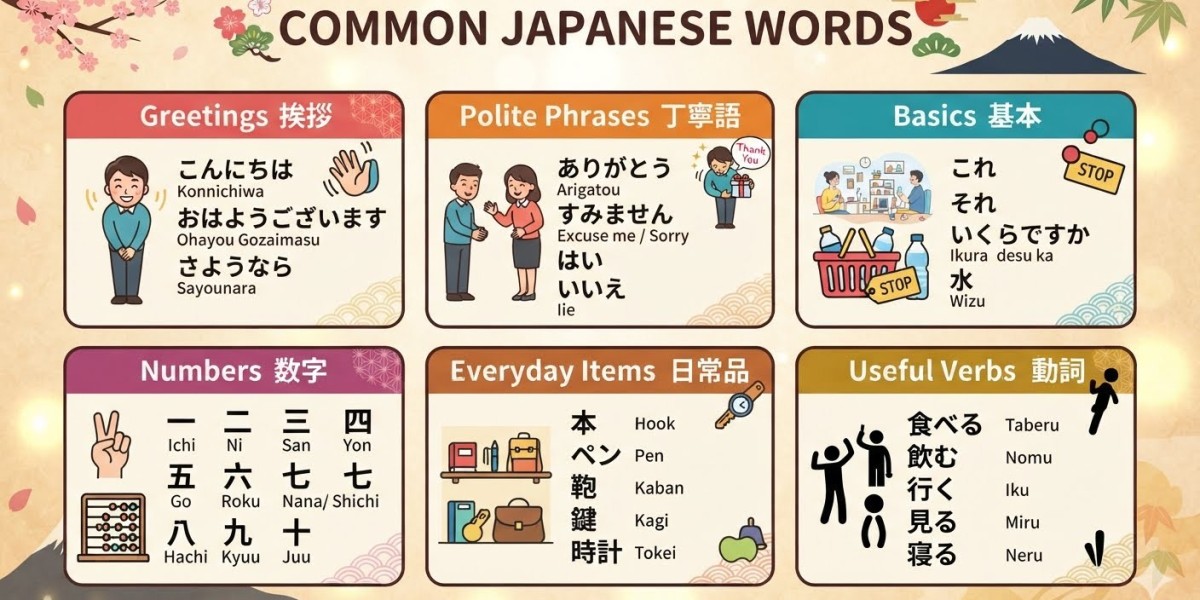


Anyone who has ever opened a Japanese textbook, downloaded a language app, or watched a few minutes of anime with subtitles has probably asked the same question: where do I actually start? Japanese looks intimidating from the outside three writing systems, a grammar structure that runs almost backward compared to English, and a wall of unfamiliar sounds. But the truth is simpler than it appears. The best time to learn Common Japanese Words is right at the very beginning, before grammar rules, before kanji memorization, and before any pressure to sound fluent. Vocabulary is the foundation everything else is built on, and starting with the most frequently used words gives beginners a fast, motivating entry point into the language.
Why Vocabulary Should Come First
Grammar without vocabulary is like a skeleton with no muscles: technically structured, but unable to do anything. A beginner who memorizes verb conjugation patterns but knows only twenty words will struggle to form a single useful sentence. On the other hand, someone who knows two hundred common words, even without deep grammatical knowledge, can already point, gesture, and communicate basic ideas. This is why language educators consistently recommend that new learners learn Common Japanese Words first words like konnichiwa (hello), arigatou (thank you), sumimasen (excuse me/sorry), oishii (delicious), and eki (station). These words appear constantly in daily conversation, media, and travel situations, so learning them early creates immediate, tangible rewards.
The Right Timing: From Day One
There's a common myth that vocabulary should wait until after a learner has "grasped the basics" of grammar or can read hiragana fluently. In reality, the opposite approach works better for most beginners. Language acquisition research shows that early exposure to high-frequency words builds confidence and comprehension simultaneously. A beginner who starts learning core vocabulary in their very first week alongside hiragana will recognize words in real content much sooner than someone who delays vocabulary until later stages.
This doesn't mean grammar should be ignored. Rather, vocabulary and basic sentence structure should grow together, like two vines climbing the same trellis. In the first month, a learner might focus on:
- Greetings and polite expressions
- Numbers and counting words
- Common nouns (food, places, family members)
- Basic verbs (to eat, to go, to see, to be)
- Simple adjectives (big, small, good, bad)
By focusing on these categories, beginners naturally start to notice patterns in how words combine, which makes grammar lessons feel less abstract when they arrive.
The 80/20 Rule of Language Learning
One of the most efficient strategies in vocabulary acquisition is the Pareto Principle roughly 20% of words account for 80% of everyday usage. In Japanese, this means mastering the top 500 to 1,000 most common words unlocks a surprising amount of real-world comprehension. Words such as desu (to be), suki (like), ikimasu (go), tabemasu (eat), and hito (person) appear repeatedly across conversations, anime, songs, and signage. Beginners who prioritize these high-frequency words over obscure or overly formal vocabulary will progress faster and feel more capable, faster.
This is precisely why so many structured courses encourage students to learn Common Japanese Words before diving into JLPT-style grammar drills or kanji stroke order. Confidence built from real comprehension keeps motivation high, and motivation is often the single biggest factor in whether someone continues studying a language or gives up.
Age and Learning Style Considerations: Benefits of Learning Japanese
While vocabulary-first learning Benefits of Learning Japanese nearly everyone, timing can be adjusted based on age and goals. Children often absorb vocabulary through immersion, songs, and repetition, so common words can be introduced playfully and early, even before formal grammar instruction. Adult learners, especially those with academic or travel goals, benefit from combining vocabulary lists with spaced repetition apps like Anki or WaniKani, reviewing 10–15 new words per day. Business learners preparing for professional contexts may want to prioritize workplace-related vocabulary earlier than casual conversational words.
Regardless of age, the guiding principle remains the same: don't wait. The earlier a learner starts absorbing frequently used words, the sooner they can engage with real Japanese content: menus, train announcements, simple conversations, and children's shows.
Practical Tips for Beginners
To make vocabulary learning stick, beginners should:
- Use flashcards or spaced repetition systems for daily review.
- Learn words in context (phrases, not isolated terms).
- Pair vocabulary with hiragana reading practice.
- Practice speaking words aloud immediately after learning them.
- Revisit and reuse words weekly to reinforce memory.
Conclusion
There is no need to wait for the "right" stage of study to begin building vocabulary. In fact, waiting can slow progress and reduce motivation. Beginners who choose to learn Common Japanese Words from day one set themselves up for faster comprehension, greater confidence, and a much smoother transition into grammar and kanji later on. Vocabulary isn't just a stepping stone to fluency it's the very ground learners stand on as they take their first steps into the Japanese language.








