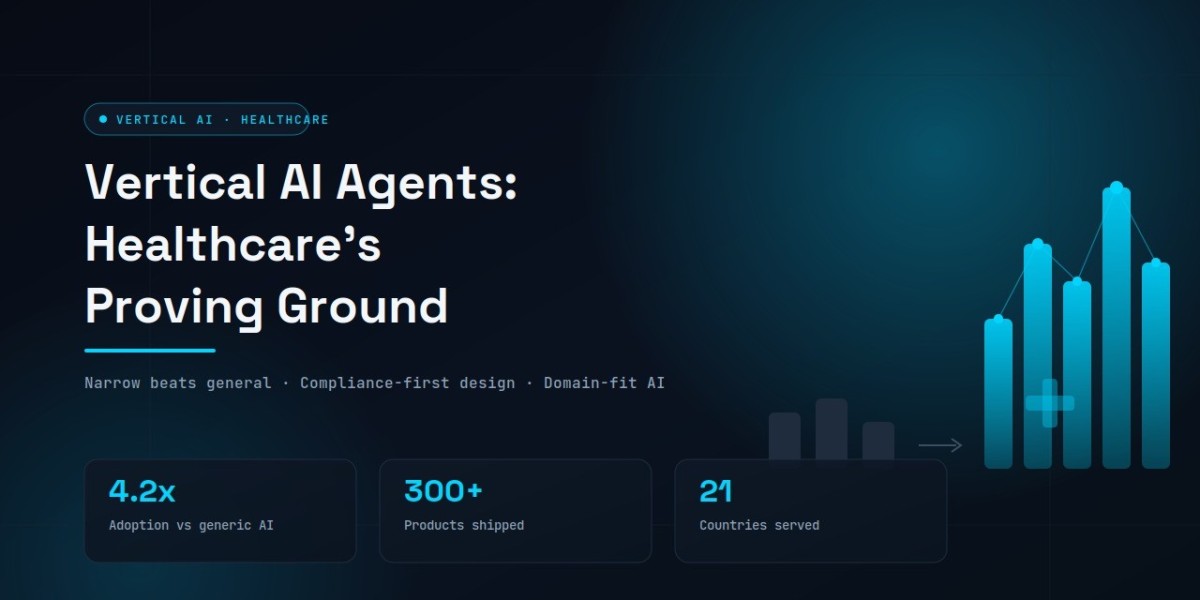


A quiet shift is underway in how software gets built. For years, "add AI" meant bolting a chatbot onto an existing product. In 2026, the more consequential trend is the opposite: purpose-built, vertical AI agents designed around one domain's data, workflows, and compliance constraints — replacing generic tools rather than sitting on top of them. Healthcare is where this shift is most visible, and most instructive, because the stakes for getting it wrong are highest.
Why generic tools are losing ground
A general-purpose scheduling app or a generic patient portal was never built to reason about clinical context — it stores data and executes rules. A vertical agent, by contrast, is trained and configured around a specific domain's vocabulary, edge cases, and failure modes. In healthcare app development, this distinction has become the dividing line between tools that clinicians tolerate and tools they actually adopt: a generic AI assistant that occasionally gets medical terminology wrong erodes trust fast, while a narrowly scoped agent that knows its limits and defers to a human at the right moments builds it.
This is also why "LLM-powered" has stopped being a meaningful differentiator on its own. The market question has shifted from which model a product uses to how narrowly and safely it's been shaped for its domain — retrieval grounded in verified clinical sources, explicit uncertainty flagging, and workflows that keep a licensed professional in the loop for anything consequential.
The build-vs-partner decision is getting sharper
Standing up a vertical agent properly requires more than prompt engineering. It requires data pipelines that respect HIPAA and GDPR boundaries, evaluation harnesses that catch hallucinations before they reach a clinician, and integration work with existing EHR and practice-management systems. Few internal teams have all of that muscle already in place, which is a major reason healthcare organizations are increasingly working with a specialized healthcare app development company instead of retrofitting general engineering teams onto a domain they don't have deep experience in. The learning curve on compliance alone can consume months that a specialized partner has already absorbed.
Staffing the gap without overcommitting
Vertical AI work also demands a narrower, harder-to-hire skill set than typical product engineering — people fluent in both LLM evaluation and healthcare data standards at the same time. Full-time hiring for a capability this specialized, before it's clear how large the long-term need will be, is a real risk for many organizations. That's pushing more teams toward software development team augmentation: bringing in engineers with the exact skill set needed for a defined project window, embedded inside the existing team rather than isolated in a separate vendor relationship. It's a faster, lower-commitment way to get vertical-agent expertise in the door while internal capability catches up.
What this means going into next year
The organizations pulling ahead aren't the ones with the newest model — they're the ones that have narrowed their AI to fit their domain's actual constraints, and built the surrounding engineering discipline to match. In healthcare specifically, that discipline is non-negotiable. Whichever way a team gets there — building in-house, partnering with specialists, or augmenting an existing team — the direction of travel is the same: narrower, safer, and more accountable AI, not bigger and more general.
Insights informed by ongoing product and engineering work at Ailoitte, a healthcare app development company.