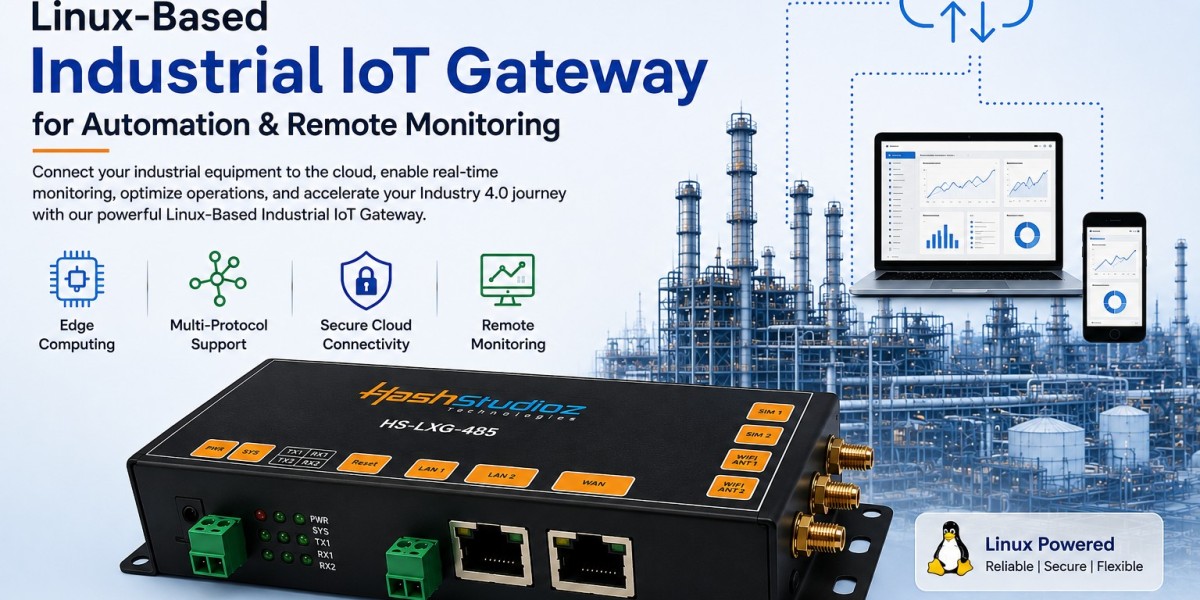


Introduction
As industries embrace Industry 4.0 and Industrial Internet of Things (IIoT) technologies, reliable connectivity between industrial equipment and cloud platforms has become essential. Manufacturing plants, utilities, transportation systems, and smart infrastructure all rely on real-time data to improve operational efficiency, reduce downtime, and enable predictive maintenance.
A Linux-Based Industrial IoT Gateway serves as the intelligent bridge between field devices and modern cloud applications. Built with the stability and flexibility of the Linux operating system, these gateways securely collect, process, and transmit industrial data while supporting multiple communication protocols.
Whether you're modernizing legacy equipment or deploying a new IoT infrastructure, a Linux-based Industrial IoT Gateway offers the performance, security, and scalability required for today's connected industries.
What Is a Linux-Based Industrial IoT Gateway?
A Linux-Based Industrial IoT Gateway is an embedded industrial computer designed to connect industrial machines, PLCs, sensors, RTUs, and controllers with enterprise software and cloud platforms.
Unlike traditional gateways that simply transfer data, Linux-powered gateways can perform:
Edge computing
Data filtering
Protocol conversion
Device management
Local analytics
Secure remote access
Intelligent automation
Because Linux is open-source, highly secure, and extremely stable, it has become the preferred operating system for industrial edge computing applications.
Why Linux Is Ideal for Industrial IoT
Linux offers several advantages over proprietary operating systems in industrial environments.
High Reliability
Linux systems are known for long-term stability and continuous operation, making them ideal for industrial applications that require 24/7 uptime.
Enhanced Security
Industrial gateways require strong protection against cyber threats. Linux supports advanced security features such as:
Firewall configuration
Secure Shell (SSH)
SSL/TLS encryption
VPN connectivity
User authentication
Secure software updates
Open Architecture
Manufacturers can customize Linux to meet application-specific requirements without vendor lock-in.
Low Resource Consumption
Linux efficiently utilizes processor and memory resources, allowing gateways to perform multiple industrial tasks simultaneously.
Key Features of a Linux-Based Industrial IoT Gateway
Multi-Protocol Communication
Industrial environments often contain equipment from different manufacturers.
A Linux gateway supports numerous industrial protocols including:
Modbus RTU
Modbus TCP
MQTT
HTTP/HTTPS
TCP/IP
UDP
OPC UA
CAN Bus (depending on hardware)
Serial RS-232
RS-485
This ensures seamless communication across heterogeneous industrial systems.
Edge Computing Capabilities
Instead of sending every piece of raw data to the cloud, Linux gateways can process information locally.
Benefits include:
Lower bandwidth usage
Faster response time
Reduced cloud processing costs
Real-time decision making
Improved operational efficiency
Remote Monitoring
Industrial managers can monitor equipment from anywhere.
Real-time access includes:
Machine status
Sensor values
Alarm notifications
Production statistics
Device health
System logs
Remote monitoring minimizes maintenance visits and improves operational visibility.
Secure Cloud Connectivity
Modern Linux gateways integrate easily with cloud platforms such as:
AWS IoT
Microsoft Azure IoT
Google Cloud IoT solutions
Private cloud infrastructure
Enterprise IoT platforms
Secure communication is maintained through encrypted protocols and authenticated connections.
Industrial-Grade Hardware
Most Linux-based gateways are built specifically for harsh industrial environments.
Typical specifications include:
Wide operating temperature
Metal enclosure
DIN rail mounting
Fanless cooling
Low power consumption
Long operational lifespan
Surge and ESD protection
Remote Device Management
Administrators can remotely:
Update firmware
Configure network settings
Monitor gateway performance
Restart services
Troubleshoot issues
Deploy applications
This significantly reduces maintenance costs.
Applications Across Industries
Smart Manufacturing
Factories use Linux gateways to collect production data from machines and transmit it to Manufacturing Execution Systems (MES) and cloud dashboards.
Applications include:
Production monitoring
Equipment utilization
Predictive maintenance
Energy management
Oil & Gas
Remote field equipment can be monitored continuously.
Common use cases include:
Pipeline monitoring
Pressure measurement
Flow monitoring
Tank level monitoring
Energy Management
Utilities use industrial gateways for:
Smart meters
Solar monitoring
Wind farms
Power distribution
Grid automation
Building Automation
Linux gateways integrate multiple building systems such as:
HVAC
Lighting
Access control
Fire safety
Energy optimization
Water & Wastewater
Water treatment plants use IoT gateways for:
Pump monitoring
Reservoir management
Water quality analysis
Remote SCADA communication
Transportation
Industrial gateways enable:
Fleet management
Railway monitoring
Traffic management
Vehicle diagnostics
Smart logistics










