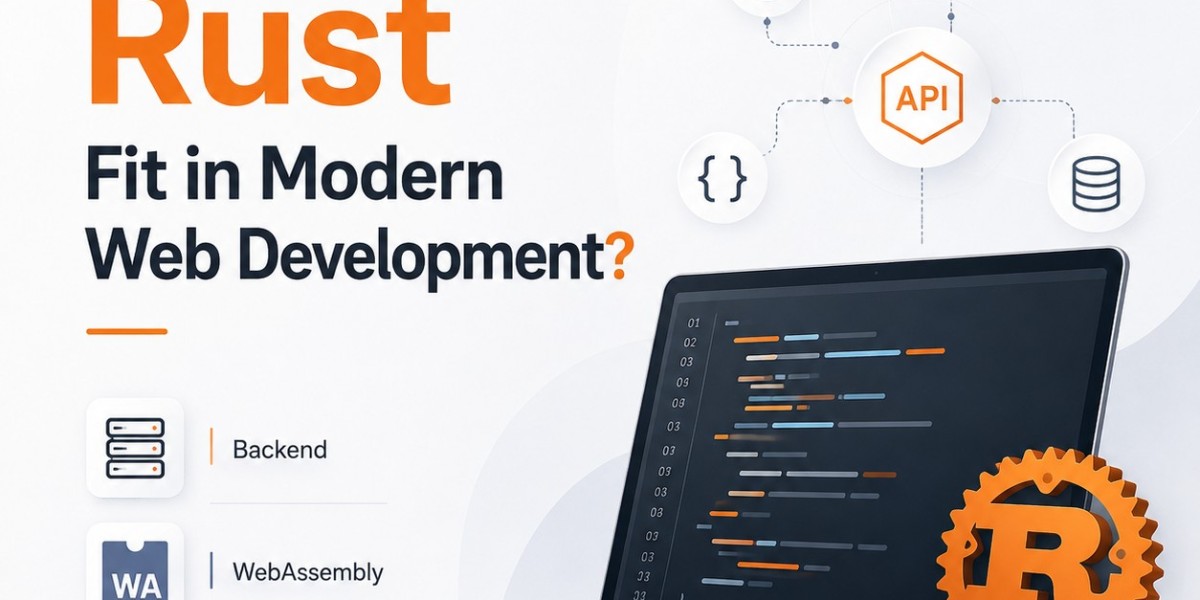


Rust is designed to prevent many common programming errors before an application is launched. Its ownership and borrowing system helps developers control memory without depending on a traditional garbage collector. This makes Rust suitable for web projects where security, stability, and predictable performance are important.
Rust in Backend Web Development
One of the most practical uses of Rust in web development is building backend systems. The backend manages server-side logic, user authentication, database connections, payments, application data, and communication between different services.
Rust can be used to create fast and secure web servers, REST APIs, microservices, and cloud-based platforms. Frameworks such as Axum, Actix Web, and Rocket provide useful tools for routing, handling requests, validating data, managing sessions, and connecting applications with databases.
Axum is often selected for applications built around asynchronous processing and the Tokio ecosystem. Actix Web is known for strong performance and flexibility, while Rocket offers a more approachable structure for developers who want to build secure web applications with readable code.
A professional Software Development Company may recommend Rust when a platform needs to manage high traffic, process many requests, or maintain reliable performance under demanding conditions. Rust can also be a strong choice for financial systems, SaaS platforms, analytics tools, cybersecurity products, and infrastructure services.
Rust for APIs and Microservices
Modern applications often depend on APIs to connect websites, mobile applications, databases, and external services. Rust allows developers to create APIs that are fast, lightweight, and secure.
Its strict compiler can identify many problems during development instead of allowing them to appear after deployment. This can reduce unexpected crashes and improve the reliability of important application services.
Rust is also useful for microservice architecture. In this approach, a large application is divided into smaller independent services. Each service performs a specific task, such as managing payments, sending notifications, processing customer information, or handling user accounts.
Because Rust applications can use system resources efficiently, businesses may use it to build microservices that require lower memory consumption and consistent response times. However, development teams must still consider the availability of experienced Rust developers and the complexity of the overall project.
Rust and WebAssembly
WebAssembly is one of the areas where Rust has gained significant attention in web development. WebAssembly allows code written in languages such as Rust to run inside a web browser alongside JavaScript.
Developers can compile Rust code into WebAssembly modules and use those modules for browser-based features that require greater performance. This does not mean Rust completely replaces JavaScript. Instead, Rust and WebAssembly can support JavaScript by managing demanding tasks more efficiently.
For example, Rust with WebAssembly can be useful for image and video processing, gaming, advanced data visualization, browser-based editing software, scientific calculations, mapping applications, and interactive design tools.
JavaScript can continue to manage the user interface and general browser interactions, while Rust handles complex calculations or resource-intensive operations. This combination allows developers to use the strengths of both technologies.
Performance and Memory Safety
Performance is one of the main reasons businesses consider Rust. The language is compiled into machine code, which allows applications to run efficiently. It also provides developers with detailed control over memory and system resources.
Rust’s memory-safety features help prevent issues such as invalid memory access and data races. These problems can create crashes, security weaknesses, and unpredictable behaviour in software systems.
For applications that manage sensitive information or perform important operations, these protections can be valuable. However, Rust’s strict rules may also make the development process more challenging for teams that are new to the language.
Is Rust Suitable for Every Website?
Rust is not necessary for every web development project. A small company website, personal blog, portfolio, or standard ecommerce store can often be built more quickly with established technologies such as JavaScript, PHP, Python, or popular content management systems.
Using Rust for a simple website may increase development time and cost without providing significant benefits. The technology should be selected according to the actual needs of the project rather than its popularity.
An experienced web design agency can assess the website’s features, traffic expectations, security needs, integrations, and future growth plans before recommending a technology stack.
Rust may be appropriate when a website includes advanced applications, real-time processing, custom infrastructure, high-performance APIs, or browser features powered by WebAssembly. For simpler projects, other technologies may provide a faster and more affordable solution.
Challenges of Using Rust
Although Rust offers many benefits, it also has some limitations. The language has a relatively steep learning curve because developers must understand concepts such as ownership, borrowing, lifetimes, and strict type checking.
Finding experienced Rust developers may also be more difficult than hiring professionals who work with widely used web technologies. In addition, some web development libraries and integrations may have smaller ecosystems compared with JavaScript or Python.
Businesses should evaluate whether the performance and security benefits justify the additional development complexity.
Final Thoughts
Rust fits modern web development best when speed, memory safety, security, and technical control are major priorities. It can support high-performance backend systems, APIs, microservices, cloud platforms, and WebAssembly applications.
However, Rust should not be treated as the default solution for every website. The right decision depends on the project’s technical requirements, budget, available developers, expected traffic, and long-term objectives.
For a complete overview of its applications, benefits, and limitations, read Can Rust Be Used for Web Development?.