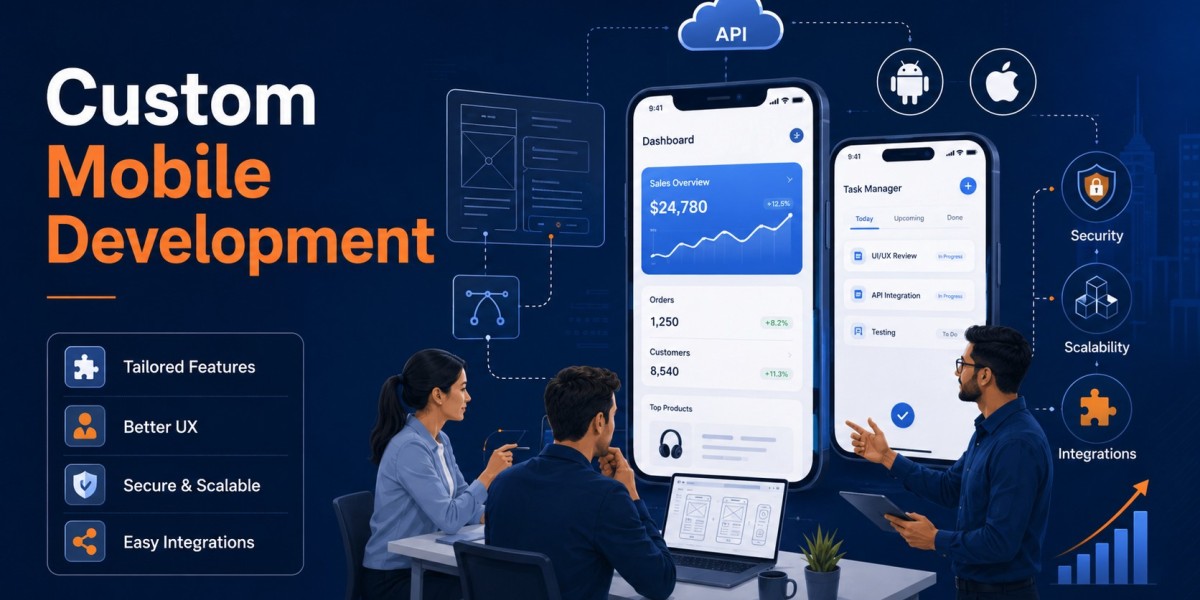


Mobile applications have become an important part of how businesses communicate with customers, manage operations, deliver services, and build long-term relationships.
However, not every business can achieve its goals with a ready-made application.
Generic mobile apps are designed for broad use cases. They may work well initially, but they often become limiting when a business requires unique workflows, specific integrations, stronger security, or a personalised customer experience.
This is where custom mobile development becomes valuable.
Custom mobile development involves designing and building a mobile application around the specific needs of a business and its users. Instead of forcing the business to adjust its processes to fit existing software, the application is developed to support the way the business actually works.
What Is Custom Mobile Development?
Custom mobile development is the process of creating a mobile application specifically for a particular company, audience, or business model.
The application may be developed for:
- Android devices
- iPhones and iPads
- Both Android and iOS
- Internal employees
- Customers
- Vendors or service providers
- Business partners
- Field teams
A custom mobile application can include features such as user accounts, payments, bookings, real-time notifications, document uploads, location tracking, dashboards, artificial intelligence, chat, subscription management, and third-party integrations.
The exact functionality depends on the business objective.
For example, a property management company may need an application for rent collection, tenant records, maintenance requests, and subscription management. A healthcare business may need appointment booking, secure patient communication, and report access.
The application is shaped around the business rather than being limited by a predefined system.
Why Businesses Choose Custom Mobile Development
Businesses usually consider custom mobile development when existing software cannot fully support their requirements.
A standard mobile solution may offer basic functionality, but it may not integrate properly with internal systems or provide the experience customers expect.
Custom development gives businesses greater control over:
- Features
- User experience
- Branding
- Data
- Security
- Integrations
- Scalability
- Product roadmap
It also allows the application to evolve as the business grows.
Instead of replacing the entire platform when requirements change, new features and integrations can be added over time.
Custom Mobile Apps Support Unique Business Processes
Every business has its own way of working.
Two companies in the same industry may still have different approval processes, pricing models, customer journeys, reporting requirements, or staff responsibilities.
A generic application may not support these differences.
With custom mobile development, the application can be designed around the company’s existing workflow.
For example, a custom application may:
- Assign leads to specific team members
- Match customers with suitable products
- Generate reports based on custom criteria
- Apply role-based access for employees
- Automate approval processes
- Connect with an existing CRM
- Send personalised reminders
- Collect and verify documents
- Support region-specific payment methods
This reduces the need for manual workarounds and disconnected tools.
Better User Experience
User experience is one of the strongest reasons to invest in a custom mobile application.
A well-designed app should make it easy for users to complete important actions without confusion.
This may include:
- Registering an account
- Booking a service
- Making a payment
- Tracking an order
- Uploading a document
- Contacting support
- Managing a subscription
- Viewing reports
- Receiving important updates
With a custom solution, every screen and interaction can be designed for the intended audience.
The business can remove unnecessary steps, use familiar terminology, and prioritise the features users need most.
This creates a smoother experience and can improve customer satisfaction, engagement, and retention.
Stronger Brand Identity
A custom mobile application allows a business to create a consistent brand experience.
The app can use the company’s:
- Logo
- Colours
- Typography
- Visual style
- Communication tone
- Illustrations
- Navigation patterns
This makes the application feel like a natural extension of the business.
In contrast, ready-made platforms may offer limited branding options or display the provider’s identity alongside the company’s content.
For businesses that want to build trust and recognition, a fully branded application can create a more professional impression.
Integration With Existing Business Systems
Many businesses already use tools for sales, customer management, payments, inventory, accounting, communication, or analytics.
A mobile application should not operate separately from these systems.
Custom mobile development makes it possible to connect the application with:
- CRM platforms
- Payment gateways
- Accounting software
- ERP systems
- Cloud databases
- Booking systems
- Email platforms
- WhatsApp services
- Mapping tools
- Analytics platforms
- Internal APIs
For example, when a customer submits an enquiry through the mobile app, the information can be sent automatically to the CRM, assigned to a sales representative, and followed by a confirmation message.
Connected systems reduce duplicate data entry and improve operational accuracy.
Greater Control Over Data
Data ownership is an important consideration when selecting a mobile solution.
With some generic platforms, businesses may have limited access to their own data or may depend heavily on the service provider.
A custom mobile application can give the business greater control over:
- Where data is stored
- Who can access it
- How it is processed
- How long it is retained
- How it is backed up
- How it is exported
- Which systems it connects with
This is especially important for businesses handling sensitive customer, financial, identity, health, or operational information.
Proper data architecture also makes reporting and future integrations easier.
Improved Security
Security requirements vary depending on the type of application and data involved.
A custom mobile development company can implement security measures based on the actual risk level of the product.
These measures may include:
- Secure user authentication
- Multi-factor authentication
- Biometric login
- Role-based access
- Encrypted communication
- Secure API access
- Database permissions
- Session management
- Activity logging
- Regular backups
- Fraud-prevention controls
- Secure payment processing
Security should be planned from the beginning of development rather than added after the application is complete.
Businesses should also ensure that the development team follows secure coding practices and regularly updates important dependencies.
Scalability for Business Growth
A mobile app may begin with a small number of users but grow rapidly after launch.
The application should be prepared to handle:
- More users
- Increased transactions
- Larger databases
- New business locations
- Additional services
- New user roles
- More integrations
- Higher notification volume
- Future platform expansion
Custom mobile development allows the technical architecture to be planned around expected growth.
This does not mean building every future feature immediately. It means creating a stable foundation that can be expanded without rebuilding the entire product.
Automation Through Mobile Applications
A custom mobile app can automate many repetitive business processes.
Examples include:
- Sending payment reminders
- Creating invoices
- Updating order status
- Assigning tasks
- Confirming appointments
- Generating reports
- Notifying staff about new requests
- Tracking field activity
- Matching users with relevant services
- Managing subscription access
Automation improves speed and consistency while reducing manual workload.
It also allows employees to focus on tasks that require decision-making, creativity, or personal communication.
Custom Mobile Development for Internal Operations
Not all mobile applications are customer-facing.
Many businesses develop internal apps to help employees work more efficiently.
An internal mobile application may support:
- Attendance tracking
- Staff communication
- Task assignment
- Inventory management
- Field inspections
- Sales reporting
- Delivery tracking
- Customer visit records
- Expense submissions
- Document management
- Approval workflows
Internal apps can be especially useful for teams that work across multiple locations or spend significant time outside the office.
They provide employees with direct access to the information and tools they need.
Native vs Cross-Platform Mobile Development
Businesses considering custom mobile development usually need to choose between native and cross-platform development.
Native Mobile Development
Native applications are developed separately for Android and iOS using platform-specific technologies.
This approach can provide:
- Strong performance
- Deep access to device features
- Platform-specific user experience
- High flexibility for complex applications
However, native development may require more time and budget because separate codebases are maintained.
Cross-Platform Mobile Development
Cross-platform applications use a shared codebase for both Android and iOS.
Technologies such as Flutter and React Native are commonly used for this approach.
Cross-platform development can offer:
- Faster development
- Lower initial cost
- Consistent design
- Easier maintenance
- Quicker launch on both platforms
The right option depends on performance requirements, product complexity, budget, integrations, and long-term plans.
A reliable development partner should explain the trade-offs before recommending an approach.
Essential Stages of Custom Mobile Development
A structured development process helps reduce risk and improve product quality.
1. Discovery and Requirement Analysis
The development team learns about the business, users, goals, existing systems, and operational challenges.
2. Product Planning
The application is divided into features, priorities, user roles, milestones, and release phases.
3. UI and UX Design
Wireframes and visual designs are created to define how users will interact with the application.
4. Technical Architecture
The team selects the frontend framework, backend technology, database, cloud platform, and integrations.
5. Mobile App Development
The application screens, backend services, APIs, database logic, and administrative tools are developed.
6. Testing
The application is tested across devices and operating systems for functionality, usability, performance, and security.
7. Deployment
The app is prepared and submitted to the Apple App Store and Google Play Store.
8. Maintenance and Improvement
The development team monitors performance, fixes issues, updates dependencies, and develops new features.
Each stage should include clear communication and review points.
Features Commonly Included in Custom Mobile Apps
The features of a custom application depend on the business, but common functionality includes:
- User registration and login
- Social or biometric authentication
- User profiles
- Push notifications
- Online payments
- Subscription management
- In-app chat
- Video or audio calling
- Location and map integration
- Document upload
- Image and video support
- Product or service listings
- Search and filters
- Booking systems
- Admin dashboards
- Reports and analytics
- Multi-language support
- Artificial intelligence
- Customer support
- Offline access
A strong product plan should prioritise essential features for the initial launch and move less important features into later phases.
How Much Does Custom Mobile Development Cost?
The cost of custom mobile development depends on several factors.
These include:
- Number of platforms
- Number of screens
- Design complexity
- Backend requirements
- User roles
- Third-party integrations
- Payment functionality
- Real-time features
- Security requirements
- Administrative dashboard
- Testing requirements
- Post-launch support
A simple application with basic features will cost less than a marketplace, fintech platform, healthcare solution, or AI-powered product.
Businesses should avoid selecting a development company based only on the lowest quotation.
The proposal should clearly explain what is included in design, development, testing, deployment, and maintenance.
How to Choose a Custom Mobile Development Company
Selecting the right development partner is essential for the success of the project.
Businesses should evaluate:
- Relevant mobile development experience
- Quality of previous applications
- UI and UX design capabilities
- Backend development knowledge
- Communication process
- Testing standards
- Security practices
- Source-code ownership
- App-store deployment experience
- Post-launch support
- Ability to scale the application
The company should also take time to understand the business before recommending features or technology.
A reliable development partner will ask questions, explain risks, and help prioritise the product rather than immediately starting development without a clear plan.
How Zygobit Supports Custom Mobile Development
Zygobit works with startups, small businesses, and growing companies to design and develop custom mobile applications for Android and iOS.
Our team supports businesses through the complete mobile development process, including:
- Product planning
- UI and UX design
- Flutter and React Native development
- Native mobile development
- Backend and API development
- Cloud database integration
- Payment gateway integration
- Artificial intelligence features
- Admin dashboard development
- App Store and Google Play deployment
- Ongoing maintenance and support
We focus on understanding the business problem before selecting the technology or finalising the feature scope.
This helps us create mobile applications that are practical, scalable, secure, and aligned with the client’s long-term goals.
Final Thoughts
Custom mobile development gives businesses the flexibility to build applications around their actual needs.
It allows greater control over features, branding, user experience, data, integrations, security, and future growth.
The strongest mobile applications are not built by adding as many features as possible. They are built by solving a clear problem and making important actions easier for users.
Businesses should begin with a focused product scope, prioritise essential features, and work with a development partner that understands both technology and business.
When planned and developed properly, a custom mobile application can improve customer engagement, reduce manual work, support business growth, and create a strong digital foundation.