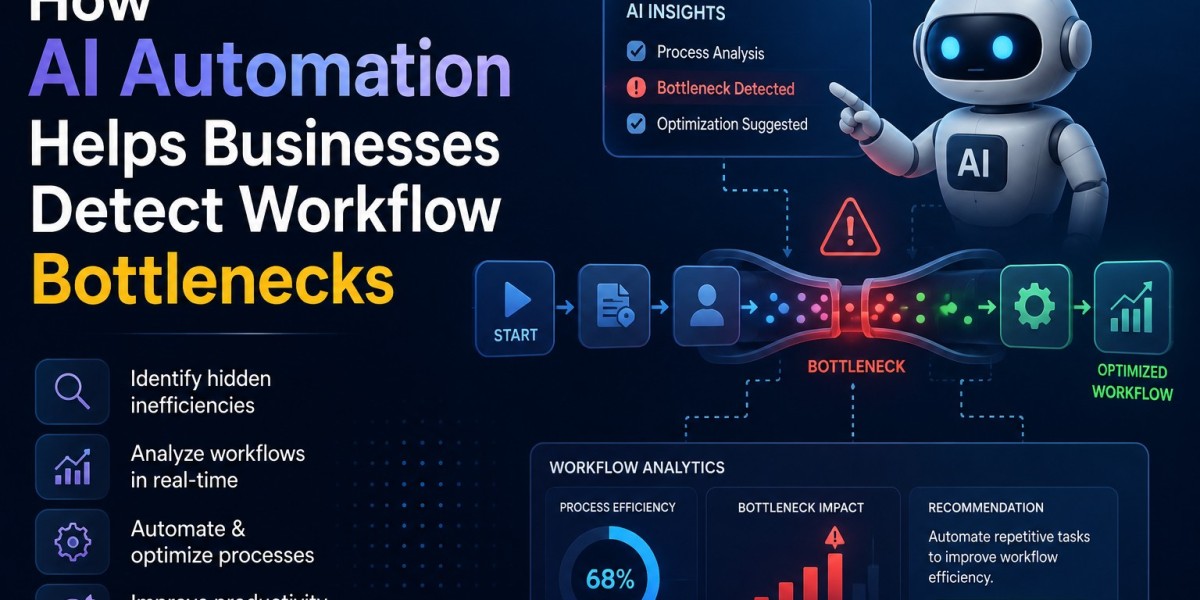


Modern businesses rely on dozens of interconnected workflows to manage sales, customer service, finance, HR, operations, and internal processes. When even one step becomes slow or overloaded, it can create a workflow bottleneck that affects the entire process.
Traditional workflow analysis often depends on manual reporting, spreadsheets, employee feedback, and periodic performance reviews. While these methods can identify obvious problems, they may not reveal hidden delays or patterns occurring across multiple systems.
AI automation provides a more intelligent approach. By continuously analyzing workflow data, AI can identify delays, detect unusual patterns, predict potential bottlenecks, and recommend actions to improve process performance.
This article explains how AI automation helps businesses detect workflow bottlenecks, the technologies involved, common use cases, benefits, and how organizations can implement AI-powered workflow monitoring.
What Is a Workflow Bottleneck?
A workflow bottleneck occurs when one stage of a business process cannot handle the volume or speed of work flowing through it.
For example, consider a sales workflow:
Lead Generation → Lead Qualification → Sales Assignment → Proposal → Approval → Contract → Customer Onboarding
If the approval stage takes several days while all other stages are completed within hours, the approval process becomes a bottleneck.
Common signs of workflow bottlenecks include:
- Increasing task backlogs
- Long approval times
- Repeated manual tasks
- Delayed customer responses
- High employee workloads
- Tasks waiting for approvals
- Frequent process exceptions
- Missed deadlines
- Increased operational costs
Identifying these issues early is essential for maintaining business efficiency.
Why Traditional Bottleneck Detection Is Challenging
Many businesses still identify workflow bottlenecks through manual reporting.
Employees may need to analyze spreadsheets, review task histories, compare performance reports, or manually investigate delayed processes.
This approach has several limitations.
Limited Visibility
Workflow data may be distributed across CRM, ERP, project management, email, and other systems.
Delayed Detection
Businesses may discover bottlenecks only after they have already affected productivity.
Manual Analysis
Employees must spend significant time reviewing process data instead of improving workflows.
Difficulty Identifying Hidden Patterns
Some bottlenecks only appear when multiple factors interact, making them difficult to identify through simple reports.
AI automation can address these limitations by continuously analyzing workflow activity.
How AI Automation Detects Workflow Bottlenecks
AI automation combines data analysis, machine learning, workflow monitoring, and intelligent decision-making to identify process inefficiencies.
1. Continuous Workflow Monitoring
AI systems can continuously monitor workflow activity across connected business applications.
For example, an AI system can track:
- Task completion times
- Approval delays
- Employee workload
- Queue sizes
- Customer response times
- Process exceptions
- System errors
Instead of relying on periodic reports, businesses can receive near real-time visibility into workflow performance.
2. Identifying Unusual Delays
AI can establish normal processing times for different workflow stages.
Suppose a particular approval usually takes two hours.
If the average processing time suddenly increases to eight hours, the AI system can identify the change as an anomaly.
The system can then alert the appropriate manager or trigger an automated investigation.
3. Predictive Bottleneck Detection
One of the biggest advantages of AI is its ability to identify potential bottlenecks before they become serious problems.
AI can analyze historical patterns and predict situations such as:
- Increasing workload
- Upcoming approval backlogs
- Resource shortages
- Seasonal demand spikes
- Increasing customer requests
For example, if customer support requests historically increase by 40% during a particular period, AI can predict a potential support bottleneck and recommend additional resources.
4. Process Mining with AI
AI-powered process mining helps businesses understand how processes actually work rather than how they were originally designed.
The system analyzes process logs from business applications and identifies:
- Repeated process loops
- Unnecessary steps
- Delays
- Rework
- Process deviations
- Approval bottlenecks
This provides businesses with a data-driven view of operational performance.
5. Employee Workload Analysis
Workflow bottlenecks are often caused by uneven workloads.
For example, one employee may be responsible for approving hundreds of requests while another team member has significantly fewer tasks.
AI can analyze workload distribution and identify resource imbalances.
The system can recommend:
- Task reassignment
- Additional resources
- Automated processing
- Priority changes
This helps organizations distribute work more efficiently.
AI Automation for Different Business Bottlenecks
AI-powered bottleneck detection can be applied across multiple departments.
Sales Workflow Bottlenecks
AI can analyze the sales pipeline to identify delays in:
- Lead qualification
- Sales follow-ups
- Proposal creation
- Contract approvals
- Customer onboarding
For example, if qualified leads consistently wait several days before being assigned to sales representatives, AI can identify lead assignment as a bottleneck.
Customer Support Bottlenecks
AI can monitor customer support workflows and identify:
- Increasing ticket queues
- Slow response times
- Repeated escalations
- Unresolved tickets
- Agent workload imbalances
AI can also automatically prioritize urgent customer requests.
Finance Bottlenecks
Finance teams can use AI to identify delays in:
- Invoice processing
- Purchase approvals
- Payment approvals
- Expense reviews
- Account reconciliation
AI can identify where invoices are spending the most time waiting for action.
HR Workflow Bottlenecks
AI can monitor recruitment and employee processes to identify delays in:
- Resume screening
- Interview scheduling
- Approval workflows
- Background verification
- Employee onboarding
This can help HR teams improve employee and candidate experiences.
IT Operations Bottlenecks
AI can analyze IT workflows and identify delays related to:
- Service tickets
- Incident resolution
- System alerts
- Deployment approvals
- Infrastructure issues
AI agents can also automate certain remediation tasks when appropriate.
AI Agents for Workflow Bottleneck Management
AI agents can take workflow monitoring a step further.
Instead of simply identifying a bottleneck, an AI agent can analyze the problem and recommend or execute corrective actions.
For example:
Workflow Delay Detected → AI Agent Investigates → Identifies Cause → Reassigns Task → Notifies Manager → Monitors Resolution
Depending on the business rules, the AI agent may be able to:
- Reassign tasks
- Send reminders
- Escalate delayed requests
- Update workflow priorities
- Generate reports
- Notify managers
- Trigger automated processes
This creates a more proactive approach to workflow management.
Benefits of AI-Powered Bottleneck Detection
1. Faster Problem Identification
AI continuously monitors workflows, allowing organizations to identify issues much faster than manual analysis.
2. Reduced Operational Delays
By identifying bottlenecks early, businesses can take corrective action before delays affect customers or employees.
3. Better Resource Allocation
AI can identify workload imbalances and recommend more efficient resource distribution.
4. Improved Productivity
Employees spend less time dealing with workflow delays and repetitive administrative tasks.
5. Lower Operational Costs
Reducing unnecessary processing time and manual work can help businesses control operational costs.
6. Better Customer Experience
Faster sales, support, and service workflows can improve customer satisfaction.
7. Data-Driven Decision-Making
AI provides businesses with objective insights into how processes actually perform.
How AI Identifies the Root Cause of Bottlenecks
Finding a bottleneck is only the first step. Businesses also need to understand why it occurred.
AI can analyze multiple data points to identify potential root causes.
For example:
Problem: Customer support response time increased.
AI analyzes:
- Ticket volume
- Employee availability
- Ticket categories
- Average handling time
- Escalation rates
- System performance
The AI may determine that a particular ticket category is creating a large workload increase.
This allows managers to address the underlying cause instead of simply adding more employees.
How to Implement AI-Powered Workflow Monitoring
Step 1: Map Existing Workflows
Document the processes you want to monitor.
Identify:
- Tasks
- Owners
- Systems
- Dependencies
- Approval points
- Expected processing times
Step 2: Collect Workflow Data
Connect relevant systems such as:
- CRM
- ERP
- HR software
- Project management tools
- Helpdesk platforms
- Accounting systems
Step 3: Establish Performance Benchmarks
Define normal performance levels for each workflow stage.
For example:
- Lead assignment: under 30 minutes
- Invoice approval: under 24 hours
- Support response: under 2 hours
These benchmarks give AI a baseline for identifying anomalies.
Step 4: Deploy AI Monitoring
Use AI to continuously analyze workflow activity and identify unusual delays, workload increases, and process deviations.
Step 5: Configure Alerts and Automation
Create automated actions when bottlenecks are detected.
For example:
Delay Detected → Manager Alert → Task Escalation → Automated Reminder
Step 6: Continuously Optimize
AI automation should be monitored and improved over time.
Analyze:
- Bottleneck frequency
- Resolution time
- Workflow performance
- Automation success rate
- Employee feedback
Use these insights to continuously improve processes.
Challenges of AI Bottleneck Detection
AI automation provides significant benefits, but businesses should also consider several challenges.
Data Quality
AI depends on reliable workflow data. Incomplete or inconsistent data can affect analysis accuracy.
Integration Complexity
Connecting multiple enterprise systems can require APIs, middleware, or custom development.
False Alerts
AI may occasionally identify normal variations as potential bottlenecks. Proper thresholds and continuous tuning are important.
Security
Workflow systems may contain sensitive business information. Strong security and access controls are essential.
Employee Adoption
Employees should understand how AI monitoring works and how recommendations will be used.
Best Practices for AI Workflow Optimization
Businesses can improve the success of AI bottleneck detection by following these practices:
- Start with one high-impact workflow.
- Define clear performance metrics.
- Integrate relevant business systems.
- Establish realistic benchmarks.
- Keep humans involved in important decisions.
- Monitor AI recommendations.
- Review false alerts regularly.
- Protect sensitive workflow data.
- Continuously optimize automation rules.
How an AI Automation Agency Can Help
Implementing AI-powered workflow monitoring requires expertise in AI, software integration, process analysis, data engineering, and automation.
An experienced AI automation agency in USA can help businesses identify workflow inefficiencies and develop intelligent automation solutions that monitor processes, detect bottlenecks, and trigger corrective actions.
Organizations requiring customized AI solutions can also work with an AI development company in USA to build AI agents, predictive analytics systems, workflow monitoring platforms, and intelligent business applications.
For businesses that need custom enterprise applications, API integrations, or workflow management software, partnering with a reliable Software Development Company in Dallas can help connect AI automation with existing business infrastructure.
The Future of AI Workflow Optimization
The future of workflow management is moving from reactive reporting toward predictive and autonomous process optimization.
Instead of waiting for managers to discover delays, AI systems will increasingly be able to predict potential bottlenecks and recommend corrective actions before performance is affected.
AI agents will also play a larger role in workflow optimization by monitoring processes, coordinating tasks, communicating with employees, and executing approved actions.
The future workflow could look like:
Monitor → Detect → Analyze → Predict → Recommend → Automate → Learn
This approach can help businesses build more agile and responsive operations.
Conclusion
Workflow bottlenecks can significantly affect productivity, customer satisfaction, employee performance, and operational costs. Traditional methods of detecting these problems often depend on manual reporting and periodic analysis, which can make it difficult to identify issues quickly.
AI automation provides a more proactive solution by continuously monitoring workflows, analyzing performance data, identifying anomalies, predicting potential delays, and helping businesses understand the root causes of process inefficiencies.
When combined with AI agents and workflow orchestration, businesses can go beyond simply detecting bottlenecks and begin automatically resolving many routine workflow issues.
For organizations looking to improve operational efficiency, AI-powered workflow monitoring can become an important part of a broader business automation strategy.
Frequently Asked Questions
What is a workflow bottleneck?
A workflow bottleneck occurs when one stage of a business process becomes slower or overloaded, causing delays throughout the rest of the workflow.
How does AI detect workflow bottlenecks?
AI analyzes workflow data such as processing times, task queues, workloads, approval delays, and historical patterns to identify unusual performance and potential bottlenecks.
Can AI predict workflow bottlenecks?
Yes. AI can analyze historical and real-time workflow data to identify patterns that indicate a potential future bottleneck.
Can AI automatically fix workflow bottlenecks?
In some cases, yes. AI agents can reassign tasks, send reminders, escalate requests, update priorities, or trigger predefined workflows based on business rules and permissions.
What business processes can AI monitor?
AI can monitor sales, customer service, finance, HR, IT, procurement, operations, and other business workflows.
Is AI bottleneck detection suitable for small businesses?
Yes. Small businesses can start with high-impact processes such as lead management, customer support, invoice processing, or employee onboarding.
What are the benefits of AI workflow monitoring?
Key benefits include faster bottleneck detection, improved productivity, reduced delays, better resource allocation, lower operational costs, and improved customer experiences.








