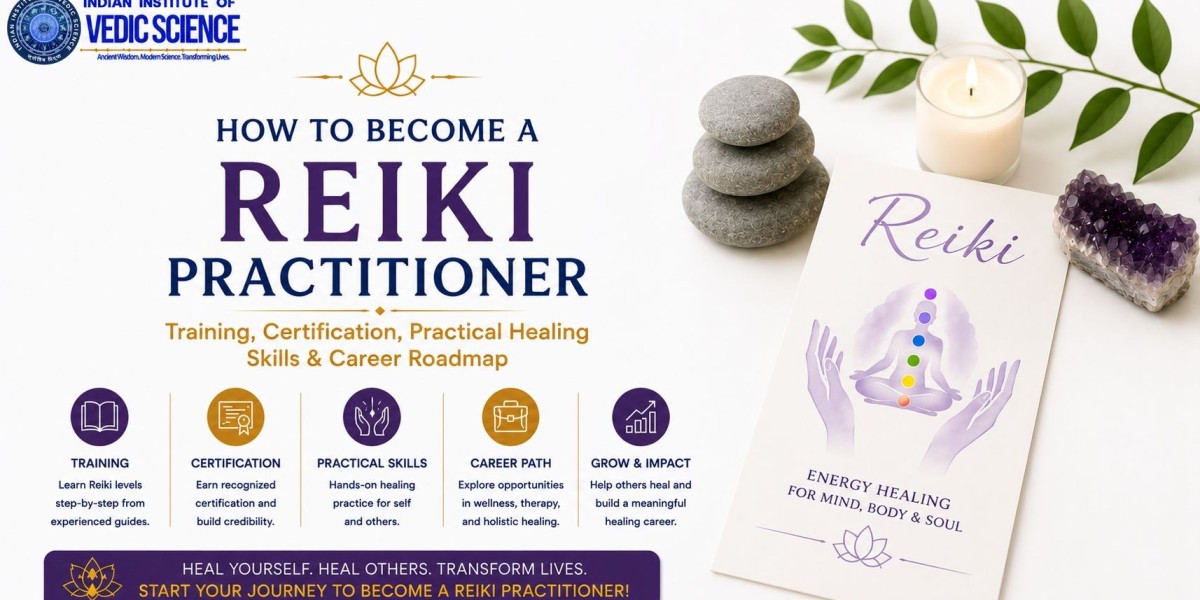


How to Become a Reiki Practitioner: Training, Certification, Practical Healing Skills & Career Roadmap
To become a Reiki practitioner, start with foundational Reiki education, learn the techniques taught within your chosen Reiki tradition, practise consistently, complete the relevant training level and understand professional boundaries. A structured reiki healing course can provide theoretical knowledge, guided practice and certification requirements. After training, practitioners generally need continued practice and experience to develop confidence rather than relying on certification alone.
Becoming a Reiki practitioner involves more than attending a class and receiving a certificate. Reiki is commonly taught as a complementary energy-based practice, and learning it involves understanding its principles, developing a consistent practice routine and learning how to conduct sessions responsibly.
For beginners, the first question is often simple: How do I become a Reiki practitioner?
The answer is best understood as a progression rather than a single qualification.
You need to choose appropriate training, understand the course structure, participate in practical learning, develop communication skills and continue practising after completing your initial education.
Online learning has also made Reiki education accessible to people who cannot regularly attend physical classes. However, the quality of training, practical guidance and transparency around certification should remain important when selecting a program.
What Does a Reiki Practitioner Actually Do?
A Reiki practitioner generally facilitates Reiki sessions according to the methods and principles of the particular Reiki tradition they have studied.
Depending on the training, practitioner activities may include:
Preparing for a Reiki session
Creating a calm session environment
Following taught hand-position techniques
Guiding relaxation practices
Maintaining professional boundaries
Communicating appropriately with clients
Documenting sessions where appropriate
Continuing personal practice
Reiki should be presented responsibly as a complementary practice. It should not be described as a replacement for qualified medical diagnosis or treatment.
A responsible practitioner should also know when a client's needs require support from an appropriate healthcare or other qualified professional.
How Do You Start Learning Reiki?
The first step is to understand the fundamentals.
If you want to learn Reiki healing, begin with a structured introduction rather than attempting advanced techniques immediately.
A beginner-level curriculum may cover:
Introduction to Reiki
History and traditional background
Reiki principles
Concepts used within the practice
Personal preparation
Meditation or grounding practices
Self-practice
Basic session procedures
Professional conduct
This foundation helps students understand the context of the techniques they are learning.
Step-by-Step Roadmap to Becoming a Reiki Practitioner
Step 1: Choose a Structured Reiki Program
Start by comparing a suitable reiki healing course.
Don't select a program based only on its certificate or promotional claims. Review:
Curriculum
Instructor experience
Practical training
Learning format
Course duration
Study material
Student support
Assessment
Certification requirements
The right program should match your current knowledge and long-term learning goals.
Step 2: Learn the Reiki Fundamentals
Before working toward practitioner-level skills, understand the basic concepts and principles taught within the Reiki system.
This stage gives you the foundation required for responsible practice.
Step 3: Develop Self-Practice
Self-practice is an important part of learning.
Students can develop familiarity with the techniques through regular personal practice. A consistent routine may also help learners understand how to prepare for and structure a session.
Step 4: Develop Practical Session Skills
The next stage is learning how to conduct a structured session.
Depending on the program, students may practise:
Session preparation
Hand positions
Session sequencing
Communication
Closing a session
Maintaining appropriate boundaries
Practice should ideally include instructor demonstrations and opportunities for feedback.
Step 5: Complete Course Requirements
Training providers may have different requirements for completion.
These can include:
Attendance
Assignments
Practical exercises
Assessments
Demonstrations
Completion of specific training levels
Understand these requirements before enrolling.
Step 6: Obtain Appropriate Certification
After meeting the requirements, students may receive reiki healing certification for the relevant training level.
Certification can document completion of a program, but it should not be treated as proof of unlimited expertise.
Step 7: Continue Practising
The learning process should continue after certification.
Practitioners can improve by:
Maintaining regular self-practice
Reviewing techniques
Participating in additional training
Reflecting on sessions
Improving communication
Learning from appropriate feedback
Continued development is particularly important for anyone planning to work with clients.
What Practical Skills Should a Reiki Practitioner Develop?
A good practitioner needs more than theoretical knowledge.
Session Preparation
Learn how to create an appropriate environment and prepare yourself before beginning a session.
Technique
Understand the techniques taught in your chosen Reiki system and practise them consistently.
Observation
Pay attention to the session process without making unsupported conclusions about a person's health.
Communication
Explain the session clearly and answer questions within the limits of your training.
Listening
Clients may describe their experiences or concerns. Listening carefully helps maintain a respectful professional interaction.
Boundaries
A practitioner should understand what Reiki can appropriately be presented as and avoid making medical promises.
Professional Conduct
Confidentiality, respect, punctuality and clear communication can contribute to a professional client experience.
What Are Reiki Healing Classes Like?
Reiki healing classes can be delivered through several formats.
Live Online Classes
These allow students to interact with instructors in real time and ask questions during sessions.
Recorded Learning
Recorded lessons can make revision convenient, although students should check whether instructor interaction is available.
In-Person Training
Physical classes can provide direct classroom interaction and demonstrations.
Blended Learning
A combination of live instruction, recorded resources and practical assignments can offer flexibility alongside interaction.
When comparing programs, don't assume one format is automatically better. Ask how practical training and feedback are delivered.
Can You Become a Reiki Practitioner Online?
Online learning can provide a convenient route into Reiki education, depending on the training system and institute.
A reiki healing certification online program should still be evaluated for educational substance.
Before enrolling, check:
Live instructor interaction
Practical demonstrations
Practice requirements
Assignments
Assessment
Doubt resolution
Certification conditions
Online students should also maintain a regular practice schedule rather than simply completing video lessons.
How Much Do Reiki Courses Cost?
Reiki healing course fees can vary depending on the institute, training level, duration, delivery format and resources included.
Instead of comparing only the advertised price, check what you receive for the fee.
Consider whether it includes:
Live instruction
Study material
Practical sessions
Instructor support
Assessments
Certification
Additional learning resources
Fees and course structures can change, so prospective students should confirm current pricing directly with the institute before enrollment.
What Does Reiki Certification Mean?
Reiki healing certification generally indicates that a learner has completed the requirements of a particular training program or level.
Before choosing a course, understand:
Who issues the certificate
What level it represents
Course-completion requirements
Whether practical assessment is included
Whether attendance is required
What the certificate is intended to demonstrate
A certificate can document education, but expertise develops through practice and experience.
This distinction is important for maintaining realistic expectations about professional development.
How Do You Choose the Right Reiki Institute?
If you are searching for the best reiki institute in Delhi, compare the actual learning experience rather than relying only on rankings or promotional language.
Look at:
Curriculum
Does the course clearly explain what you will learn at each stage?
Practical Training
Are there demonstrations and opportunities for guided practice?
Instructor Guidance
Can students ask questions and receive feedback?
Certification
Are completion and assessment requirements clearly explained?
Learning Support
Is help available when students struggle with concepts or techniques?
Ethics
Does the institute communicate Reiki responsibly without making unsupported health claims?
These criteria are also useful when comparing options accessible to students in Noida, Bangalore and Kolkata.
Can Reiki Become a Career?
Reiki can be developed into a complementary service for individuals who build appropriate knowledge, practical experience and professional skills.
Potential directions may include:
Reiki practitioner
Independent complementary practitioner
Wellness-session facilitator
Workshop facilitator
Reiki-related content creator
Educator after gaining sufficient experience
Complementary service provider
Some practitioners may offer sessions online, while others may work through physical consultations or a combination of formats.
Career outcomes vary significantly. Completing a course or certification does not guarantee employment, income or a particular number of clients.
Professional development usually involves continued learning, communication skills, reputation building and responsible service delivery.
How Can a New Practitioner Build Experience?
After completing training, avoid treating certification as the end of the learning process.
A practical development plan can include:
Build a Regular Practice
Continue personal practice to maintain familiarity with the techniques.
Practise With Appropriate Participants
Where suitable and within your training, gain experience through supervised or clearly structured practice.
Improve Communication
Learn how to explain sessions, answer questions and set expectations clearly.
Document Your Learning
Keep appropriate learning notes to reflect on what you are improving.
Seek Further Education
Advanced learning can be considered once the fundamentals are well established.
Build Reputation Gradually
Professional credibility develops through responsible conduct and consistent service rather than exaggerated promises.
What About Studying Astrology Alongside Reiki?
Some learners are interested in multiple traditional or holistic subjects.
If astrology is another area of interest, you may encounter online classes for astrology or programs designed for learners who want remote study.
You can learn astrology online independently of Reiki. However, astrology and Reiki have different concepts and methodologies, so they should be approached as separate areas of study.
When comparing astrology certification courses, examine:
Curriculum
Faculty
Practical learning
Assessment
Course duration
Study material
Certification requirements
An astrology certificate course online may be useful for someone whose primary objective is astrology education, but it should not be confused with Reiki training.
Choose the subject according to your actual learning goals rather than collecting certificates without developing practical knowledge.
Reiki Learning in Delhi, Noida, Bangalore and Kolkata
Learners in Delhi, Noida, Bangalore and Kolkata can explore both local and online learning options.
Online training can be especially useful when:
You have work commitments.
Travel is inconvenient.
You need flexible scheduling.
You prefer studying from home.
You want access to instructors outside your immediate location.
Local classes may appeal to students who prefer a physical learning environment.
Regardless of location, compare the curriculum, practical training, instructor support and certification requirements before making a decision.
Why Consider IIVS for Reiki Training?
The Indian Institute of Vedic Science (IIVS) offers structured learning opportunities in Reiki and related disciplines.
Prospective learners can evaluate IIVS based on:
Structured curriculum
Instructor guidance
Practical learning
Study resources
Certification
Student support
Beginner suitability
Opportunities for continued practice
If you are considering Reiki training from Delhi, Noida, Bangalore, Kolkata or another location, online learning can provide additional flexibility.
Before enrollment, confirm the current course duration, curriculum, learning format, practical requirements, certification process and reiki healing course fees directly with IIVS.
Learning how to become a Reiki practitioner is a gradual process. The journey generally begins with foundational education, continues through practical training and certification, and develops further through consistent practice and professional experience.
A strong learning program should teach more than techniques. It should help you understand session preparation, communication, boundaries, practical application and responsible professional conduct.
When comparing a reiki healing course, look beyond the certificate. Examine the curriculum, practical training, instructor support, learning format, course duration and reiki healing course fees.
Most importantly, remember that certification is a starting point rather than a guarantee of professional success. Continued practice, ethical communication and ongoing development are what help build a sustainable professional foundation.
Start Your Reiki Learning Journey With IIVS
If you are considering Reiki as a personal learning goal or potential complementary professional skill, connect with the Indian Institute of Vedic Science (IIVS) for course information and free counselling.
Website: https://iivs.com/
Phone: +91 79826 57336
Discuss your learning goals with the IIVS team or get a free counseling and confirm the current curriculum, course duration, practical training, certification requirements, learning format and fees before enrollment.
Frequently Asked Questions
What qualifications do I need to become a Reiki practitioner?
Beginners generally start with appropriate Reiki training rather than needing a prior professional qualification. Requirements can vary by institute and Reiki level.
Can I become a Reiki practitioner through online training?
Online training can provide a pathway to learning Reiki, depending on the program. Check whether the course includes live guidance, practical learning and clear certification requirements.
How long does it take to become a Reiki practitioner?
There is no universal timeframe. It depends on the Reiki system, training level, institute and amount of practice. Confirm the current duration with your chosen training provider.
Is Reiki certification necessary?
Certification can document completion of formal training, but professional competence also depends on continued practice, communication and experience.
How much do Reiki healing courses cost?
Reiki healing course fees vary according to level, institute, duration, format and included resources. Always confirm the latest fees and inclusions before enrolling.
Can Reiki be a full-time career?
Some practitioners develop Reiki-related services professionally, while others use it as a complementary skill. Career outcomes vary and should not be guaranteed by a training provider.
Can I study Reiki and astrology together?
Yes. They are separate disciplines, so you can study both according to your interests. If astrology is your second area of interest, compare the curriculum and practical training of available programs before enrolling.