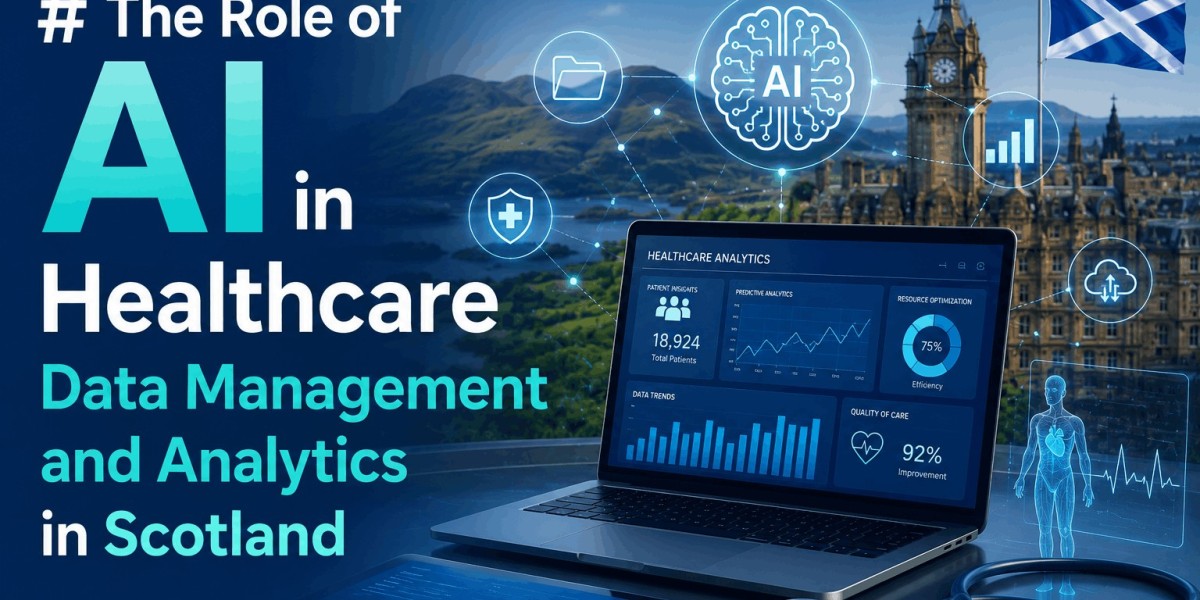


Healthcare generates enormous amounts of information every day, from patient records and diagnostic results to appointment data, treatment histories, population health information, and operational records. Managing this information effectively is becoming increasingly important for healthcare organizations across Scotland.
Scotland already has a dedicated Data Strategy for Health and Social Care that focuses on improving how health and care data is collected, accessed, shared, and used. The strategy highlights better data quality, interoperability, secure access, research, innovation, and creating useful insights from data as important priorities.
Artificial Intelligence (AI) can strengthen these efforts by helping healthcare organizations process large datasets, identify patterns, automate data-related tasks, and turn complex information into useful insights.
The opportunity is not simply about having more data. It is about helping healthcare professionals and decision-makers make better use of the data they already have.
Why Healthcare Data Management Matters in Scotland
Healthcare data needs to be accurate, accessible, secure, and properly organised before it can deliver meaningful value.
Scotland's health and social care system includes multiple organizations, services, and technology platforms. Differences in how information is recorded and stored can make it difficult to share and connect data effectively. Scotland's Data Strategy specifically identifies interoperability and common information standards as important areas for improvement.
AI development can help organizations work with this complex data environment by automating parts of data processing, identifying inconsistencies, categorising information, and helping professionals find relevant information more efficiently.
However, AI cannot compensate for poor-quality data on its own. Strong data foundations remain essential.
How AI Can Improve Healthcare Data Management
Traditional data management can involve significant amounts of manual work. Healthcare teams may need to organise information from different systems, process documents, update records, and prepare data for reporting or analysis.
AI-powered solutions can automate some of these repetitive activities.
For example, AI can help classify documents, extract relevant information, identify duplicate records, organise unstructured information, and generate summaries from approved datasets.
This can reduce manual workloads and allow healthcare teams to spend more time on activities that require professional expertise.
Scotland's recent health and social care data strategy update also highlights exploring automation of data collection, analysis, and the use of AI as part of ongoing work.
Turning Healthcare Data Into Actionable Insights
Having large amounts of healthcare data is only useful when organizations can understand what that data means.
AI and machine learning can analyse large datasets much faster than traditional manual approaches. They can identify trends, relationships, and patterns that may otherwise be difficult to detect.
Healthcare organizations could use these capabilities to understand service demand, identify population health trends, monitor operational performance, and support planning.
For example, data analytics could help identify periods when demand for particular healthcare services increases. Decision-makers can then use these insights to plan resources and improve service delivery.
Scotland's Data Strategy specifically aims to create insights that can support service improvement, targeted interventions, policy development, and better partnership working.
Supporting Predictive Healthcare Analytics
One of the more advanced applications of AI is predictive analytics.
Instead of only looking at what has already happened, AI models can analyse historical and current information to identify patterns that may indicate what could happen next.
In healthcare, this could support areas such as demand forecasting, early risk identification, resource planning, and population health management.
Scotland's health and social care data work has already identified AI-supported predictive analytics as an area of interest, including its use to support early intervention and informed decision-making.
Predictive analytics should not be treated as a replacement for clinical expertise. Predictions need to be assessed by appropriately qualified professionals and used within suitable governance frameworks.
Helping Healthcare Professionals Access Information Faster
Healthcare professionals often need to review information from multiple sources before making decisions.
AI can help by summarising approved information, organising relevant records, and making large datasets easier to navigate.
An AI-powered system could, for example, help a professional identify important information from a patient's history without requiring them to manually search through every available record.
This can save time and reduce information overload, particularly in environments where healthcare professionals are already managing significant workloads.
The value comes from improving access to the right information at the right time, which is also a central ambition of Scotland's health and social care data strategy.
Improving Population Health Planning
AI-powered healthcare analytics can also operate at a population level.
Instead of focusing only on individual patients, organizations can analyse larger datasets to identify trends across communities and groups.
This can help healthcare planners understand changing patterns in demand, identify areas where additional support may be required, and evaluate the effectiveness of services.
Better population-level insights can contribute to preventative approaches, helping organizations move beyond reacting to health problems and towards identifying opportunities for earlier intervention.
Scotland's current health and social care reform agenda places increasing emphasis on prevention, digital innovation, improved access, and using data to support better outcomes.
Data Security and Responsible AI Are Essential
Healthcare data is highly sensitive, so AI adoption must be accompanied by strong privacy, security, and governance measures.
Organizations need to understand what data an AI system uses, how it is processed, where it is stored, who can access it, and how outputs are generated.
Scotland's Data Strategy calls for a trusted and secure health and care data ecosystem, while also recognising the need to manage risks associated with technologies such as AI and automated decision-making.
Scotland's new AI Strategy for 2026 to 2031 also includes a specific commitment to establish a trusted framework for the safe, ethical, and efficient use of AI across health and social care services.
This means healthcare organizations should consider responsible AI from the beginning rather than treating governance as an afterthought.
Building Better Healthcare Analytics With Strong Data Foundations
AI can only provide reliable insights when the underlying data is reliable.
Healthcare organizations therefore need to pay attention to data quality, interoperability, standardisation, infrastructure, and secure access.
Scotland has already been working towards stronger data foundations, including common standards and improved interoperability across health and social care systems. Its data strategy also promotes the FAIR principles, meaning data should be Findable, Accessible, Interoperable, and Reusable where appropriate and safe.
For healthcare organizations considering AI analytics, this means the first step should not always be choosing an AI model. It may instead be improving how data is collected, structured, connected, and governed.
The Future of AI-Driven Healthcare Data in Scotland
AI is likely to become an increasingly important part of how Scotland manages and uses healthcare data.
The combination of AI, machine learning, data analytics, automation, and improved digital infrastructure can help healthcare organizations move towards more informed, proactive, and efficient services.
But successful adoption will depend on more than technology. Healthcare professionals need appropriate training, patients need confidence that their information is being handled responsibly, and organizations need clear governance around how AI systems are used.
Scotland's approach is increasingly focused on combining digital innovation with responsible data use. Its Health and Social Care Data Board provides strategic oversight of the health and social care data landscape and works on areas including data standards, governance, and alignment with Scotland's wider digital and AI strategies.
Final Thoughts
AI can transform healthcare data management and analytics in Scotland by helping organizations process information more efficiently, discover valuable insights, support predictive analytics, and give professionals faster access to relevant information.
However, the biggest opportunity is not simply using AI to analyse more data. It is using AI responsibly to turn high-quality healthcare data into information that can support better decisions and better services.
For Scottish healthcare organizations, the path forward should combine strong data foundations, responsible AI, secure infrastructure, professional oversight, and a clear focus on patient outcomes.
Malgo helps organizations explore and develop AI-powered healthcare solutions designed around real operational and data challenges. By combining AI development, automation, and intelligent analytics, healthcare organizations can make better use of their data while keeping security, human expertise, and patient needs at the centre.









