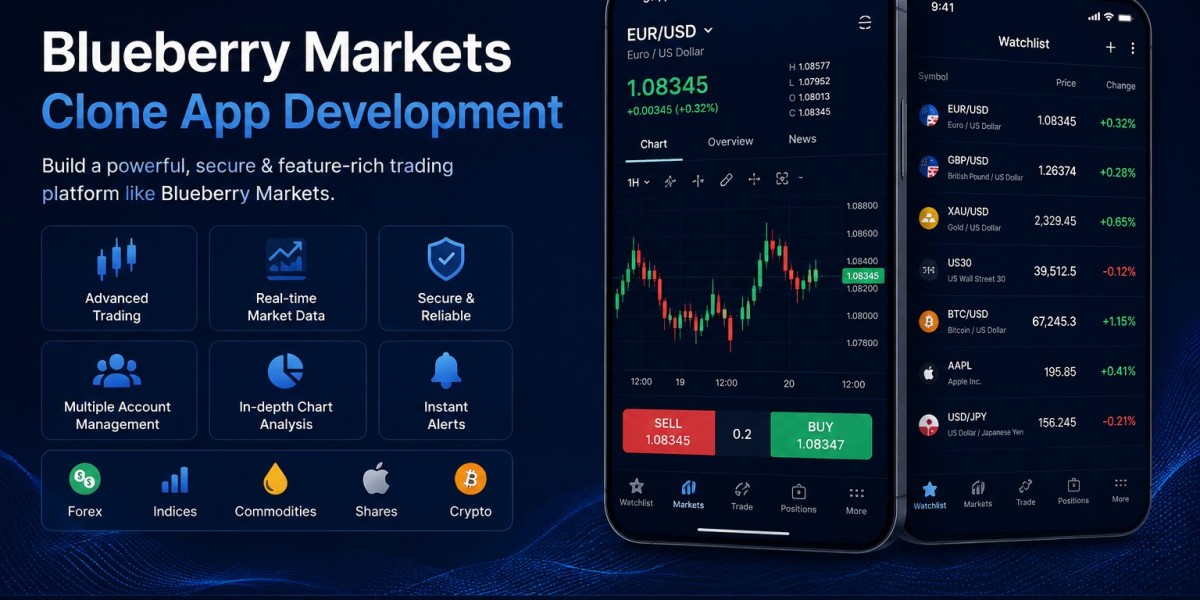


Building a forex or CFD brokerage platform involves much more than designing a trading dashboard. Development teams need to manage client onboarding, KYC and AML workflows, deposits and withdrawals, trading-account connectivity, partner commissions, administrative permissions, audit trails, compliance processes, and third-party integrations.
Because of this complexity, technical teams generally face two paths: start with a ready-made Blueberry Markets Clone and customize it, or build the brokerage platform completely through custom development.
Both approaches can work. The better choice depends on feature requirements, architecture control, available engineering resources, integration complexity, and long-term product strategy.
What Is a Blueberry Markets Clone?
A Blueberry Markets Clone is a ready-made brokerage operations platform built around the systems required to manage forex and CFD clients.
The Miracuves Blueberry Markets Clone is positioned as the operational layer surrounding trading terminals rather than a replacement for MT4 or MT5. It covers onboarding, money movement, compliance, partner programs, prop trading, CRM, and back-office management while trade execution remains inside the connected trading terminal.
This means developers do not need to rebuild every brokerage workflow before starting customization.
Custom development takes the opposite approach. Engineers design the complete application architecture, database, APIs, user interfaces, integrations, access controls, and operational workflows specifically for one brokerage.
Feature Development
Feature depth is one of the biggest differences between these approaches.
A custom brokerage platform may require developers to build:
- Registration and authentication
- KYC document processing
- AML screening
- Client dashboards
- Wallets
- Deposits and withdrawals
- Trading account management
- MT4 and MT5 connectivity
- IB programs
- Affiliate tracking
- Prop challenges
- CRM workflows
- Support tickets
- Risk controls
- Admin dashboards
- Audit logs
Every feature requires frontend development, API logic, database structures, validation, permission rules, testing, and monitoring.
The Miracuves Blueberry Markets Clone already includes client, partner, administrative, compliance, finance, and support workflows. Its platform also includes trading-account provisioning, wallets, partner economics, prop evaluations, payment operations, and compliance features.
For developers, that can reduce the amount of foundational engineering required.
Architecture Control
Custom development provides maximum architecture freedom.
Technical teams can decide exactly how services are separated, which frameworks are used, how databases are structured, and how integrations communicate.
This is valuable when a brokerage has highly specialized workflows or needs infrastructure that differs significantly from conventional platforms.
A ready-made clone provides an existing architecture instead.
Miracuves currently describes its Blueberry Markets Clone as a Next.js 16 and React 19 application written in strict TypeScript, with marketing, client portal, admin console, and REST API contained in one codebase. Its PostgreSQL database contains 93 tables organized across 12 business domains.
The benefit for developers is that the architecture already exists while still using widely adopted technologies that can be modified.
Trading Platform Integration
Neither approach automatically removes the need for external trading infrastructure.
MT4 and MT5 handle actual order execution. The surrounding brokerage application manages account provisioning, funding, compliance, reporting, and operational workflows.
Miracuves explicitly states that its current MT4 and MT5 integrations require bridge configuration for live account provisioning, position synchronization, and trade reconciliation.
With custom development, engineers must design this integration layer themselves.
A development team needs to consider:
- Trading account provisioning
- Bridge connectivity
- Position synchronization
- Trade-history synchronization
- Liquidity-provider connectivity
- Failure handling
- Reconciliation
A ready-made architecture can provide the surrounding workflow while developers configure the specific trading infrastructure used by the brokerage.
Payments and Wallet Engineering
Financial transactions need stronger backend controls than ordinary application data.
Deposits, withdrawals, internal transfers, currency conversions, commissions, refunds, and manual adjustments should all create traceable transaction records.
The Miracuves platform includes deposit and withdrawal queues, payment approvals, provider webhook tracking, wallet adjustments, internal transfers, and reconciliation workflows.
However, live payment movement still requires the brokerage's own merchant contracts, credentials, and provider configuration.
Custom development provides complete freedom over these workflows but requires engineers to build the transaction logic, reconciliation system, webhook handling, and failure management themselves.
Role-Based Access and Security
Brokerage applications require strong separation of operator responsibilities.
Miracuves currently implements six roles: client, partner, admin, support, compliance, and finance. Permissions are applied at the operational-area level rather than simply hiding dashboard navigation. For example, compliance can handle KYC decisions without approving payments, while finance can process financial actions without modifying KYC decisions.
Custom development can implement an equally strict or even more specialized permission model.
However, developers must design permissions correctly across APIs, services, database operations, and user interfaces.
For financial platforms, frontend-only permission checks are insufficient because users could potentially access restricted actions through APIs.
Partner and Affiliate Programs
Many brokerages depend heavily on introducing brokers, affiliates, and partner networks.
These systems can become technically complex because commissions must be attributed accurately.
The Miracuves partner engine supports tiered rebates, sub-IB hierarchies, CPA attribution, commission schedules, and payout runs.
With custom development, engineers can design entirely unique partner models but must build the calculation and reconciliation engine from zero.
Starting with a clone can make more sense when the planned partner structure closely resembles established brokerage workflows.
Scalability
Custom development is often associated with better scalability, but scalability depends more on architecture quality than on whether the application started from a clone.
A custom platform gives engineers complete control over database partitioning, services, caching, queues, containerization, and infrastructure.
This becomes valuable at very large scale.
Miracuves describes a more conventional scaling path using managed PostgreSQL, read replicas, and standard Next.js hosting. It also organizes its data architecture into separate business domains so specific areas can be extended without restructuring the entire platform.
For many brokerages, this conventional architecture may be easier to operate than introducing complex distributed infrastructure too early.
Third-Party Integrations
Brokerage platforms depend on external providers.
Common integrations include:
- MT4 and MT5
- Liquidity providers
- KYC services
- AML providers
- Payment gateways
- Market-data services
- Email providers
- Notification systems
Miracuves uses a typed integration registry containing configurable vendor definitions. The page also clearly distinguishes between capabilities that are complete, simulated, configured externally, or still require integration.
Custom development provides greater integration freedom, but developers must create the provider abstraction layer themselves.
Source Code Ownership
For developers, source-code ownership can influence the decision significantly.
Traditional white-label platforms sometimes restrict backend access or lock customers into vendor-controlled infrastructure.
Miracuves states that its Blueberry Markets Clone includes the complete Next.js, React, TypeScript, PostgreSQL schema, and application source code, which can be modified, extended, and redeployed.
This makes the approach different from a closed SaaS white-label platform.
Custom development normally also provides complete ownership when source-code transfer is included in the development agreement.
When a Blueberry Markets Clone Makes Sense
A Blueberry Markets Clone is generally more practical when the brokerage needs conventional workflows such as KYC, funding, MT4 or MT5 account management, partner commissions, prop challenges, administrative operations, and compliance controls.
Instead of engineering those systems from zero, developers can spend more time on integrations, custom workflows, jurisdiction-specific requirements, branding, and product differentiation.
When Custom Development Makes Sense
Custom development is more appropriate when the brokerage model differs substantially from standard brokerage operations.
It may be preferable when the business requires proprietary trading infrastructure, unusual financial products, highly specialized risk engines, unique regulatory workflows, or architecture requirements that would require extensive modification of an existing platform.
In those situations, starting from a blank architecture can provide better long-term flexibility.
Final Verdict
Blueberry Markets Clone development and custom development solve the same problem from different starting points.
Custom development provides maximum architectural freedom but requires engineers to create every major brokerage workflow.
A ready-made platform provides those foundations earlier.
The Miracuves Blueberry Markets Clone includes client operations, funding, KYC and AML workflows, partner programs, prop functionality, role-based administration, integrations, and source-code ownership while leaving external trading, payment, and regulatory integrations configurable for each deployment.
For developers building a conventional forex or CFD brokerage platform, starting with an established codebase can reduce repetitive engineering work.
For highly differentiated financial products, fully custom development may provide the architectural freedom needed for long-term growth.
The right choice ultimately depends on how much of the brokerage infrastructure the development team truly needs to reinvent.








