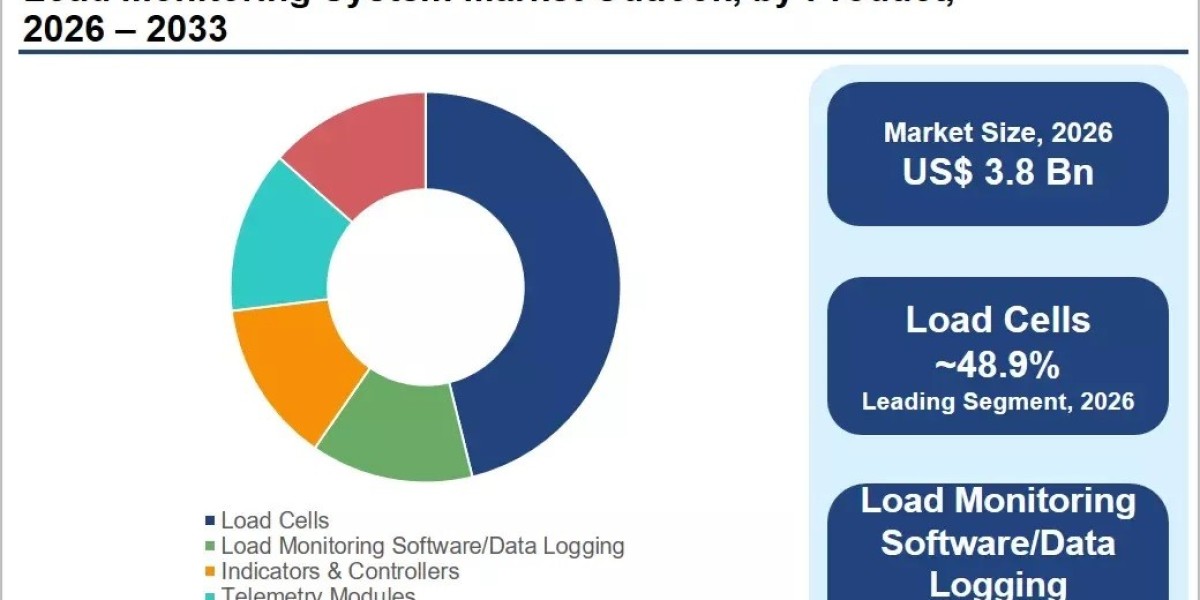


The global Load Monitoring System Market is expected to reach US$ 3.8 billion in 2026 and is projected to reach US$ 5.2 billion by 2033, expanding at a CAGR of 4.5% during 2026–2033. Load monitoring systems combine technologies such as load cells, force sensors, indicators, controllers, data-loggers, telemetry equipment, and software to measure and analyze weight, tension, compression, force, or electrical load in real time. Their role has expanded from basic measurement into broader industrial safety, equipment protection, process control, energy management, and predictive maintenance. Industrial automation, stricter workplace safety requirements, connected equipment, and the increasing need for accurate real-time data are encouraging manufacturers and infrastructure operators to adopt sophisticated load monitoring solutions. Industry research also identifies increasing smart-factory adoption, IoT-enabled systems, wireless load cells, predictive analytics, and real-time energy monitoring as important trends supporting market expansion.
The industrial segment is expected to remain a leading end-user category, as manufacturing, mining, construction, logistics, energy, and heavy machinery applications require accurate measurement to prevent overloading, improve productivity, and protect equipment. By technology, digital and wireless solutions are gaining momentum because they provide faster data transmission, remote monitoring, and easier integration with industrial automation and cloud platforms. Asia-Pacific is emerging as the most attractive growth region, supported by expanding manufacturing capacity, infrastructure investment, construction activity, and industrial automation across China, India, Japan, and Southeast Asia. One market assessment identifies Asia-Pacific as both the largest and fastest-growing regional market, with the region accounting for about 38% of global revenue in 2024.
Sample Link :https://www.persistencemarketresearch.com/samples/37103
Key Highlights from the Report
- The global Load Monitoring System Market is projected to reach US$ 5.2 billion by 2033 from US$ 3.8 billion in 2026.
• The market is expected to expand at a CAGR of 4.5% between 2026 and 2033.
• Industrial automation and workplace safety requirements are major forces accelerating adoption.
• Wireless load cells and connected monitoring platforms are increasing the availability of real-time load data.
• Asia-Pacific offers significant growth potential due to manufacturing, construction, logistics, and infrastructure expansion.
• Predictive maintenance, IoT connectivity, and digital analytics are reshaping next-generation load monitoring solutions.
Load Monitoring System Market Segmentation
By offering, the load monitoring system market includes load cells, indicators and controllers, and data logging or monitoring software. Load cells form the fundamental sensing component in many systems because they convert mechanical force or weight into measurable electrical signals. Indicators and controllers process and display measurements, while software platforms increasingly provide historical data analysis, alarms, remote access, reporting, and predictive insights. As customers move toward connected industrial environments, the software component is becoming more important because it converts raw measurement data into actionable operational information.
By technology, the market can be divided into analog and digital systems, with wired and wireless configurations used across different applications. Analog systems continue to serve established industrial installations where simplicity and reliability are priorities, while digital systems are gaining ground because they can provide improved data processing, connectivity, diagnostics, and integration with automation platforms. Wireless load monitoring is particularly attractive for cranes, offshore operations, construction equipment, logistics, and applications where cabling can be difficult or unsafe.
By application, load monitoring systems are used for load measurement, energy management, fault detection and diagnostics, peak-load management, load forecasting, and equipment monitoring. In heavy-duty applications, accurate load measurement helps prevent overload conditions and improves operational safety. In smart factories, the same technology can support process optimization and predictive maintenance by identifying abnormal load patterns before equipment failure occurs.
By end user, the market spans automotive, manufacturing, construction, healthcare, aerospace, marine, oil and gas, mining, logistics, energy and utilities, and other industrial sectors. Manufacturing is particularly important because load monitoring is integrated into production lines, material-handling systems, robotics, testing equipment, and quality-control processes. Construction, marine, and oil and gas operators also rely heavily on load monitoring for lifting and tension applications where inaccurate measurements can create serious safety and operational risks.
Regional Insights
Asia-Pacific is positioned as a major growth center for load monitoring systems. China benefits from its large manufacturing base, infrastructure projects, logistics networks, and expanding industrial automation. India is also generating demand as manufacturing, automotive production, construction, food and beverage processing, and infrastructure investment increase. Japan remains an established technology market with applications across shipbuilding, pharmaceuticals, precision manufacturing, and industrial equipment. The region's combination of industrial expansion and investment in smart manufacturing creates favorable conditions for digital and wireless load monitoring technologies.
Europe maintains strong demand because of its advanced manufacturing, automotive, aerospace, marine, and industrial machinery industries. Germany and the U.K. are important markets, with established engineering capabilities and significant material-handling applications. Industrial safety requirements and investments in automation are supporting demand for accurate load measurement and monitoring technologies.
North America represents a mature but technologically advanced market. The region benefits from extensive applications in construction, aerospace, oil and gas, logistics, mining, manufacturing, and energy. Customers increasingly favor systems that provide remote monitoring, data logging, and integration with existing industrial control systems. Meanwhile, Latin America and the Middle East & Africa offer longer-term opportunities through mining, infrastructure development, energy projects, ports, logistics, and heavy industrial applications.
Market Drivers
The growing adoption of industrial automation and Industry 4.0 is a central driver of the load monitoring system market. Modern production environments depend on sensors to continuously collect information about equipment and processes. Load monitoring enables operators to identify overload conditions, monitor machine performance, improve production consistency, and integrate measurement data with automation systems. As factories become more connected, demand is shifting from standalone measurement devices toward intelligent systems capable of communicating with broader industrial networks.
Industrial safety is another powerful growth factor. Cranes, lifting equipment, construction machinery, offshore systems, and material-handling equipment must operate within specified load limits. Accurate monitoring can help operators detect unsafe loading conditions and reduce the risk of equipment damage or accidents. At the same time, manufacturers are adopting load monitoring to improve quality control and reduce material waste, making the technology valuable from both safety and productivity perspectives.
Market Restraints
The relatively high initial investment associated with advanced load monitoring systems can limit adoption among smaller industrial operators. Costs may include sensors, load cells, controllers, communication hardware, software, installation, calibration, and system integration. Existing machinery may also require modification before a modern monitoring platform can be installed, increasing implementation complexity.
Accuracy and compliance requirements can create additional challenges. Load cells and related sensors must be properly installed, calibrated, maintained, and protected from environmental conditions such as vibration, moisture, extreme temperatures, and mechanical shock. Certification requirements can also add time and cost to product development and deployment. Industry research highlights the importance of standards and certifications in manufacturing and weighing applications, which can create barriers for suppliers entering regulated markets.
Market Opportunities
The transition toward wireless, cloud-connected, and IoT-enabled load monitoring systems presents a significant opportunity. Wireless technologies can eliminate complicated cabling and allow measurement data to be transmitted from difficult-to-access equipment. Cloud platforms can further enable centralized monitoring across multiple facilities, while analytics software can identify abnormal operating conditions and support predictive maintenance.
Another opportunity lies in emerging applications such as renewable energy, electric-vehicle manufacturing, smart logistics, automated warehouses, offshore infrastructure, and advanced construction. Load monitoring can provide critical information in applications involving heavy components, lifting operations, robotic production, and structural loads. The integration of artificial intelligence and predictive analytics could further transform systems from measurement tools into proactive equipment-management platforms.
Company Insights
- Flintec
• Mettler Toledo
• Precia Molen
• Spectris
• Vishay Precision Group
• Dynamic Load Monitoring
• JCM Load Monitoring
• Load Monitoring Systems
• Straightpoint
• FUTEK Advanced Sensor Technology
• Mantracourt Electronics
• Eilersen Electric Digital Systems
• Thames Side Sensors
• Standard Loadcells
• TE Connectivity
• Kistler Group
• Honeywell International
• Siemens
• Schneider Electric
• Rockwell Automation
These companies compete through sensor accuracy, wireless connectivity, product durability, customized engineering, software integration, calibration services, and expansion into new industrial applications. Market research identifies companies such as Flintec, Mettler Toledo, Vishay Precision Group, Dynamic Load Monitoring, Load Monitoring Systems, FUTEK, Mantracourt, and Thames Side Sensors among the principal participants.
Two recent developments demonstrate the industry's movement toward greater connectivity and service coverage. In April 2025, Load Monitoring Systems launched the T24-HK-S all-in-one handset, designed to work with its wireless load links, load-pin shackles, running-line monitors, and compression load cells. The rugged IP67-rated device is aimed at applications including offshore, oil and gas, construction, renewable energy, and entertainment. In November 2025, Load Monitoring Systems announced an expansion of its global calibration network, including new high-precision 55-tonne calibration machines and local calibration capabilities in the U.K., Norway, and the Netherlands, with a Singapore center planned. The initiative is intended to reduce transportation costs and equipment downtime while improving access to calibration services.
Conclusion
The Load Monitoring System Market is moving steadily from conventional measurement toward connected, intelligent, and data-driven monitoring. With the market projected to increase from US$ 3.8 billion in 2026 to US$ 5.2 billion by 2033 at a CAGR of 4.5%, opportunities will increasingly come from industrial automation, safety compliance, predictive maintenance, wireless sensing, and IoT integration. Manufacturing and other heavy industrial applications will remain important revenue generators, while Asia-Pacific is expected to provide substantial expansion opportunities through industrialization and infrastructure development. As companies seek safer operations, greater equipment uptime, and better visibility into industrial processes, load monitoring systems are likely to become an increasingly integrated part of modern industrial control and asset-management strategies.






