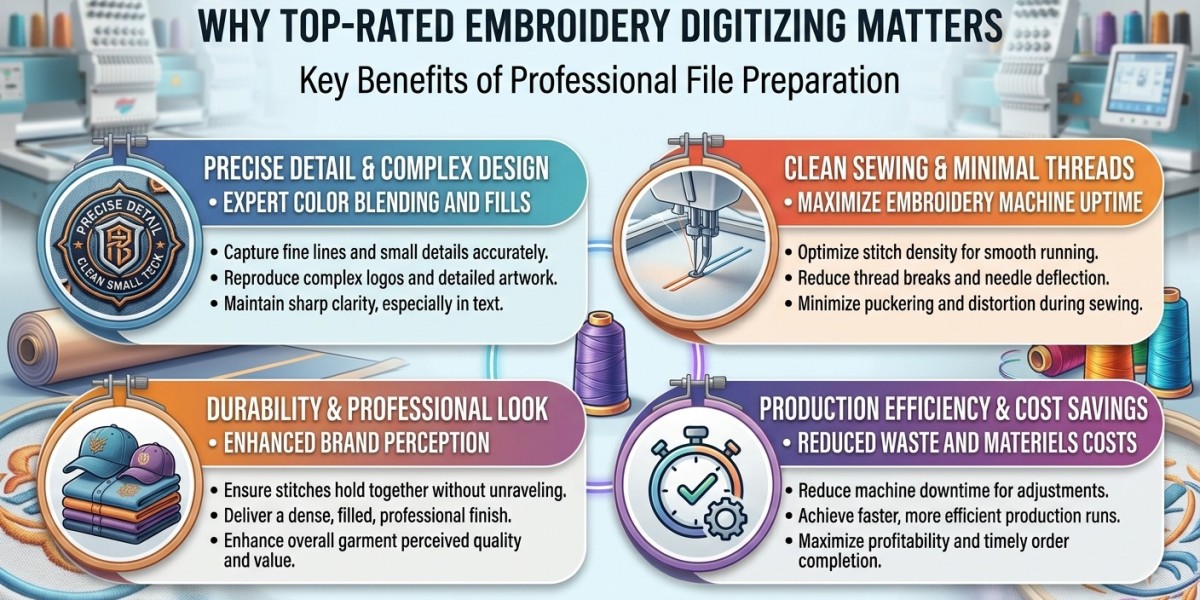


Professional embroidery depends on more than a good logo or attractive artwork. The design must be converted into a machine-readable embroidery file that tells the embroidery machine where to place stitches, which stitch types to use, how densely to stitch each area, and when to change thread colors. top-rated embroidery digitizing focuses on these technical details to help produce cleaner, more consistent embroidery on different fabrics and products.
A design that looks perfect on a computer screen may not automatically produce good embroidery. Fabric stretches, threads have different characteristics, stitch density affects coverage, and poorly planned stitch sequences can create gaps, puckering, thread breaks, or distorted shapes. Professional digitizing accounts for these production factors before the design reaches the embroidery machine.
Understanding why digitizing quality matters can help businesses, apparel producers, promotional product companies, and embroidery professionals make better decisions when preparing designs.
What Is Embroidery Digitizing?
Embroidery digitizing is the process of converting artwork into a digital embroidery file that an embroidery machine can read.
The digitizer determines how the artwork will be constructed with stitches.
This includes decisions about:
- Stitch types
- Stitch direction
- Stitch density
- Underlay
- Stitch sequence
- Thread changes
- Pull compensation
- Machine settings
- Design dimensions
The final file may use formats such as DST, PES, EXP, JEF, VP3, or other machine-specific formats.
The appropriate format depends on the embroidery machine and software being used.
Why Digitizing Quality Affects Embroidery
The embroidery machine follows the instructions contained in the digitized file.
If those instructions are poorly planned, the machine may reproduce the design with unnecessary thread changes, uneven coverage, excessive density, or other problems.
Professional digitizing considers how stitches interact with the fabric and with one another.
This makes the digitizing stage one of the most important parts of the embroidery production process.
1. Better Stitch Placement
Accurate stitch placement helps the design maintain its intended shape.
Each area of artwork must be converted into an appropriate stitch structure.
If stitches are placed incorrectly, edges may look uneven or details may shift from their intended positions.
Professional digitizing focuses on positioning stitches accurately according to the original artwork.
This becomes particularly important for logos, lettering, borders, and small details.
2. Improved Stitch Density
Stitch density refers to how closely stitches are placed within a design area.
Too much density can make embroidery stiff and may increase thread consumption or create puckering.
Too little density can result in poor coverage and allow the fabric to show through.
A professional digitizer selects density based on factors such as fabric type, design size, thread, and stitch type.
There is no single density value that works for every design.
3. Better Underlay Structure
Underlay stitches are placed beneath the visible stitches.
They can help stabilize fabric and create a foundation for the top stitching.
Different fabrics and design elements may require different underlay approaches.
For example, stretchy fabrics may need stronger stabilization than stable woven materials.
Proper underlay planning can contribute to cleaner edges and more consistent coverage.
4. Improved Stitch Direction
Stitch direction affects how embroidered areas reflect light and how the design visually appears.
Changing stitch angles can help separate design sections and create visual structure.
Poor stitch direction can make a design appear flat, uneven, or visually inconsistent.
Professional digitizing uses stitch direction intentionally based on the artwork and desired appearance.
5. Reduced Thread Breaks
Thread breaks can interrupt embroidery production and increase machine downtime.
Several factors can contribute to thread breaks, including excessive density, unsuitable stitch lengths, poor sequencing, machine tension, needle condition, thread quality, and fabric characteristics.
Good digitizing can reduce problems caused by the design itself by using sensible stitch structures, density, and sequencing.
However, digitizing cannot eliminate every possible thread break because machine maintenance, thread, needles, and other production conditions also matter.
6. Better Small-Detail Reproduction
Small text and fine artwork details are challenging in embroidery.
A design that contains very small lettering may not reproduce clearly when converted directly from artwork without modification.
Professional digitizing considers the physical limitations of embroidery.
Some details may need to be simplified, enlarged, or adjusted to maintain readability.
This is particularly important for business logos and branded apparel.
7. More Efficient Stitch Sequencing
Stitch sequence determines the order in which different parts of the design are embroidered.
An inefficient sequence can increase unnecessary movement, thread changes, jump stitches, and production time.
A well-planned sequence can make the embroidery process more efficient.
It can also help reduce unnecessary overlaps and improve the final appearance.
Why Fabric Type Matters
The same digitized design may not perform identically on every fabric.
Cotton, denim, polyester, fleece, caps, performance fabrics, and stretchy materials have different characteristics.
Fabric thickness, stretch, stability, and texture can influence how stitches behave.
Professional digitizing takes the intended fabric into account whenever that information is available.
Digitizing for Caps and Hats
Caps create additional challenges because of their curved surface and limited embroidery area.
Designs intended for caps may require different stitch planning from flat garments.
The stitch direction, center-out approach, density, and design placement can all affect the result.
Small details may also need to be simplified to maintain clarity.
Digitizing for Jackets and Heavy Fabrics
Heavy fabrics can support denser embroidery, but they still require appropriate stitch planning.
Large designs can become heavy if too many stitches are used.
A professional digitizer balances coverage, detail, stitch count, and fabric characteristics.
The objective is to create embroidery that looks clean without adding unnecessary stitches.
Digitizing for Stretch Fabrics
Stretch materials can move during embroidery.
Without appropriate stabilization and stitch planning, designs may become distorted or develop puckering.
The digitizing approach may need to account for fabric movement and the direction of stretch.
Proper backing and hooping are also important.
The Role of Pull Compensation
Fabric can shift or pull slightly as stitches are formed.
Pull compensation helps account for this behavior by adjusting certain design dimensions.
Without appropriate compensation, gaps may appear between design elements or edges may not align as intended.
The correct amount depends on the fabric, stitch type, density, and design.
Why Stitch Count Matters
Stitch count represents the approximate number of stitches in an embroidery design.
A higher stitch count does not automatically mean higher quality.
Excessive stitches can increase production time, thread consumption, and fabric stress.
A skilled digitizer aims to use enough stitches to achieve the required coverage and detail without adding unnecessary complexity.
Importance of Thread and Needle Selection
Digitizing quality works together with appropriate thread and needle selection.
Different thread weights and needle sizes can affect how the design is produced.
For example, small lettering may require finer thread and an appropriate needle size to maintain readability.
Production conditions should be considered when preparing the embroidery file.
Why Test Stitching Is Important
A digitized file should ideally be tested before large-scale production.
A test sew allows the digitizer or embroiderer to evaluate:
- Stitch coverage
- Thread tension
- Density
- Underlay
- Design alignment
- Small details
- Fabric response
If problems appear during testing, adjustments can be made before the design is used for a large order.
Professional Digitizing vs. Automatic Conversion
Automatic embroidery conversion software can create a starting point for simple designs, but it does not always understand the physical behavior of fabric and thread.
Automatic conversion may produce poor stitch direction, excessive density, unsuitable underlay, or inefficient sequencing.
Professional digitizing involves human decisions based on the artwork and intended production conditions.
This is especially valuable for detailed logos, small lettering, gradients, and complex graphics.
How to Choose a Top-Rated Digitizing Service
When selecting a digitizing provider, review actual embroidery samples rather than judging only from digital previews.
Look for clean lettering, smooth edges, balanced density, good coverage, and minimal unnecessary thread problems.
Ask whether the provider can work with different fabrics and embroidery applications.
It is also useful to confirm supported file formats, revision policies, turnaround time, and whether test sew adjustments are available when needed.
Information to Provide Before Digitizing
Providing accurate project information can improve the digitizing process.
Useful details include the original artwork, final embroidery size, garment or fabric type, placement, preferred thread colors, machine format, and any specific production requirements.
If the design will be embroidered on caps, jackets, polos, bags, or other products, mention this before digitizing begins.
The more complete the production information, the better the digitizer can plan the file.
Common Mistakes to Avoid
One common mistake is assuming that a print-ready logo can be converted directly into embroidery without modification.
Embroidery has physical limitations that do not apply to digital graphics.
Another mistake is choosing a digitizer only because of a low price.
Businesses may also overlook the importance of test stitching.
Finally, using the same file at dramatically different sizes without checking its suitability can cause quality problems.
An embroidery file should be evaluated for its intended size and application.
Why Professional Digitizing Supports Consistent Branding
Businesses often embroider the same logo on multiple products.
If each version is digitized differently, stitch density, proportions, lettering, and colors may vary.
Using a carefully prepared master embroidery file can help maintain consistency.
For different sizes or product types, separate optimized versions may be appropriate.
This is particularly useful for companies producing uniforms, promotional apparel, caps, jackets, and branded merchandise.
Conclusion
Top-Rated Embroidery Digitizing matters because embroidery machines require detailed instructions to reproduce artwork accurately with thread. Stitch placement, density, underlay, stitch direction, sequencing, pull compensation, and fabric considerations all influence the final result.
Professional digitizing can help reduce design-related stitch problems, improve small-detail reproduction, support better fabric coverage, and create more consistent embroidery across different products.
A reliable digitizing process should also include careful artwork preparation, appropriate file formatting, testing, and adjustments when necessary.
iDigitize provides professional embroidery digitizing services focused on accurate stitch planning, clean embroidery details, appropriate file preparation, and designs suited to different fabrics and embroidery applications.
Frequently Asked Questions
Q1. What is embroidery digitizing?
Embroidery digitizing converts artwork into a machine-readable file containing instructions for stitch placement, sequence, density, direction, and other embroidery settings.
Q2. Why does digitizing affect embroidery quality?
The digitized file controls how the embroidery machine constructs the design. Poor stitch planning can cause gaps, excessive density, thread issues, or distorted details.
Q3. Can professional digitizing reduce thread breaks?
Good digitizing can reduce thread-break problems caused by unsuitable stitch structures, density, or sequencing. However, machine condition, needles, thread, tension, and fabric also affect thread breaks.
Q4. Does higher stitch count mean better embroidery?
No. Excessive stitch count can increase production time and fabric stress. Quality depends on appropriate stitch planning rather than simply using more stitches.
Q5. Why is fabric type important for digitizing?
Different fabrics react differently to embroidery. Stretch, thickness, stability, and texture can affect stitch behavior and may require different digitizing approaches.
Q6. Should an embroidery design be test stitched?
Yes. Test stitching can reveal problems with density, coverage, lettering, alignment, thread tension, and fabric response before full production.
Q7. What information should I provide to a digitizer?
Provide the artwork, intended embroidery size, fabric type, placement, thread colors, machine format, and any specific production requirements.









