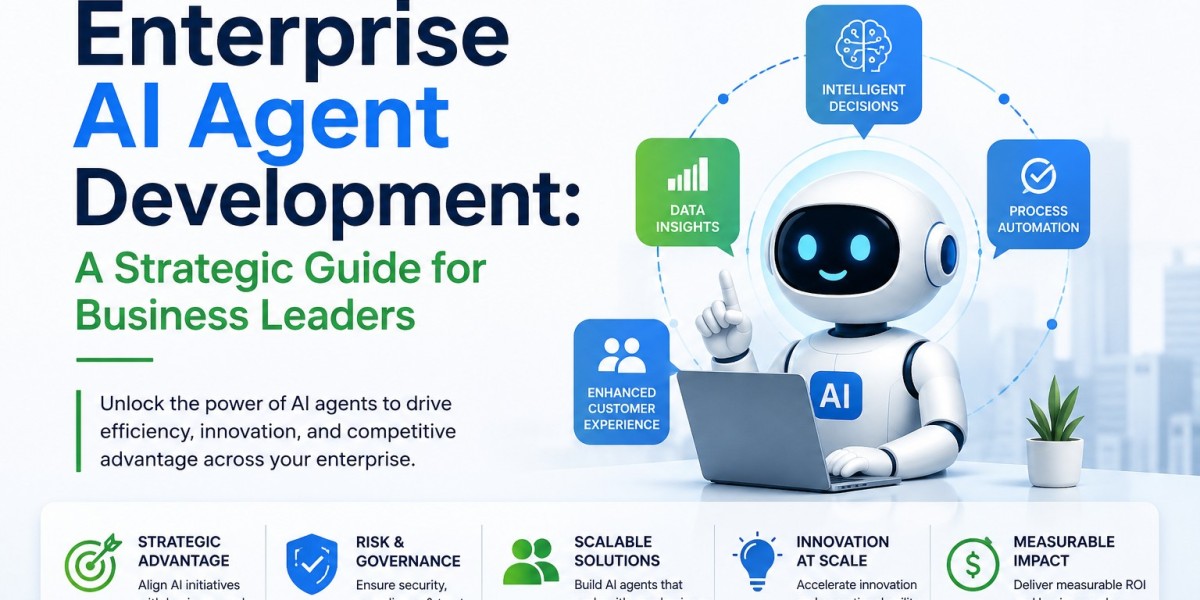


Artificial intelligence is moving beyond simple chatbots and isolated automation. Enterprises are increasingly looking for systems that can understand business context, make decisions within defined boundaries, use enterprise data, and complete multi-step tasks. This shift is driving growing interest in Enterprise AI Agent Development.
AI agents can connect language models with business applications, databases, APIs, workflows, and human approval processes. Instead of simply answering a question, an enterprise AI agent can analyze information, determine the next action, execute approved tasks, and escalate complex situations when human judgment is required.
For business leaders, however, implementing AI agents is not simply a matter of selecting an AI model. Successful adoption requires a clear business case, secure architecture, reliable data, governance, integration, and measurable outcomes.
What Is Enterprise AI Agent Development?
Enterprise AI Agent Development is the process of designing and building AI-powered software agents that can perform business tasks using enterprise data, applications, tools, and predefined policies.
Unlike conventional automation, which typically follows fixed rules, AI agents can interpret changing inputs and determine appropriate actions within a controlled environment.
For example, an enterprise customer-service agent could:
Understand a customer's request.
Retrieve relevant account information.
Check company policies.
Identify the appropriate resolution.
Update the CRM.
Generate a response.
Escalate the case if authorization is required.
The objective is not to remove humans from every process. Instead, enterprise AI agents can handle repetitive and information-heavy work while allowing employees to focus on decisions requiring judgment, creativity, and accountability.
Why Enterprises Are Investing in AI Agents
Traditional business automation has delivered significant efficiency gains, but many enterprise processes remain difficult to automate because they involve unstructured information and variable decision paths.
Employees may need to read emails, interpret documents, search multiple systems, compare information, make recommendations, and then execute several actions.
AI agents can bring these activities into a connected workflow.
1. Automating Complex Workflows
AI agents can coordinate multiple steps rather than performing only one predefined action.
For example, an AI procurement agent could review a purchase request, compare supplier information, check spending policies, prepare documentation, and route the request for approval.
2. Improving Employee Productivity
Employees often spend substantial time searching for information and completing repetitive administrative tasks.
An AI agent can act as an intelligent operational assistant by retrieving relevant information, preparing summaries, drafting documents, and initiating approved workflows.
3. Enhancing Customer Experiences
Enterprise AI agents can support customer-service teams by providing faster access to account information, product knowledge, policies, and recommended actions.
They can also operate across multiple channels while maintaining consistent business rules and escalation procedures.
4. Connecting Enterprise Systems
The real value of an AI agent often comes from integration.
An agent can potentially connect with systems such as:
CRM platforms
ERP systems
HR software
Help-desk platforms
Databases
Document repositories
Internal APIs
Business intelligence systems
Communication platforms
This allows the agent to work with the enterprise's existing technology environment rather than operating as another isolated application.
Enterprise AI Agents vs. Traditional Automation
Traditional automation and AI agents are not competing technologies. They can complement each other.
Rule-based automation works well when a process is predictable and the required decisions are straightforward.
AI agents become more valuable when processes involve natural language, unstructured information, multiple systems, or changing circumstances.
Traditional Automation | Enterprise AI Agents |
Primarily rule-based | Context-aware |
Fixed workflows | Dynamic workflows within boundaries |
Structured inputs | Structured and unstructured inputs |
Predictable decisions | Reasoning-assisted decisions |
Limited flexibility | Greater adaptability |
Often task-specific | Can coordinate multiple tasks |
A mature enterprise strategy may combine both approaches. Deterministic automation can handle predictable steps, while AI agents can manage interpretation, coordination, and decision support.
Key Components of Enterprise AI Agent Development
A reliable enterprise AI agent requires more than an LLM.
Foundation Model
The language model provides capabilities such as natural-language understanding, reasoning, summarization, and generation.
The right model depends on factors including accuracy, latency, cost, privacy, context requirements, and deployment environment.
Agent Orchestration
The orchestration layer determines how the agent plans and executes tasks.
It can manage tools, workflows, memory, permissions, retries, and escalation paths.
Enterprise Data
AI agents need access to accurate and relevant business information.
Enterprise data may come from databases, knowledge bases, documents, APIs, or internal applications.
Retrieval mechanisms can help agents access relevant information without requiring sensitive business data to be embedded directly into model parameters.
Tool and API Integration
An agent becomes significantly more useful when it can take authorized actions.
For example, an agent might retrieve a customer's order, create a support ticket, generate a report, or initiate a workflow through approved APIs.
Security and Access Controls
Enterprise AI agents may interact with sensitive information and business-critical systems.
Therefore, identity management, role-based permissions, encryption, audit logs, data isolation, and access controls should be considered core architecture components rather than afterthoughts.
Monitoring and Evaluation
AI systems can behave differently from traditional deterministic software.
Enterprises need ongoing monitoring for accuracy, hallucinations, policy violations, latency, cost, tool failures, and unexpected behavior.
Evaluation should include realistic business scenarios rather than relying only on generic model benchmarks.
How to Build an Enterprise AI Agent Successfully
Enterprise leaders should approach AI agent development as a business transformation initiative rather than an isolated technology experiment.
Step 1: Identify a High-Value Use Case
Start with a process where AI can produce measurable value.
Good candidates often involve:
High transaction volumes
Repetitive knowledge work
Large amounts of unstructured information
Slow manual processes
Multiple systems
Significant employee time requirements
Avoid starting with a broad goal such as "implement AI across the company."
A specific use case creates a clearer path to measurable results.
Step 2: Define Success Metrics
Before development begins, establish measurable objectives.
Depending on the use case, metrics could include:
Processing time
Cost per transaction
Employee hours saved
Customer response time
Resolution rate
Accuracy
Escalation rate
Revenue generated
Operational error rate
A successful AI agent should solve a business problem, not simply demonstrate that AI technology works.
Step 3: Map the Existing Workflow
Document how the process currently works.
Identify:
Inputs
Business rules
Systems involved
Human decisions
Approval requirements
Exceptions
Compliance requirements
Final outcomes
This helps determine where an AI agent should operate and where deterministic automation or human intervention remains preferable.
Step 4: Design the Agent Architecture
The architecture should define how the AI agent interacts with models, data, tools, applications, and users.
A typical architecture may include:
User → AI Agent → Reasoning/Orchestration → Enterprise Data + Tools → Business Application → Human Approval
The exact architecture should be based on the use case rather than adopting a generic agent framework simply because it is popular.
Step 5: Establish Guardrails
Enterprise agents should operate within clearly defined boundaries.
Guardrails can include:
Permission controls
Approved tools
Data-access restrictions
Validation rules
Human approval checkpoints
Output validation
Rate limits
Audit trails
Escalation mechanisms
The more consequential the action, the stronger the controls should be.
Step 6: Pilot Before Scaling
A controlled pilot allows organizations to evaluate real-world performance.
Measure the agent against representative scenarios, including normal requests, ambiguous requests, incomplete information, unusual cases, and adversarial inputs.
Only after the system demonstrates reliable performance should enterprises consider expanding it to additional workflows.
Common Enterprise AI Agent Use Cases
Enterprise AI agents can support a wide range of departments.
Customer Service
Agents can assist with customer questions, ticket classification, knowledge retrieval, case summaries, and workflow execution.
Finance
AI agents can support invoice processing, financial document analysis, reconciliation workflows, reporting, and internal finance assistance.
Human Resources
HR agents can help employees locate policy information, answer routine questions, assist with onboarding, and route requests.
Sales
Sales agents can research accounts, summarize customer interactions, prepare meeting briefs, update CRM records, and assist with follow-up workflows.
IT Operations
AI agents can support incident triage, knowledge retrieval, troubleshooting, ticket management, and routine operational workflows.
Manufacturing
Agents can help teams analyze operational information, retrieve maintenance knowledge, summarize production data, and coordinate selected workflows.
The Biggest Challenges in Enterprise AI Agent Development
AI agents create opportunities, but enterprise deployment also introduces important challenges.
Data Quality
An intelligent agent cannot reliably compensate for inaccurate, outdated, or poorly structured enterprise information.
Organizations should establish data-quality processes before expanding agent capabilities.
Hallucinations and Incorrect Actions
A generated answer can be wrong. An AI agent that can execute actions introduces an additional level of risk.
For high-impact workflows, organizations should use validation, constrained tools, approval processes, and monitoring.
Security
Agents can potentially access multiple enterprise systems. Poorly designed permissions could create serious security risks.
Least-privilege access and strong identity controls should be built into the architecture.
Integration Complexity
Enterprise environments often contain legacy systems, disconnected applications, proprietary databases, and inconsistent APIs.
Integration planning is therefore a major part of AI agent development.
Governance
Organizations need clear policies covering acceptable AI usage, data access, human oversight, accountability, monitoring, and incident response.
How Much Does Enterprise AI Agent Development Cost?
There is no single price for an enterprise AI agent because development complexity varies significantly.
The total investment can depend on:
Number of integrations
AI model selection
Data requirements
Security requirements
Agent complexity
User volume
Infrastructure
Custom workflows
Governance requirements
Maintenance and monitoring
A simple internal assistant may require considerably less investment than a multi-agent system connected to critical enterprise applications.
For this reason, organizations should evaluate AI projects based on expected business value and total cost of ownership rather than focusing only on initial development cost.
How to Choose an Enterprise AI Development Partner
Selecting the right development partner can determine whether an AI initiative becomes a useful production system or remains a proof of concept.
Enterprise decision-makers should evaluate whether a provider can demonstrate:
Business understanding: Can the team translate a business problem into an AI-enabled workflow?
Technical expertise: Can it design integrations, data pipelines, model orchestration, APIs, security controls, and monitoring?
Scalability: Can the solution support increasing users, workloads, and business complexity?
Security: Does the architecture account for enterprise data protection and access management?
Measurable outcomes: Does the provider define success using business metrics rather than AI features alone?
Long-term support: Can the team maintain, evaluate, monitor, and improve the system after deployment?
A strong partner should be willing to discuss limitations and risks—not simply promise that an AI agent can automate everything.
Why Enterprise AI Agent Development Should Start With Business Value
AI agents are becoming an important part of enterprise software, but adopting them simply because they are trending can lead to expensive experiments with limited business impact.
The better approach is to begin with a clearly defined operational problem.
Ask:
What process is costing the organization the most time?
Where are employees repeatedly searching for information?
Which workflows involve multiple systems?
Where can faster decisions improve customer or employee experience?
Which processes can safely benefit from AI-assisted execution?
Where should humans remain in control?
These questions help organizations identify opportunities where AI agents can create measurable value.
Building the Next Generation of Enterprise Software
Enterprise AI Agent Development is moving AI from passive information retrieval toward active, controlled participation in business workflows.
The organizations that gain the most value will not necessarily be those deploying the largest number of agents. They will be the organizations that identify the right use cases, connect AI to reliable enterprise data, establish appropriate guardrails, integrate existing systems, and continuously measure outcomes.
For enterprises considering their first AI agent, a focused pilot is often the best starting point. For organizations that already have AI initiatives underway, the next step may be connecting existing capabilities into more coordinated, intelligent workflows.
KriraAI helps businesses explore and build AI-powered solutions aligned with their operational goals, technology environment, and growth objectives. By combining AI capabilities with business workflows and enterprise requirements, organizations can move from AI experimentation toward practical, measurable implementation.









