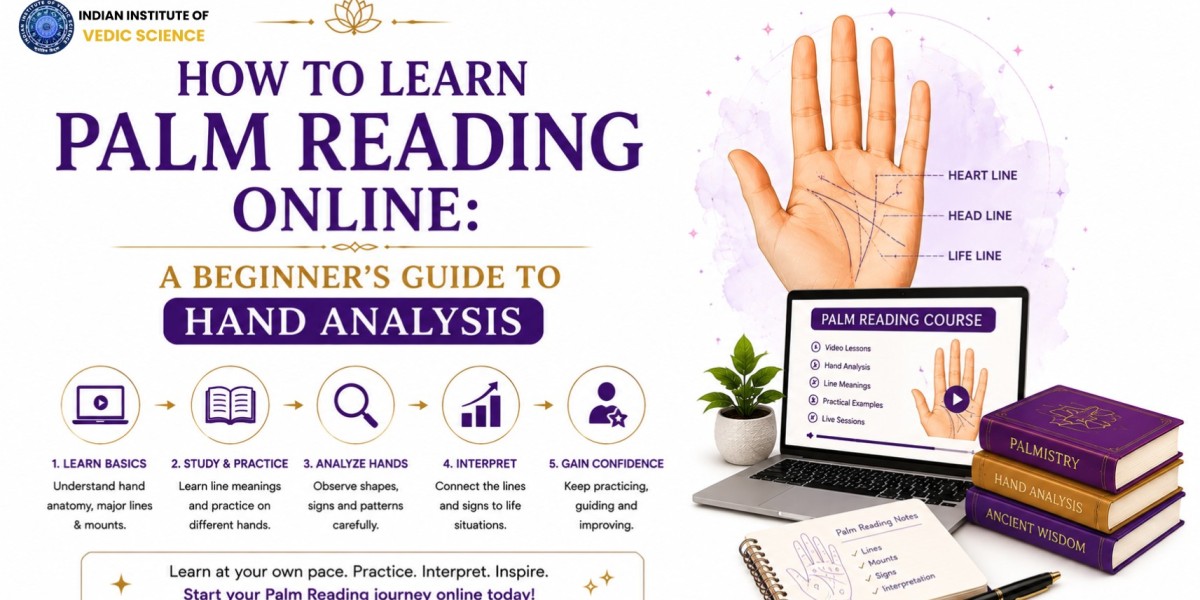


How to Learn Palm Reading Online: A Beginner’s Guide to Hand Analysis
Learning palm reading involves much more than memorising the meanings of a few lines on the hand. A beginner needs to understand hand shapes, fingers, thumb structure, major lines, mounts, markings, and how these features are traditionally interpreted together.
For learners who want flexibility, a palmistry course online can provide a structured way to study these concepts from home. However, practical observation remains essential. Students need opportunities to examine different hands, work through examples, complete exercises, and receive feedback.
If you want to learn palm reading online, this beginner's guide explains the fundamentals, learning process, practical training, and factors to consider before choosing a course.
How Can Beginners Learn Palm Reading Online?
A beginner can follow this learning sequence:
Understand the fundamentals of palmistry.
Study hand shapes and characteristics.
Learn about fingers and the thumb.
Identify the major palm lines.
Study minor lines and markings.
Understand the mounts.
Learn how different features are interpreted together.
Practise with hand images and case studies.
Conduct mock readings.
Continue practising with instructor feedback.
A structured programme can make this process easier, but expertise develops through continued observation and practice.
What Is Palm Reading?
Palm reading, traditionally associated with palmistry, involves observing physical features of the hand and interpreting them according to a particular palmistry system.
A reading may consider:
Hand shape
Palm proportions
Fingers
Thumb
Major lines
Minor lines
Mounts
Markings
Texture
Flexibility
Overall hand structure
Different traditions may use different interpretations. Therefore, beginners should first understand which methodology they are studying.
Step 1: Understand the Basics of Palmistry
Before studying individual lines, beginners should understand the basic framework of palmistry.
A beginner-level palmistry course online may introduce:
History and background
Basic terminology
Hand structure
Observation techniques
Traditional principles
Reading methodology
This foundation helps students approach a hand systematically rather than immediately assigning meaning to one particular line.
Step 2: Learn Different Hand Shapes
Hand shape is one of the first things a learner can observe.
Training may introduce characteristics such as:
Palm length and width
Finger proportions
Overall hand structure
Palm texture
Flexibility
Relative proportions between the palm and fingers
The purpose of this stage is to develop observation skills.
Instead of asking, "What does this single feature mean?" beginners should learn to ask, "What overall characteristics can I observe?"
Step 3: Study the Fingers and Thumb
Fingers and the thumb provide another area of study.
Learners may examine:
Finger length
Finger shape
Spacing between fingers
Flexibility
Finger tips
Thumb structure
Relative proportions
The thumb is also traditionally given particular importance in several palmistry systems.
When you learn palmistry online, look for lessons that explain how these features are examined as part of the complete hand rather than treated as isolated indicators.
Step 4: Identify the Major Palm Lines
The major lines are usually introduced early in palmistry education.
Life Line
The Life Line is traditionally examined according to characteristics such as its shape, depth, curvature, and markings.
Head Line
The Head Line is commonly studied in traditional palmistry in connection with interpretations relating to thinking and mental tendencies.
Heart Line
The Heart Line is traditionally examined through its direction, shape, depth, and other characteristics.
Students should understand that responsible learning involves studying the complete palm rather than making conclusions from one line alone.
Step 5: Learn Minor Lines and Markings
Once the major lines are understood, students can progress to additional palm features.
Depending on the system being taught, these may include:
Fate Line
Sun Line
Mercury-related lines
Relationship lines
Travel-related markings
Crosses
Stars
Islands
Breaks
Other traditional markings
The exact terminology and interpretations may vary between schools of palmistry.
Step 6: Understand the Mounts
Mounts are raised areas of the palm that have traditional symbolic associations.
A structured curriculum may introduce:
Mount of Jupiter
Mount of Saturn
Mount of Apollo or Sun
Mount of Mercury
Mount of Venus
Mount of Mars
Mount of Moon
Students should learn how to assess the development of mounts in relation to the rest of the hand.
This is an important part of moving from basic observation toward more complete hand analysis.
Step 7: Learn How to Analyse the Whole Hand
One of the most important principles for beginners is avoiding isolated interpretation.
For example, instead of looking at one line and immediately reaching a conclusion, a learner can consider:
Overall hand shape
Finger characteristics
Thumb
Major lines
Minor lines
Mounts
Markings
Texture
Proportions
The complete reading should be based on the framework taught by the chosen palmistry system.
How Can You Practise Palm Reading Online?
A major advantage of online education is the ability to use digital resources for repeated practice.
Students can practise with:
Hand photographs
Sample cases
Instructor demonstrations
Practice assignments
Comparison exercises
Case studies
Mock consultations
If you are trying to learn palm reading online, don't limit your study to watching lessons. Make your own observations and write down your interpretations.
For example, you can create a practice worksheet containing:
Hand observation → Lines → Mounts → Markings → Overall analysis → Questions → Interpretation
This creates a repeatable process for future readings.
What Is the Difference Between Palm Reading Online and Learning Palmistry Online?
These terms are often confused.
Palm reading online can refer to receiving a palm reading remotely, usually by sharing hand photographs or participating in a video consultation.
Learning palmistry online, however, means studying the subject through an educational programme.
If your objective is to develop your own skills, search specifically for an educational programme such as a palm reading course online, rather than a consultation service.
What Should a Beginner Look for in a Palm Reading Course?
A good palm reading course online should ideally provide a progressive learning structure.
Look for:
Beginner-Friendly Curriculum
The programme should explain basic concepts before introducing advanced interpretation.
Practical Exercises
Students should get opportunities to analyse different hands.
Instructor Guidance
Feedback can help beginners identify errors in observation and interpretation.
Study Material
Notes, diagrams, examples, or recordings can support revision.
Assessments
Assignments or practical assessments can help students evaluate their understanding.
Doubt Resolution
Learners should have a way to ask questions when concepts are unclear.
Certification
The institute should clearly explain whether and how certification is provided.
How to Choose Palmistry Courses in India
When comparing palmistry courses in india, don't judge programmes only by their names or promotional claims.
Consider:
Curriculum
Faculty
Practical training
Course duration
Live vs recorded classes
Study material
Assignments
Assessments
Certification
Student support
Career guidance
Professional ethics
A programme should match your actual learning objective.
Someone interested in personal knowledge may require a different depth of training from someone planning to develop consultation skills.
How to Evaluate the Best Palmistry Institute in India
The phrase best palmistry institute in india can mean different things to different learners.
Instead of choosing based solely on rankings or advertisements, compare institutes according to measurable educational factors.
Ask:
Is the curriculum clearly explained?
Are practical sessions included?
Can students interact with instructors?
Is feedback available?
Are assessments conducted?
Is certification transparent?
Is student support provided?
Are current course details publicly explained?
This approach helps you choose according to your learning requirements rather than relying on a generic "best" claim.
Is an Online Palmistry Course Suitable for Beginners?
Yes. Beginners can study palmistry online if the programme provides structured instruction and practical learning.
Online learning can be particularly useful for people who:
Have busy schedules
Live away from training centres
Prefer learning from home
Want flexible revision
Prefer digital study resources
However, learners should confirm how practical training is conducted.
For a subject based heavily on visual observation, practical exercises and feedback are especially valuable.
Can Palmistry Be Studied Alongside Astrology?
Yes. Some learners choose to explore multiple traditional disciplines.
You may encounter related searches such as astrology classes online, online classes for astrology, and learn astrology online.
However, palmistry and astrology are different subjects.
An astrology programme may cover:
Planets
Zodiac signs
Houses
Birth charts
Nakshatras
Dashas
Transits
Planetary relationships
Palmistry focuses on hand observation and traditional palm interpretation.
If you are interested in both, consider dedicated courses for each subject rather than assuming one programme provides comprehensive training in both.
What Skills Can You Develop?
With structured study and practice, learners can develop:
Observation skills
Hand-analysis techniques
Pattern recognition
Symbol interpretation
Analytical thinking
Documentation
Communication
Active listening
Consultation skills
Case-study analysis
Professional boundaries
These skills develop gradually. A certificate alone does not establish practical expertise.
Does Palmistry Certification Make You a Professional?
Certification can document successful completion of an institute's programme or assessment requirements.
Before enrolling, understand:
Who issues the certificate
What assessments are required
Whether practical work is evaluated
Attendance requirements
Course-completion criteria
A certificate should not be treated as a guarantee of expertise, clients, employment, or income.
Professional competence requires continued study, practical experience, communication skills, and responsible practice.
What Career Opportunities Can Palmistry Training Support?
After developing sufficient knowledge and experience, learners may explore:
Palmistry consultation
Online palm readings
Educational content creation
Writing and research
Workshops
Teaching after developing adequate expertise
Related Vedic science services
Career outcomes vary according to individual skills, experience, professional development, communication, reputation, and market conditions.
A course should therefore be viewed as a foundation for learning rather than a guaranteed career outcome.
Why Consider IIVS for Palmistry Learning?
The Indian Institute of Vedic Science (IIVS) offers structured learning opportunities in Vedic science and related disciplines.
Learners considering palmistry training should review the current programme details, including:
Curriculum
Course duration
Practical training
Instructor guidance
Study material
Learning format
Assessments
Certification
Student support
IIVS can be considered by students looking for structured education in palmistry and related subjects. Current course details should be confirmed directly with the institute before enrollment.
Learning palm reading online can be a convenient starting point for beginners, but effective training requires more than memorising individual line meanings.
If you want to learn palm reading online, start with hand structure, shapes, fingers, thumb, major lines, minor lines, mounts, and markings. Then progress toward complete hand analysis through case studies and repeated practice.
When comparing a palmistry course online, focus on curriculum quality, practical training, instructor guidance, assessments, certification transparency, and student support. Similarly, when researching palmistry courses in india, choose according to your learning goals rather than relying solely on promotional claims about being the "best."
For learners interested in expanding into related subjects, online classes for astrology can be explored separately. The important thing is to approach each discipline systematically and continue practising after completing formal training.
Get Free Course Counselling From IIVS
If you are unsure which palmistry programme matches your learning goals, contact the Indian Institute of Vedic Science (IIVS) for free course-selection guidance.
Website: https://iivs.com/
Email: support@iivs.in
Phone: +91 79826 57336
Frequently Asked Questions
1. Can I learn palm reading online as a complete beginner?
Yes. A beginner-friendly course can introduce the fundamentals before progressing to lines, mounts, markings, and complete hand analysis.
2. What should I learn first in palmistry?
Start with hand structure, basic terminology, hand shapes, fingers, thumb, and the major palm lines before moving into advanced interpretation.
3. Is practical training necessary for palmistry?
Yes. Palmistry involves visual observation, so analysing different hands and receiving feedback can significantly support skill development.
4. What is a palm reading course online?
It is an educational programme delivered through online classes or digital learning resources that teaches students how to study and interpret palm features.
5. Can I learn palmistry completely from home?
Yes. Online courses can provide remote learning, but students should select programmes that include practical exercises, instructor interaction, and feedback.
6. Does palmistry certification guarantee professional success?
No. Certification can document course completion, but professional development requires continued learning, practice, communication, experience, and ethical conduct.
7. Can I study palmistry and astrology together?
Yes. They can be studied together according to your interests, but each subject has its own concepts, methods, and learning requirements.









