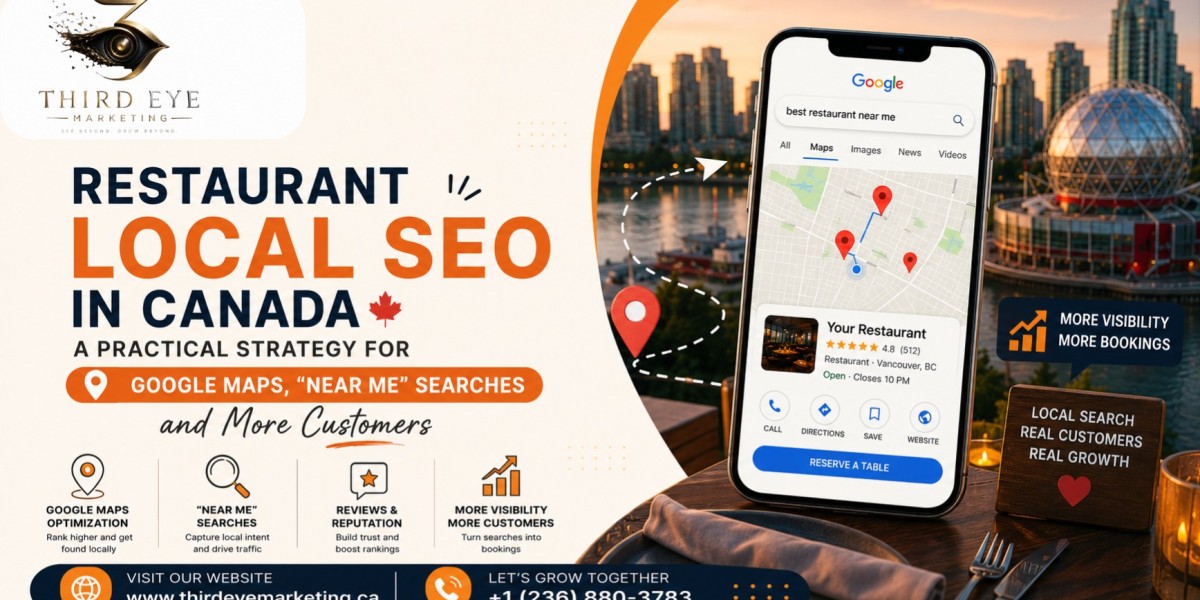


Restaurant Local SEO in Canada: A Practical Strategy for Google Maps, “Near Me” Searches and More Customers
For restaurants, being visible when customers are ready to eat can make a major difference to foot traffic, reservations, and revenue.
A potential customer may search “restaurant near me,” “best restaurant in Vancouver,” “Italian restaurant in Toronto,” or “family restaurant near me” and make a decision within minutes.
This is where local SEO for restaurants becomes valuable.
Instead of depending entirely on social media, paid advertising, or word-of-mouth, restaurants can build organic visibility across Google Search and Google Maps and reach customers who are actively looking for nearby dining options.
For Canadian restaurants, an effective local search strategy should connect Google Business Profile optimization, website SEO, reviews, location relevance, content, mobile usability, trust signals, and conversion optimization.
The goal is not simply to rank.
The goal is to turn local searches into calls, directions, reservations, orders, and visits.
What Is Restaurant Local SEO?
Restaurant local SEO is the process of improving a restaurant's online presence so it can appear more prominently for geographically relevant searches.
This can include searches such as:
Restaurants near me
Restaurants in Vancouver
Restaurants in Surrey
Best restaurant in Calgary
Indian restaurant Toronto
Family restaurants Edmonton
Restaurants open near me
The exact searches depend on the restaurant's cuisine, location, audience, and services.
A strong strategy helps search engines understand what your restaurant offers, where it operates, and why customers should consider it.
1. Start With Google Business Profile Optimization
Your Google Business Profile is one of the most important local assets for a restaurant.
Customers can discover your business through Google Search and Maps and immediately see information such as:
Restaurant name
Address
Phone number
Opening hours
Website
Menu
Photos
Reviews
Booking options
Directions
Google Business Profile optimization should therefore be treated as an ongoing process rather than a one-time setup.
Make sure your primary category accurately represents your restaurant.
Add relevant secondary categories where appropriate, maintain accurate hours, upload high-quality photos, and keep your menu information current.
2. Make Your Restaurant Information Consistent
Search engines and customers both benefit from consistent business information.
Your restaurant's:
Name
Address
Phone number
Website
Opening hours
should be accurate across important online platforms.
Inconsistent information can create confusion.
For example, if your website says you close at 10 PM but another profile says 11 PM, customers may question which information is correct.
Consistency also strengthens trust.
3. Target “Near Me” Search Intent Naturally
“Near me” searches are highly relevant to restaurants because customers often search based on immediate location and intent.
Examples include:
“pizza near me”
“coffee shop near me”
“restaurants open near me”
“best dinner near me”
You don't need to repeat the phrase “near me” throughout your website.
Instead, build strong local relevance.
Clearly communicate your:
Location
Neighborhood
Service area
Cuisine
Menu
Opening hours
Restaurant experience
Google can use multiple signals to understand geographic relevance.
The goal is to create a useful page for customers, not a page filled with repeated keywords.
4. Optimize Your Restaurant Website
Your website should support your Google visibility.
Important pages and information include:
Homepage
Menu
About
Contact
Location
Reservations
Catering
Private dining
Events
If you have multiple locations, each location should have accurate, useful information.
Your website should also work exceptionally well on mobile devices because many restaurant searches happen when customers are already out.
Make it easy for users to:
Call → Get Directions → View Menu → Reserve → Order
5. Use Local Keywords Strategically
Keyword research helps identify how customers search for restaurants.
Depending on your market, relevant phrases might include:
Restaurant in Vancouver
Restaurant in Surrey
Restaurant in Calgary
Indian restaurant Toronto
Family restaurant Edmonton
Best restaurant near me
However, don't try to place every keyword on every page.
Use keyword clustering.
For example, a Vancouver restaurant page could naturally cover:
restaurant Vancouver + dining in Vancouver + local restaurant + dinner in Vancouver
The surrounding context helps search engines understand the topic.
This is much better than repeating one phrase dozens of times.
6. Build Local Content
Restaurants can create content that answers questions customers have before visiting.
Examples include:
Best dishes to try
Restaurant guides
Private dining information
Event dining
Family dining guides
Dietary options
Catering information
Neighborhood dining guides
Seasonal menus
A Vancouver restaurant might publish a guide to planning a special dinner in the city.
A Chilliwack restaurant might create content around local celebrations or group dining.
Useful local content supports topical authority while giving customers more reasons to interact with your brand.
7. Reviews Are a Major Trust Asset
Customers frequently check reviews before visiting a restaurant.
A strong review profile can help communicate:
Food quality
Service quality
Atmosphere
Cleanliness
Value
Customer experience
Encourage genuine customers to leave honest reviews.
Respond professionally to feedback.
When responding to reviews, avoid using generic responses every time.
A thoughtful response can demonstrate that the business actually listens to customers.
This makes online reputation management an important part of local restaurant growth.
Never purchase fake reviews.
Authentic feedback creates stronger long-term trust.
8. Use High-Quality Restaurant Photos
When customers compare restaurants in Google Maps, images can influence their decision.
Use high-quality photos of:
Signature dishes
Restaurant interior
Exterior
Dining areas
Bar
Private rooms
Team
Seasonal dishes
Images should accurately represent the restaurant.
Avoid misleading edits that create unrealistic expectations.
Good visual content helps customers understand the experience before they arrive.
9. Optimize for Google Maps
Google Maps visibility can be particularly valuable for restaurants because many searches have immediate local intent.
A customer searching for dinner may compare several nearby restaurants directly in Maps.
To strengthen your presence:
Keep your profile complete
Select accurate categories
Maintain current business information
Add fresh photos
Encourage genuine reviews
Keep menus updated
Ensure your website is relevant
Provide accurate location information
Your overall local presence matters more than a single optimization trick.
10. Strengthen Local Citations
Citations are online mentions of your business information.
These can appear on relevant:
Business directories
Food directories
Local websites
Industry platforms
Community websites
Quality matters more than quantity.
Don't create hundreds of low-quality listings simply to increase the number of citations.
Focus on relevant and trustworthy platforms.
The information should remain consistent.
11. Improve Your Website for Conversions
Getting visitors to your website is only part of the journey.
The website needs to convert them.
This is where conversion optimization agency principles become relevant.
For restaurants, conversion improvements may include:
Prominent reservation buttons
Easy-to-find menus
Click-to-call buttons
Clear directions
Simple booking processes
Strong customer testimonials
Mobile-friendly design
Fast loading speed
A customer shouldn't need to search through five pages to find the reservation button.
Reduce friction.
Make the next action obvious.
12. Use AEO and AIO for Modern Search
Search is becoming increasingly conversational.
Customers may ask:
“What are the best restaurants in Vancouver for a family dinner?”
Or:
“Which restaurants near Chilliwack offer private dining?”
Restaurants should answer relevant questions clearly on their websites.
FAQ sections, guides, service pages, and useful location content can support AEO.
Clear, structured, trustworthy business information can also help with AIO, as AI-powered search experiences increasingly summarize information from multiple sources.
The priority should remain useful information rather than manipulating search systems.
13. Combine SEO With Social Media
Social media and SEO can support each other.
A customer might discover your restaurant through Instagram.
Later, they search your name on Google.
They check:
Google Maps → Reviews → Website → Menu → Reservation
This means your social profiles, Google Business Profile, website, and review presence should communicate a consistent brand.
Social media builds awareness.
Search captures intent.
Your website facilitates conversion.
14. Track Business Outcomes
SEO should not be measured only through rankings.
Restaurant owners should also monitor:
Google impressions
Website clicks
Calls
Direction requests
Menu visits
Booking clicks
Reservations
Online orders
Customer enquiries
These metrics show whether visibility is translating into business activity.
For example, ranking for a high-volume keyword may look impressive, but if it produces no bookings, it may be less valuable than a lower-volume search that generates regular customers.
15. Build a Complete Local Customer Journey
The strongest restaurant strategy connects every stage:
Google Search
↓
Google Maps
↓
Restaurant Profile
↓
Website
↓
Reviews
↓
Menu
↓
Reservation
↓
Visit
↓
Review
↓
Repeat Customer
This is why local SEO should be viewed as a complete growth system rather than simply a ranking tactic.
SEO + AEO + GEO + AIO for Canadian Restaurants
A modern restaurant strategy should combine multiple search disciplines.
SEO helps improve organic visibility.
AEO helps answer customer questions.
GEO strengthens geographic relevance.
AIO prepares useful business information for AI-powered discovery.
Together, these approaches help restaurants remain discoverable as search behavior evolves.
The restaurant that provides accurate information, useful content, strong reviews, excellent user experience, and clear conversion paths has a stronger foundation for long-term visibility.
Get More Customers From Local Search
Restaurant marketing is no longer just about having a website or posting food photos.
Customers are searching, comparing, reading reviews, checking menus, and making decisions online before they walk through the door.
A strong local SEO for restaurants strategy connects those actions into one customer journey.
At Third Eye Marketing, we help restaurants and hospitality businesses build digital growth strategies combining local SEO, Google Business Profile optimization, website optimization, content marketing, AEO, GEO, AIO, CRO, social media, and reputation management.
The goal is simple:
Get discovered → Build trust → Make it easy to choose you → Turn searches into customers.
Ready to Improve Your Restaurant's Local Visibility? Connect with Third Eye Marketing today and book your free consultation.
Website: https://thirdeyemarketing.ca/
Phone: +1 236-880-3783
Be visible where local customers are searching. Build trust. Generate more visits and bookings.
FAQs
1. How can local SEO help my restaurant get more customers?
Local SEO helps your restaurant become more visible when customers search for nearby dining options. Strong Google Business Profile optimization, reviews, website content, and conversion paths can turn search visibility into calls, visits, and bookings.
2. How important is Google Maps for restaurants?
Google Maps is highly valuable because customers can discover restaurants, compare options, read reviews, view photos, check hours, get directions, and sometimes book directly.
3. How do I rank for “near me” restaurant searches?
You cannot simply force a ranking for “near me.” Focus on strong local relevance, an optimized Google Business Profile, accurate business information, reviews, useful website content, and a strong overall local presence.
4. Does restaurant SEO work across Canada?
Yes, but local SEO should be adapted to each restaurant's specific city, neighborhood, audience, cuisine, and competition. A strategy for Vancouver may need different content and targeting from one for Toronto, Calgary, or Chilliwack.
5. How long does local restaurant SEO take?
The timeline varies based on competition, website authority, existing visibility, technical issues, content quality, and the strength of the local presence. Consistent optimization is generally required for sustainable results.






